

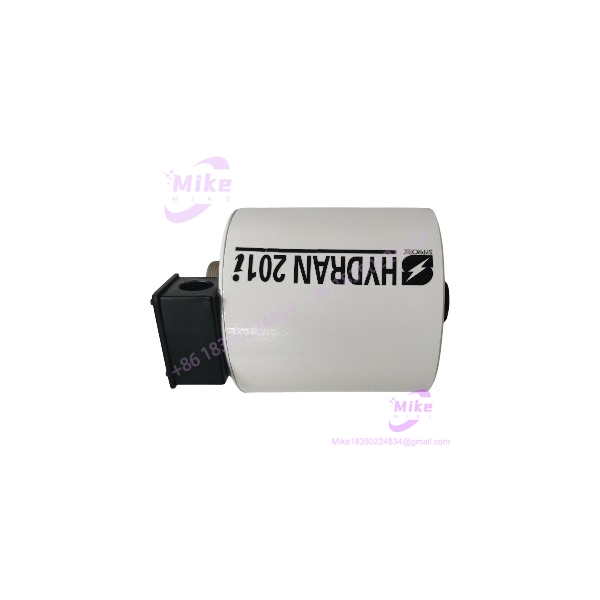
Description
GE Hydran H201Ti | Online Transformer Gas Monitor
Product Introduction
A transformer can develop an internal fault long before conventional electrical protection produces a decisive trip. The GE Hydran H201Ti addresses that gap by continuously extracting a composite fault-gas measurement from transformer insulating oil and reporting the result in ppm. GE describes the 201Ti as a permanently mounted early-warning transmitter for small and medium transformers, with particular value where continuous visibility is preferred over periodic manual oil sampling.
The sensing element is a fuel-cell-type sensor behind a gas-permeable membrane. Hydrogen receives 100% relative sensitivity, while carbon monoxide, acetylene, and ethylene contribute smaller relative responses; therefore the displayed value should be understood as a composite gas indication expressed as hydrogen equivalent, not as a laboratory-grade individual-gas chromatograph measurement.
The H201Ti is intended to work as part of the broader Hydran 201i architecture. Depending on the installation generation, it can communicate through RS-485 using Modbus or Hydran protocol and can interface with H201Ci controllers and supervisory software.

H201TI
Key Technical Specifications
- Model: GE Hydran H201Ti
- Function: Online composite transformer fault-gas monitoring
- Sensor technology: Fuel-cell sensor behind gas-permeable membrane
- Primary sensitivity: Hydrogen, 100% relative sensitivity
- Secondary sensitivity: CO approximately 15 ±4%; C₂H₂ approximately 8 ±2%; C₂H₄ approximately 1.5 ±0.5% relative sensitivity
- Measurement range: 0–2000 ppm volume/volume, H₂ equivalent
- Accuracy: ±10% of reading ±25 ppm H₂ equivalent
- Response time: Approximately 10 minutes for 90% of a step change
- Digital communications: RS-485, isolated
- Protocols: Modbus or Hydran protocol
- Analog output: 4–20 mA, 0–2000 ppm, isolated on documented Mark IV configurations
- Alarm functions: Gas High, Gas High-High, and Service/Fail alarm functions depending on configuration
- Local interface: LCD display and keypad on documented current-generation 201Ti units
- Local data logging: Significant events and gas measurements can be logged for up to one year on documented units
- Operating ambient temperature: -40°C to +55°C
- Ambient humidity: 0–95% RH, non-condensing
- Transformer-oil temperature at valve: -40°C to +105°C with the appropriate installation arrangement
- Oil pressure at valve: 0–700 kPa / 0–100 psi
- Enclosure: NEMA Type 4X; documented units meet IP66 requirements
- Dimensions: Approximately 178 mm diameter × 180 mm long
- Installed weight: Approximately 5.6 kg
- Mounting: 1″, 1.5″, or 2″ female NPT valve arrangement with appropriate adapter
- Power: 90–132 VAC or 180–264 VAC, 47–63 Hz, on the documented Mark IV specification
GE Vernova’s current product information confirms the 201Ti’s core role as a continuous online early-warning transmitter and identifies local/remote alarms, serial communications, self-diagnostics, and composite fault-gas measurement as key functions.
Global Sourcing & Live-Test SOP
1. Inbound Verification
For an H201Ti, nameplate verification is only the first step.
- Photograph the complete transmitter and nameplate.
- Confirm H201Ti rather than H201Ci-1, H201Ci-4, or H201Ci-C.
- Record serial number and hardware revision.
- Photograph the sensor assembly, valve adapter, sampling port, connectors, and enclosure.
- Inspect the gas-permeable membrane/sensor assembly for damage.
- Check enclosure seals and cable entries.
- Verify whether the unit is an earlier 201i generation or a later Mark IV configuration.
- Confirm the actual power-input configuration.
- Record any supplied calibration certificate.
The eBay product page identifies the item as GE H201TI Hydran Gas Analyzer and gives H201TI as the MPN/model. That establishes the family identity, but it does not by itself establish sensor condition or calibration status.
2. Sensor and Mechanical Inspection
The sensor is part of the measurement chain, so do not evaluate the unit as if it were merely an electronic transmitter.
Inspect:
- Sensor housing
- Membrane condition
- Oil manifold
- NPT mounting connection
- Sampling port
- Heat-sink adapter where installed
- Internal heater/cooling arrangement
- Cable glands
- Grounding connection
GE documentation emphasizes that installation location and oil flow have a direct bearing on meaningful readings. The earlier 201Ti specification recommends installation on a full-bore gate valve or suitable ball valve with good oil flow, preferably on a straight cooler-return-pipe section.
3. Electrical Test
Before field installation:
- Verify the AC supply requirement against the unit’s nameplate.
- Confirm protective grounding.
- Inspect internal power connections.
- Power the unit on a controlled bench supply arrangement.
- Verify display operation where fitted.
- Check self-test and diagnostic status.
- Verify alarm outputs.
- Test RS-485 communication.
- Test the analog output if fitted.
Do not assume every H201Ti has the same analog-output arrangement. Earlier technical documentation describes a non-isolated 0–1 mA output with an optional isolated 4–20 mA output specified at ordering; later Mark IV documentation specifies an isolated 4–20 mA output.
4. Communications Test
For an RS-485 installation, verify:
- Correct polarity
- Shielding
- Termination
- Device addressing
- Baud-rate/configuration settings
- Modbus or Hydran protocol selection
- Communication error handling
- Controller compatibility
The current GE specification identifies RS-485 as standard and supports Modbus or Hydran protocols.
For legacy installations using H201Ci controllers, the supervisory link architecture must also be checked rather than assuming direct modern Modbus operation.
5. Measurement Verification
A bench electrical test cannot fully prove sensor accuracy.
For a production-critical unit, verify:
- Sensor status
- Zero/baseline behavior
- Displayed ppm value
- Alarm thresholds
- Rate-of-change calculations
- Historical logging
- Calibration information
- Self-diagnostic status
Do not substitute a generic gas source for the manufacturer’s prescribed calibration procedure. The sensor is specifically designed to interact with dissolved gases transferred from transformer oil.
6. Final Preparation
Record:
- H201Ti model
- Serial number
- Hardware revision
- Sensor identification
- Calibration information
- Firmware revision where accessible
- Power configuration
- Communication protocol
- RS-485 address
- Analog-output configuration
- Alarm settings
- Test results
Package the unit with the sensor and valve interface protected against impact and contamination.
Field Engineer’s Pitfall Guide
❗ H201Ti Does Not Measure Individual Dissolved Gases Like a DGA Laboratory
The H201Ti provides a composite gas measurement expressed as H₂ equivalent. Its sensor has different relative responses to hydrogen, CO, acetylene, and ethylene. It therefore should not be interpreted as four independent gas concentrations.
If the maintenance program requires full individual-gas DGA, the Hydran reading should be treated as an online screening/trending measurement rather than a replacement for laboratory DGA.





