

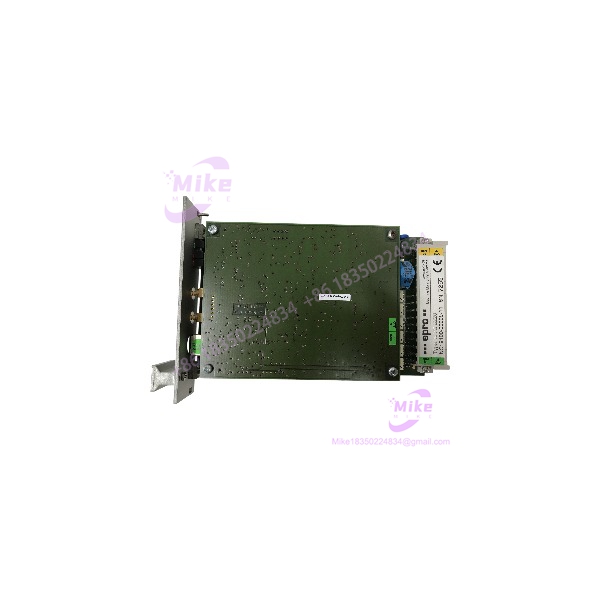
Description
EPRO MMS6220 | Dual-Channel Shaft Eccentricity Monitor
Product Introduction
A turbine rotor can look perfectly healthy from the control room while the shaft itself is developing an eccentricity problem. Temperature and process variables may remain inside their normal ranges; the rotor geometry is telling a different story. The EPRO MMS6220 is designed to capture that mechanical information directly, using two independent eddy-current measurement channels to monitor relative radial shaft eccentricity.
The module belongs to the MMS 6000 machine-monitoring family and works with compatible EPRO PR 642-series eddy-current measuring chains. Its signal-conditioning section accepts differential sensor signals, while separate dynamic and scaled DC outputs make the measurement available for analysis, indication, or downstream protection logic. The MMS6220 also provides RS-232 for configuration and RS-485 for connection to the MMS 6850 analysis and diagnostic system.
This is specialized turbomachinery instrumentation — not a generic analog input card.
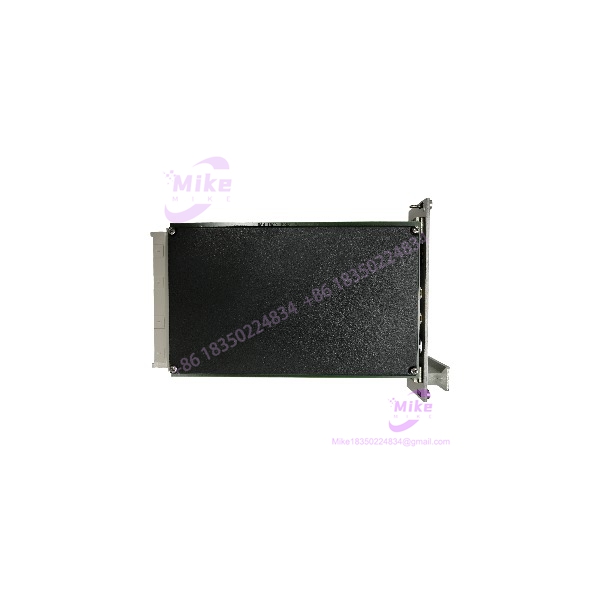
MMS6220
Key Technical Specifications
- Model: EPRO MMS6220
- System: MMS 6000 Machine Monitoring System
- Function: Shaft eccentricity measurement and monitoring
- Channels: 2 independent measurement channels
- Measurement Principle: Relative radial shaft eccentricity using eddy-current transducers
- Compatible Sensor Family: EPRO PR 642-series sensors and associated signal converters
- Sensor Input: Differential, non-reactive, open- and short-circuit protected
- Nominal Input Signal: −1.0 to −22.16 VDC
- Input Limit: 0 to −30 VDC
- Input Resistance: >100 kΩ
- Sensor Signal Output: Approximately −1 to −24 V, 1:1 with sensor input
- Sensor Signal Frequency Range: 0–16 kHz
- Dynamic Output: 0–20 V peak-to-peak
- Dynamic Measurement Frequency: 0.1 Hz–16 kHz
- Dynamic Output Accuracy: ±1% full scale
- Scaled DC Output: 0–10 VDC
- Scaled DC Resolution: 12-bit
- Characteristic Current Outputs: 0–20 mA or 4–20 mA
- Current Output Accuracy: ±1% full scale
- Current Output Resolution: 16-bit
- Maximum Current-Output Load: 500 Ω
- RS-232: Local configuration and measurement readout
- RS-485: MMS 6850 / host communication
- Power Supply: 18–31.2 VDC
- Power Consumption: Maximum 6 W
- Power Architecture: Two redundant, diode-decoupled supply inputs
- Module Format: Standard Eurocard / DIN 41494
- Width: 6 TE / approximately 30 mm
- Operating Temperature: 0°C to +65°C
- Storage/Transport Temperature: −30°C to +85°C
- Humidity: 5–95%, non-condensing
The technical documentation specifies separate signal conditioning for channels 1 and 2, 16-bit current-output resolution, 12-bit scaled DC outputs, and a 0.1 Hz–16 kHz dynamic signal path.
Application Scenarios & Pain Points
Steam and Gas Turbine Monitoring
Rotor eccentricity can become particularly important during startup and shutdown, when mechanical conditions change rapidly.
The MMS6220 can record characteristic values from the monitoring channels and supports evaluation of peak-to-peak and minimum/maximum measurements. Its documentation specifically identifies turbine protection as an application.
Compressor and Fan Trains
Without dedicated eccentricity monitoring:
A control system may report acceptable speed, temperature, pressure, and lubrication values while the rotating shaft develops a changing radial signature.
With the MMS6220:
Two eddy-current measurement chains provide direct relative shaft-position information that can be fed into protection and diagnostic systems.
This is particularly useful where mechanical condition needs to be distinguished from normal process variation.
Startup / Run-Up Analysis
The module can record and store characteristic values associated with the latest run-up or run-down. That gives maintenance personnel another layer of information when investigating a machine that behaves normally at steady state but produces abnormal readings during acceleration or deceleration.
Dual-Location Shaft Measurement
Two independent channels allow measurements at separate shaft locations. Depending on the machine design, that can provide more useful mechanical information than monitoring a single probe position.
The important part is preserving the original sensor locations and configuration when replacing a legacy card.
Legacy MMS 6000 Rack Preservation
The compact 6 TE Eurocard construction fits the modular MMS 6000 architecture. For a plant with an existing rack, retaining the established monitoring platform can be considerably simpler than redesigning the complete machine-protection system.
QA & Live Testing SOP
For the , powering the card and watching the LEDs is only the beginning.
A practical acceptance procedure should include:
- Identity check: Confirm model marking, hardware identification, and revision information.
- Physical inspection: Examine the card edge, front connectors, PCB condition, mounting hardware, and signs of contamination.
- Power verification: Confirm the 18–31.2VDC supply range and verify both redundant supply paths where applicable.
- Controlled rack test: Install the module in an appropriate MMS 6000 test rack or approved laboratory fixture.
- Channel 1 simulation: Apply a controlled signal representing the expected eddy-current sensor output.
- Channel 2 simulation: Repeat the procedure independently.
- Input verification: Confirm differential input behavior and the expected signal scaling.
- Dynamic-output test: Verify the AC/dynamic output across representative frequencies and amplitudes.
- Scaled DC test: Check the 0–10V output against known input values.
- Current-output test: Verify 0–20mA or 4–20mA operation according to the configured application.
- Alarm verification: Exercise the configured pre-alarm and main-alarm thresholds where the test system permits.
- RS-232 test: Confirm local configuration and measurement-data access.
- RS-485 test: Verify communication with compatible MMS analysis hardware where available.
- Power-cycle test: Confirm correct restart and configuration retention.
- ESD-safe packaging: Protect the card edge and electronics throughout handling and shipment.
One important manufacturer’s warning deserves attention: calibration and repair of MMS 6000 monitors are not intended as routine field work. The documentation states that the sandwich/controller board is calibrated with the main board and should not simply be exchanged independently.
Field Engineer’s Pitfall Guide
❗ Do Not Confuse With MMS6210
The model numbers are dangerously similar.
The MMS6210 is a shaft-displacement monitoring module, while the is specifically a shaft eccentricity monitor. The processes relative radial shaft vibration/eccentricity signals from eddy-current measuring chains.
Do not approve a replacement based only on the MMS 6000 family name.
❗ Verify the Entire Eddy-Current Measurement Chain
The monitor expects a compatible sensor and signal-converter arrangement. The documentation identifies EPRO PR 642-series transducers and corresponding signal converters as the intended measurement chain.
Probe, extension cable, converter, target, and monitor all matter.
❗ Configuration Is Part of the Replacement
The uses configurable measurement ranges, filtering, characteristic-value calculations, current-output behavior, alarm settings, and communication parameters.
A physically identical replacement can therefore require configuration before it becomes a valid functional replacement. The commissioning documentation states that the monitor is supplied with a restricted parameter set unless otherwise ordered and requires configuration at initial commissioning.
❗ Do Not Open the Card Casually
The manufacturer’s operating instructions state that repair or recalibration should be performed by EPRO and specifically warn against replacing the calibrated sandwich board independently.
For a failed legacy card, bench testing and professional repair are preferable to component-level experimentation in the field.
Intent-Driven FAQ
What is the EPRO used for?
The is a dual-channel shaft eccentricity monitor used with eddy-current measuring chains. It is designed to measure relative radial shaft eccentricity on turbines, compressors, fans, gear units, and similar rotating equipment.
Is the the same as the MMS6210?
No. The two modules perform different measurement functions. The is specifically intended for shaft eccentricity measurement, whereas the MMS6210 is associated with shaft displacement measurements such as axial position, radial position, and differential expansion.
What sensors work with the ?
The documented design is intended for EPRO PR 642-series eddy-current transducers and associated signal converters. Other measurement chains may be technically usable when they provide the required signal characteristics, but the complete sensor interface should be verified before substitution.
How many channels does have?
It has two independent measurement channels. Each channel has its own differential sensor input and signal-conditioning path.
What is the input signal range?
The documented nominal input range is approximately −1.0 to −22.16VDC, with a stated limit range of 0 to −30VDC. Input resistance is greater than 100kΩ.
Does provide 4–20mA output?
Yes. The characteristic-value current outputs can be configured for 0–20mA or 4–20mA, with 16-bit resolution, approximately ±1% full-scale accuracy, and a maximum specified load of 500Ω.
Does support RS-485?
Yes. RS-485 provides communication with the EPRO MMS 6850 analysis and diagnostic system or compatible host equipment. RS-232 is available at the front for configuration and measurement readout.
What power supply does require?
The specified supply range is 18–31.2VDC. The module uses two redundant supply inputs that are diode-decoupled, and maximum module power consumption is specified at approximately 6W.
What is the operating temperature of the ?
The documented nominal operating range is 0°C to +65°C, with storage and transport specified from −30°C to +85°C and relative humidity of 5–95% non-condensing.
Can the be configured through a laptop?
Yes. The front-panel RS-232 interface is intended for connection to a laptop or configuration system. Parameters and operating modes can be configured, and measured characteristic values and run-up/run-down information can be visualized.
What should I verify before purchasing an replacement?
Verify the complete model, hardware revision, sensor and converter combination, measurement range, alarm configuration, current-output mode, communication settings, and MMS 6000 rack compatibility.
For a legacy turbine-protection system, the sensor chain and configuration file can be just as important as the card itself.
Bottom line: the is a dedicated two-channel eccentricity-monitoring card for legacy MMS 6000 turbomachinery protection systems. Its eddy-current inputs, 16-bit characteristic-value outputs, 0–20mA/4–20mA interfaces, RS-232/RS-485 communications, and configurable measurement functions make exact configuration matching essential when sourcing a replacement.





