

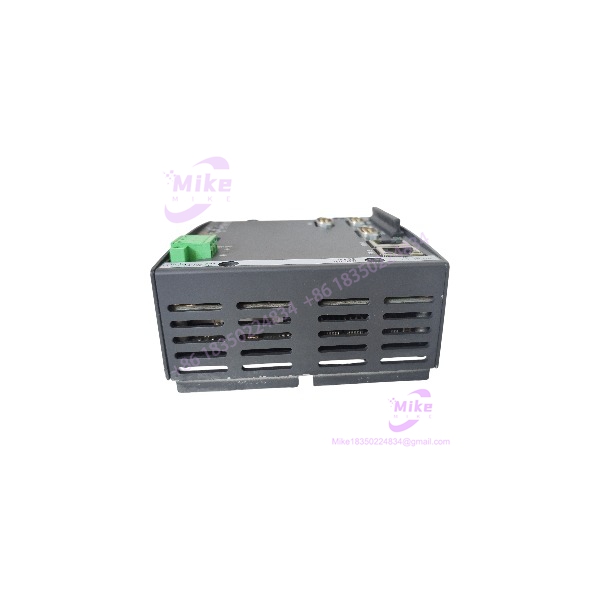
Description
Bachmann MX213 | Processor Module 266MHz M1 Controller
Dynamic Product Introduction
Operating critical turbine pitches or continuous offshore process loops leaves zero margins for processor stalls. When field hardware faces harsh temperature swings and high vibration, basic PLC racks falter, but the Bachmann MX213 unit handles hard real-time multitasking without missing a single cycle. This module serves as the primary processing engine for the Bachmann M1 architecture, delivering precise task execution across multiple fieldbus channels simultaneously.
Unlike generic processor boards that require standalone power modules, this unit integrates a 17W internal power supply directly onto the module width. Featuring an AMD LX 266 MHz engine coupled with 512 kB of battery-backed NVRAM, the Bachmann MX213 maintains complete non-volatile memory retention during unannounced line drops. It eliminates system bottlenecks by running C/C++, MATLAB/Simulink, and IEC 61131-3 logic concurrently on a deterministic real-time OS.
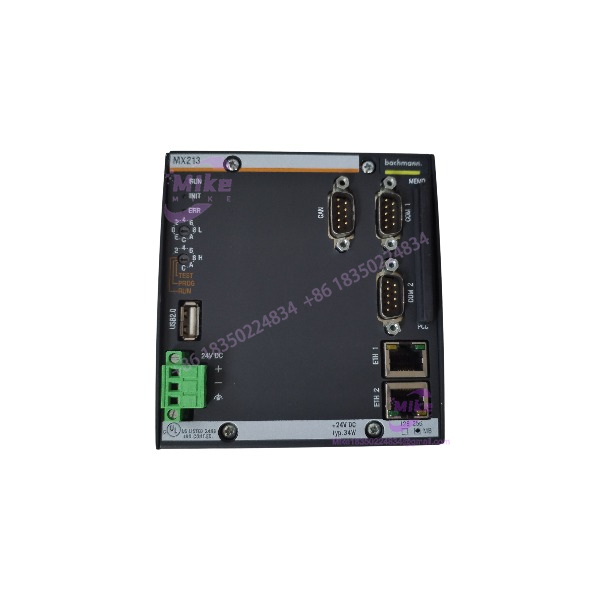
MX213
Key Technical Specifications
- Processor Architecture: AMD LX 266 MHz x86 CPU
- System Memory: 256 MB DRAM
- Retentive Memory: 512 kB NVRAM (Battery-buffered)
- Flash Storage: 16 MB or 64 MB onboard File-Flash, expandable via CompactFlash slot
- Network Interfaces: 2x 10/100 Base-TX Ethernet ports (RJ45, Auto-MDIX)
- Fieldbus / Serial Connections: 1x CAN/CANopen (isolated, up to 1 Mbit/s), 1x RS232, 1x RS232/RS422/RS485
- USB Interface: 1x USB 2.0 Type-A
- Power Supply: Integrated 24 VDC nominal (18 to 34 VDC range)
- Backplane Power Output: 17 W total (5 VDC @ 2.8 A, +15 VDC @ 250 mA, -15 VDC @ 200 mA)
- Operating Temperature: -30 °C to +60 °C (Fanless execution)
- Programming Environments: M-1 Solution, IEC 61131-3, C/C++, MATLAB/Simulink
Global Sourcing & Live-Test SOP (Transparency Core)
Navigating gray-market hardware risks can paralyze a facility if secondary inventory turns out defective. Sourcing pre-owned or surplus stock for the Bachmann MX213 demands rigorous multi-stage qualification before field installation.
- Inbound Verification: Incoming units undergo physical inspection for chassis degradation, PCB stress, terminal pin bending, and anti-tamper security label matching. Serial numbers are validated against OEM manufacturing logs to catch counterfeit builds or gray-market remanufacturing.
- Live Test Bench Simulation: Modules mount into an authentic Bachmann BS200 backplane rack. Engineers verify physical seating torque, system bus locking mechanisms, and cold-start backplane rail voltages.
- Functional & Fieldbus Diagnostics: The Bachmann MX213 runs an automated diagnostic suite. We test full cyclic process updates, verify real-time clocks under battery drain, execute Modbus/TCP loopbacks, and drive continuous CANopen master handshakes at 1 Mbit/s. A 24-hour continuous burn-in cycle inside a thermal chamber ensures no intermittent memory or CPU thermal throttling occurs.
- Firmware Baseline & Safe Handling: Units are flashed to agreed-upon client firmware baselines (or archived to factory default). Firmware versions are explicitly documented on the QC report before sealing the module in static-shielding ESD bags with fresh desiccant.
The Field Engineer’s Pitfall Guide
- ❗ M1 firmware kernel mismatches will crash backplane communication: Replacing an older Bachmann MX213 revision with a unit loaded with a newer M-OS version can cause expansion modules to enter a safe-state bootloop. Always back up the application runtime and verify system software version alignment using SolutionCenter before swapping hardware.
- ❗ Ignoring DIP/Hex switch settings halts network booting: Forgetting to record and transfer the two 16-position hexadecimal switches on the front panel will break IP assignments and boot parameters. If configured for fixed boot locations or custom CAN node addresses, an incorrect switch setup renders the processor unreachable over Ethernet.
- ❗ Overloading the integrated 17W backplane bus trips system power: The internal power supply on the Bachmann MX213 feeds attached I/O cards up to specific current thresholds (2.8A at 5V). I’ve seen plant technicians lose entire production shifts because adding extra analog modules exceeded the integrated power limit, causing cyclical processor resets under heavy I/O polling. Compute total module power consumption before commissioning large local racks.
Intent-Driven FAQ
Will I lose my logic program if I swap out my current unit?
The application logic and user configuration live on the removable CompactFlash card. Swapping the physical processor board with an identical hardware revision usually allows immediate cold-boot recovery by simply transferring the CF card. However, retentive variables stored in NVRAM require an active backup file or a working buffer battery to prevent data loss.
Can I hot-swap this controller while the backplane is powered?
No. Pulling or inserting the Bachmann MX213 while the 24V supply line is live risks arc-damage on the backplane connector pins and can corrupt active flash memory writes. Always isolate the main power source before pulling the unit from the rack.
What happens if the internal real-time clock battery dies?
A dead RTC battery resets system time on power cycles and clears non-volatile RAM. While the CPU will still boot from the CompactFlash card, event logging, timestamped alarms, and retentive variables will be compromised until the rechargeable buffer system restores adequate charge.
How do I configure the dual Ethernet ports for redundant topologies?
The twin Ethernet ports on the Bachmann MX213 operate as independent network interfaces. You must assign unique IP addresses and subnets to each interface via SolutionCenter to prevent routing loops, unless you are using specific software-managed ring redundancy protocols.
Are ColdClimate variants compatible with standard Bachmann MX213 modules?
Yes, functional logic is identical. ColdClimate variants (marked with CC) feature conformal coating to protect against condensation, corrosive gases, and extended temperature ranges (-40 °C to +70 °C). A CC version can directly replace a standard model in any installation.





