


Description
AMAT 1080-01772 | High-Precision Semiconductor Motion Control Quantified Spec
Dynamic Product Introduction
Motion control errors and axis synchronization faults on legacy semiconductor processing platforms usually trace back to failing drive electronics. When a multi-axis servo module drops communication packets or struggles to maintain precise trajectory profiling, wafer handling robots jam and abort valuable production runs. The Applied Materials (AMAT) 1080-01772 Xenus Plus dual-axis servo drive resolves these bottlenecks by enforcing accurate, deterministic motion control across critical robotic transport and mechanical positioning axes.
Unlike commercial-grade motion controllers, this specialized drive is engineered to handle the rigorous duty cycles, tight positioning tolerances, and electrical noise environments inherent in semiconductor manufacturing tools. Maintaining absolute motion synchronization on older AMAT toolsets demands exact hardware matching—making this servo drive essential for preventing unexpected fab line interruptions.
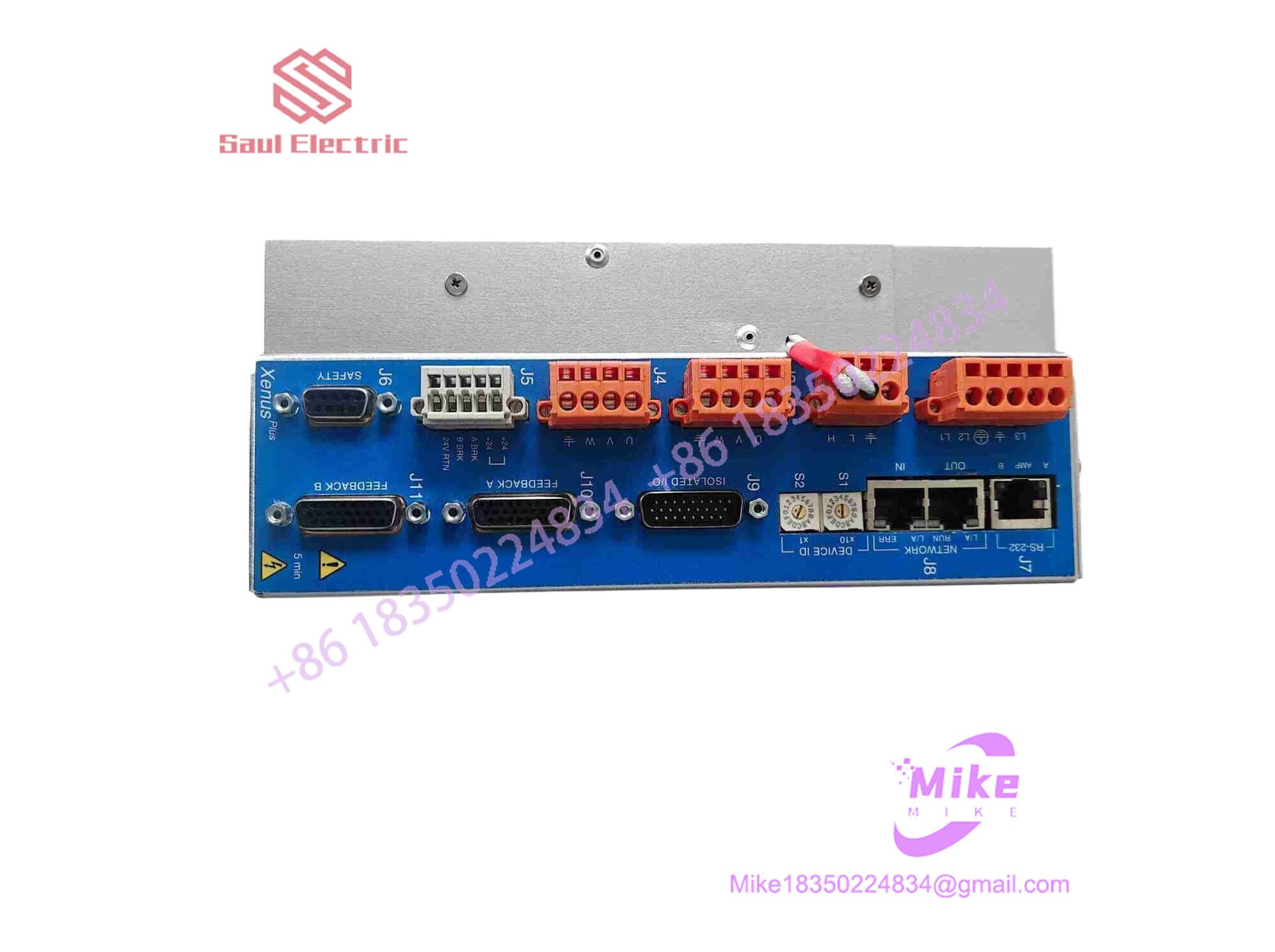
1080-01772
Key Technical Specifications
| Parameter | Specification Detail |
| Manufacturer | Applied Materials (AMAT) |
| Assembly Part Number | 1080-01772 (Xenus Plus Series / Ref: 800-2032) |
| Primary Architecture | Dual-Axis Digital Servo Drive |
| Control Loops | High-speed digital current, velocity, and position loops |
| Interface Compatibility | Standard AMAT tool communication protocols |
| Form Factor | Cabinet-Mount Panel Module |
| Diagnostic Features | Status and network LED indicators for real-time fault tracking |
| Operating Environment | Cleanroom tool enclosure (15^\circ C to 40^\circ C, non-condensing) |
Global Sourcing & Live-Test SOP (Transparency Core)
Acquiring secondary-market semiconductor motion hardware requires rigorous electrical and mechanical verification to ensure zero internal switching degradation or communication failure before installation. Our multi-stage qualification protocol covers:
- Inbound Verification: Incoming servo drives undergo high-magnification optical inspection along the power terminal blocks, logic connectors, and internal board traces to check for heat stress, dust contamination, or capacitor bulging. OEM laser markings and traceability tags are authenticated against global logs.
- Live Simulation: We mount the module onto a dedicated, fully powered AMAT test fixture configured to emulate active dual-axis motor loads and backplane communication traffic.
- Diagnostics: Engineers execute rigorous multi-axis motion profiling scripts using specialized software. Current output linearity, encoder feedback loops, and safety interlock response thresholds are tracked under load over an accelerated 24-hour thermal soak cycle.
- Final Prep: Once testing criteria are met, drive parameters are cleared to factory baseline configuration, and the unit is placed in an ESD-shielding bag before vacuum-sealing inside a moisture-barrier shield.
The Field Engineer’s Pitfall Guide
❗ Hot-Plugging Motor Leads: Never connect or disconnect motor power cables while the servo drive is energized. Doing so will generate severe voltage spikes, instantly destroying the internal output transistors and blowing the drive.
❗ Neglecting Parameter Tuning Backup: Swapping a drive without verifying or uploading the specific axis tuning configuration files can cause erratic motor behavior, violent oscillations, and mechanical damage to the robot arm.
❗ Inadequate Cabinet Heat Dissipation: I’ve seen technicians cram high-density servo drives into poorly ventilated enclosures without required spacing, leading to thermal overload shutdowns and shortened component lifespans.
Intent-Driven FAQ
Can I hot-swap the 1080-01772 servo drive during active tool operation?
No. Hot-swapping multi-axis high-voltage drives risks electrical arcing, bus corruption, and catastrophic damage to attached motor feedback devices. Always execute a complete power-down and lock-out/tag-out (LOTO) sequence.
Does this drive come pre-programmed with motion control profiles?
No. Surplus and replacement drives ship with generic factory firmware. You must download and apply your specific tool’s axis configuration and tuning files using the appropriate software toolset after installation.
What causes these dual-axis drives to fault out unexpectedly in production?
Common triggers include encoder feedback loss, DC bus overvoltage/undervoltage spikes from unconditioned power feeds, shorted motor windings, or internal cooling fan failures leading to thermal trips.
How do I quickly diagnose if an axis error is caused by this drive or the motor?
Swap the suspect motor channels or test the drive outputs against a known-good bench test motor using diagnostic software. If the tracking error or fault follows the drive channel, the 1080-01772 requires replacement.
What level of warranty is included with this surplus servo drive?
We back this component with a comprehensive one-year replacement warranty, covering material and operational defects under standard cleanroom working conditions.





