


Description
Agilent 5517B | Two-Frequency Helium-Neon Laser Head
Product Introduction
In advanced semiconductor manufacturing, precision CNC machine tools, and metrology calibration labs, sub-micron positioning accuracy depends entirely on absolute laser stability. The Agilent 5517B is a high-reliability, continuous-wave two-frequency helium-neon (HeNe) laser head designed specifically for laser interferometer positioning systems (such as VME- and PC-based setups or the Agilent 5527 system). It emits a coherent 633 nm beam split into two distinct, orthogonally polarized frequencies (f_1 and f_2) using a Zeeman splitting technique.
Engineered as a compact, ruggedized drop-in unit, the 5517B offers 25% greater axis velocity capacity than baseline entry models like the 5517A. It features a built-in thermal stabilization cavity design that maintains nanometer-scale wavelength precision once operating temperature is reached. Whether you are replacing a drifted laser source on a high-end PCB drill or servicing a legacy metrology station, this unit integrates directly into existing optical and electrical harnessing frameworks.
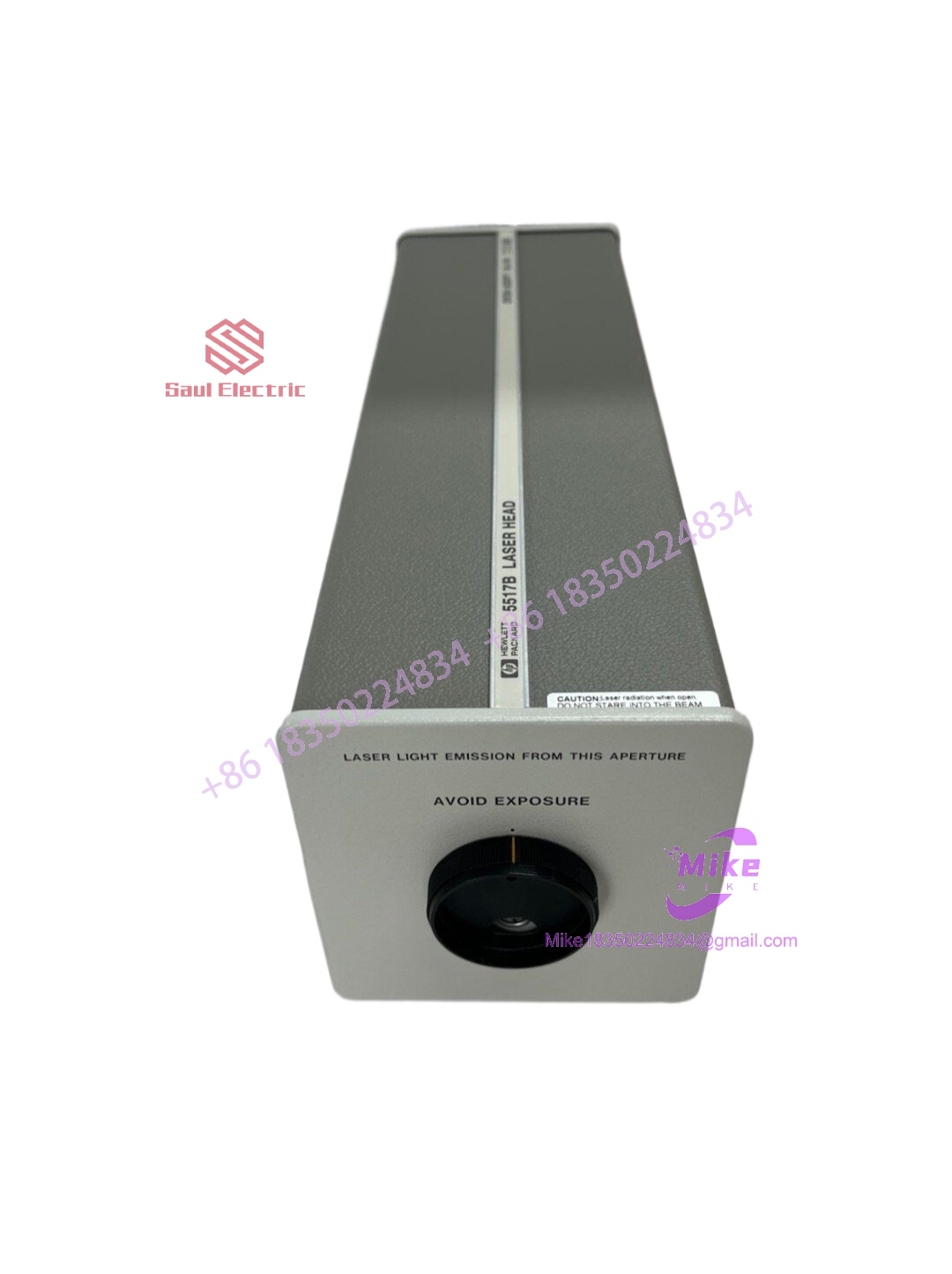
5517B
Key Technical Specifications
| Parameter | Specification Metric |
| Device Category | Two-Frequency Helium-Neon (HeNe) Laser Head |
| Nominal Vacuum Wavelength | 632.991372 nm |
| Wavelength Accuracy | \pm 0.1 ppm standard (\pm 0.02 ppm with factory calibration) |
| Wavelength Stability | \pm 0.002 ppm typical (1 hour); \pm 0.02 ppm lifetime |
| Reference Frequency | 1.9 to 2.4 MHz |
| Max Linear Axis Velocity | Up to 538 mm/s (depending on receiver electronics, e.g., E1709A) |
| Output Beam Diameter | 6 mm nominal |
| Beam Power Output | Minimum 120\ \muW, Maximum 1.0 mW |
| Input Power Requirements | +15 V\pm0.3 V at 3.0 A max; -15 V\pm0.3 V at 0.3 A max |
| Reliability (MTBF) | > 50,000 hours typical operating life |
| Operating Temperature | 0^\circC to +40^\circC standard industrial tier |
Application Scenarios & Pain Points
- High-Precision CNC Machine Tool Retrofits: Modernizing or repairing closed-loop axis feedback on multi-axis milling and turning centers requires stable heterodyne interferometry sources to eliminate mechanical encoder backlash.
- Semiconductor Wafer Steppers & Inspection Stages: Photolithography and inspection equipment demand nanometer-level linear positioning feedback over extended travel ranges, which the 5517B delivers continuously.
- Metrology and Optical Calibration Labs: Coordinate measuring machines (CMMs) and laser calibration tracks rely on the 5517B’s strict vacuum wavelength accuracy as an absolute length standard.
QA & Live Testing SOP (Trust Signal)
We don’t inventory precision laser optics without verifying beam power output and cavity lock stability; every Agilent 5517B unit goes through our rigorous multi-point bench protocol:
- External Housing & Aperture Audit: Inspected under optical magnification for physical chassis integrity, clean output aperture sealing, and undamaged rear power/signal connector pins.
- Thermal Warm-Up & Cavity Lock Test: Powered via an authorized +15V / -15V metrology supply to monitor cavity tuning behavior, ensuring the internal thermal stabilization loop transitions cleanly from startup to a solid, non-flashing READY state.
- Optical Power & Frequency Verification: Measured using optical power meters and heterodyne detection setups to validate that minimum beam power output (> 120\ \muW) and reference frequency lock (1.9–2.4 MHz) meet factory thresholds.
- Protective Packaging: Enclosed in anti-static, shock-isolated cushioning inside heavy-duty multi-walled transit containers to protect internal plasma tube alignment from drop shock.
Field Engineer’s Pitfall Guide
- ❗ Class II Laser Safety Precautions: The 5517B emits visible coherent laser radiation (633 nm class II); never look directly into the beam aperture while the unit is energized.
- ❗ Allow Complete Thermal Stabilization: Do not perform critical dimensional calibrations immediately upon startup; allow the laser head a proper warm-up cycle (up to 90 minutes depending on fan configuration) to achieve full cavity thermal equilibrium and wavelength stability.
- ❗ Power Supply Voltage Tolerance: Ensure your system power supply delivers clean, regulated DC rails within strict tolerances (+15V\pm0.3V); voltage sags can cause the plasma tube to drop lock or fail ignition.
Intent-Driven FAQ
What is the difference between an Agilent 5517A and a 5517B laser head?
While both feature a standard 6 mm beam diameter and 1 mW max power, the 5517B features a higher reference frequency (1.9–2.4 MHz) compared to the 5517A (1.5–2.0 MHz), allowing for roughly 25% faster maximum axis velocities in a more compact physical housing.
Can the Agilent 5517B be replaced by newer Keysight models?
Yes. Modern Keysight 5517B units or equivalent compatible series maintain identical form factors, optical center heights (79.5 mm), and electrical pinouts, allowing direct drop-in replacement in legacy setups.
What does a flashing “READY” LED indicate on the rear panel?
A flashing ready indicator means the laser tube is still in its automatic tuning and thermal stabilization warm-up phase. Data measurements should only be taken once the LED transitions to a solid, continuous ON state.
Does the 5517B require forced-air cooling?
While it relies primarily on convection and chassis heat sinking, connecting an approved ventilation fan to the body helps achieve faster thermal equilibrium and stabilize operating performance during continuous duty.
What kind of warranty covers this surplus laser head?
Every unit is backed by our comprehensive replacement guarantee, supported by pre-shipment optical power and frequency lock verification bench testing to ensure absolute reliability out of the box.





