


Description
Pilz 301130 (PSS SB DI16) | SafetyBUS DI Module Core Category
Dynamic Product Introduction
Expanding high-density emergency stop arrays across a large manufacturing cell often introduces severe cabling complexity if local safety islands lack adequate channel capacity. The Pilz 301130 (PSS SB DI16) resolves this spatial constraint by packing sixteen dedicated safety input channels into a compact modular housing designed natively for the SafetyBUS p ecosystem.
Outperforming smaller multi-node setups by consolidating discrete signal drop points, this hardware significantly reduces physical wire runs while retaining stringent fault-detection thresholds. System integrators leverage its integrated test pulse routing to discover cross-circuits and earth faults instantly, ensuring absolute compliance with rigorous functional safety mandates without requiring cabinet expansions.
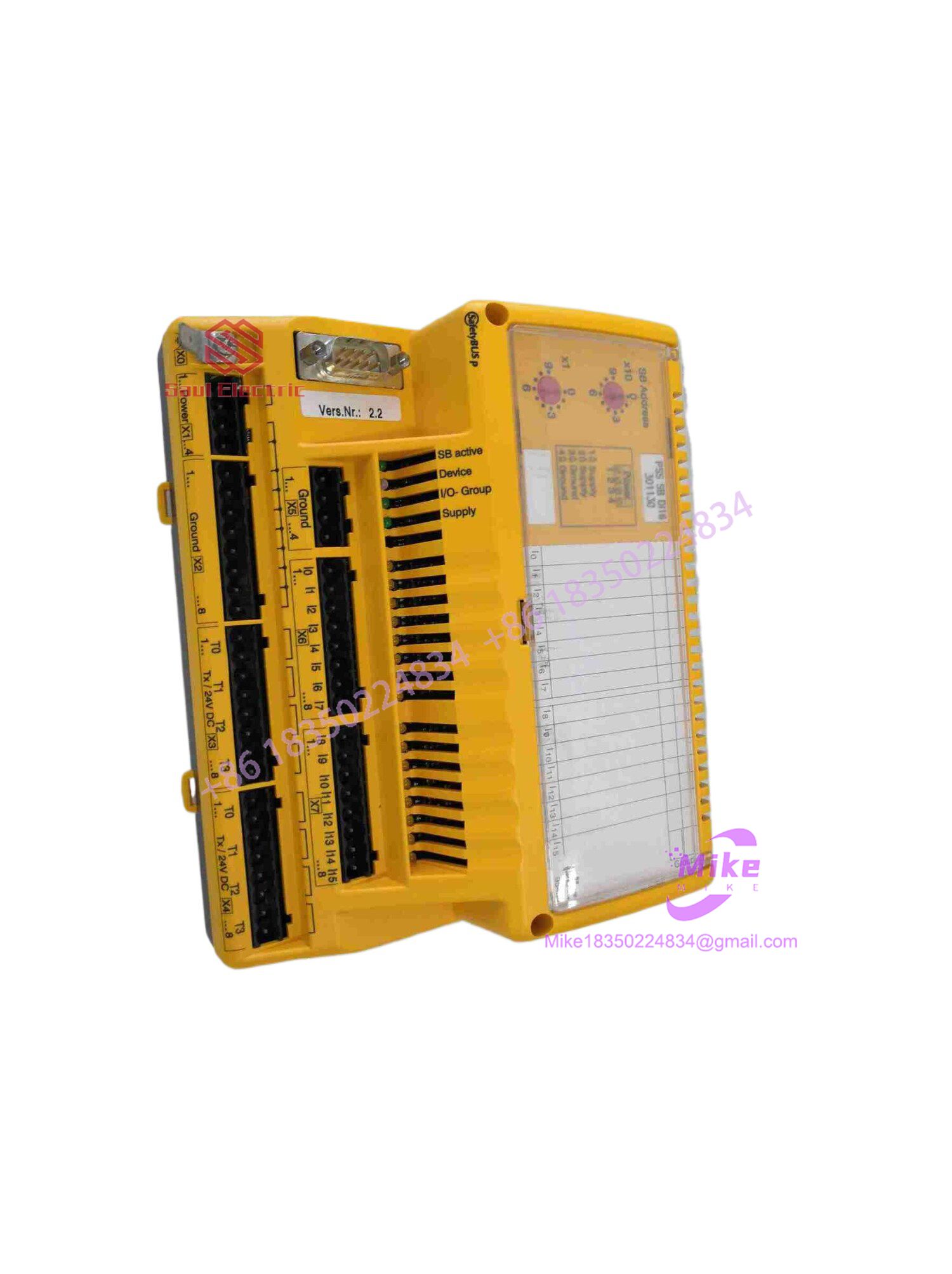
301130
4. Key Technical Specifications
| Core Parameter | Technical Specification |
| Product Identifier | 301130 (PSS SB DI16) |
| Communication Bus | SafetyBUS p |
| Operating Voltage | 24 VDC (module electronics and internal logic rails) |
| Digital Inputs | 16 channels, galvanically isolated via optocouplers |
| Test Pulse Outputs | 4 dedicated clock outputs for short-circuit detection |
| Signal Filtering | Built-in pulse suppression (transients under 300 \mus ignored) |
| Mounting Standard | DIN rail (top-hat rail) or screw-plate mounting |
| Operating Temperature | 0°C to +60°C (32°F to 140°F) |
| Enclosure Rating | IP20 base compliance |
Global Sourcing & Live-Test SOP (Transparency Core)
Deploying legacy safety hardware requires an uncompromising verification methodology to guarantee zero latent faults upon installation:
- Inbound Verification: Incoming shipments undergo strict provenance tracking, custom audit checks, and optical micro-inspection of IC date codes to eliminate gray-market counterfeits.
- Live Simulation: Modules are mounted directly onto an authorized Pilz SafetyBUS p test backplane powered by isolated, regulated industrial DC power supplies.
- Diagnostics: Technicians execute synchronized pulse-train injections across all 16 input channels, validating optocoupler isolation boundaries, response times, and thermal stability throughout a 24-hour continuous power soak.
- Final Prep: Complete test results are bound to the unit’s unique serial tracking data before the hardware is sealed inside anti-static moisture-barrier packaging.
The Field Engineer’s Pitfall Guide
❗ Clock Assignment Configuration Faults: Mapping multi-channel safety sensors without assigning the correct test pulse output channels to the corresponding input terminals will trigger immediate line-fault diagnostics locks. (I’ve seen entire commissioning teams delayed for hours because a replacement card’s software configuration didn’t match the physical test-clock wire mapping.)
❗ SafetyBUS Termination Oversights: Failing to verify physical line termination resistors at the extreme ends of the SafetyBUS p trunk can lead to intermittent packet corruption and random node dropouts.
❗ Transient Filtering Misunderstandings: Assuming instantaneous response from extremely noisy mechanical contacts without accounting for internal 300 \mus pulse suppression filters can cause unexpected timing shifts in fast-reacting safety stop loops.
Intent-Driven FAQ
Can I hot-swap this safety input module on an active, powered SafetyBUS network?
No, hot-swaping safety I/O modules under power violates standard safety procedures and risks throwing critical node synchronization errors across the bus; always power down the local sub-rack before replacement.
Does swapping this module require rewriting the safety logic program?
Typically no, because configuration parameters and node addresses are stored within the main safety controller project file, though verifying matching hardware version revisions is critical.
Are these specific units supplied brand new or as verified surplus?
Inventory conditions alternate between factory-sealed surplus (never commissioned) and thoroughly tested, fully functional secondary stock. Exact provenance is always documented prior to dispatch.
How do the integrated test pulses prevent undetected short circuits?
The module cycles pulsed test signals through the input lines, allowing the internal logic to detect if a safety sensor line has been shorted directly to a 24V power rail.





