


Description
PI C-663 Mercury | Stepper Motor Controller Spec Sheet
Product Introduction
When a high-precision optical alignment rig loses its positioning repeatability due to an unresponsive controller card, experimental downtime stretches from hours to days. The PI C-663 Mercury is not a generic commercial stepper driver; it is a heavy-duty, networkable microstepping controller engineered to deliver sub-micron positioning accuracy under strict laboratory or industrial constraints.
Seated in a benchtop or rack-mounted configuration, the unit coordinates precise phase currents and processes encoder feedback loops—keeping tracking jitter beneath critical optical thresholds. It demands a clean DC power source and proper bus termination, but once integrated into the control scheme, it provides the deterministic motion control required for photonics and microscopy automation.
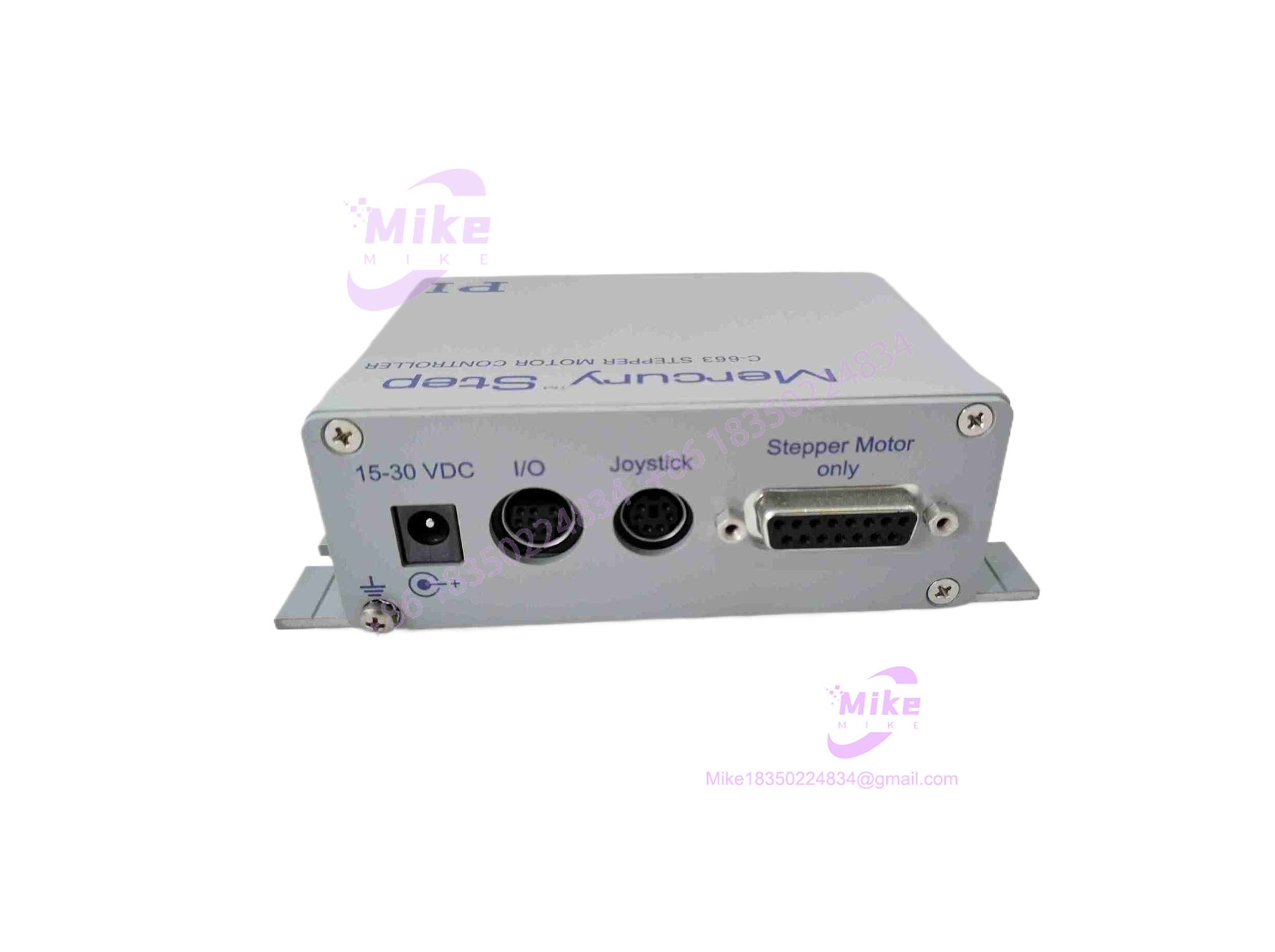
C-663
Key Technical Specifications
| Parameter | Specification |
| Drive Type | 2-phase stepper motor (Open-loop or closed-loop variants) |
| Number of Axes | 1 Axis per module (daisy-chainable up to 16 axes) |
| Step Resolution | Up to high-resolution microstepping (model dependent) |
| Operating Voltage | 15VDC to 30VDC nominal supply |
| Phase Current Limit | Up to 1000mA (standard configuration) |
| Communication Interface | USB, RS-232 with multi-drop bus capability |
| Command Set | PI General Command Set (GCS) |
| Operating Temperature | 5^\circC to 50^\circC ambient |
| Weight | Approximately 0.4 kg |
Application Scenarios & Pain Points
- Photonics Alignment Benches: Electrical ground noise used to cause erratic microstep jitter on older optical tables until technicians upgraded to an isolated controller. Swapping in the C-663 Mercury stabilized axis positioning instantly.
- Automated Semiconductor Inspection: Without standalone auto-start macro execution, host computer dropouts would halt long-term testing sequences. This controller stores scripts locally in EEPROM, ensuring uninterrupted test cycles.
- Legacy Laboratory Retrofits: A research facility avoided an expensive total motion system replacement by dropping a verified surplus C-663 unit into their existing Mercury daisy-chain network.
QA & Live Testing SOP (Trust Signal)
Precision motion control hardware demands absolute verification before deployment. Every incoming PI C-663 goes through a rigorous multi-point test protocol:
- Visual & Optical Inspection: We check internal board components for thermal wear, examine Sub-D connector pins for bending, and verify EEPROM memory health.
- Powered Bench Verification: The module is connected to a live test rig, supplied with nominal DC voltage, and subjected to automated GCS command polling and motor winding current checks.
- ESD-Safe Packaging: Units are sealed in heavy-duty moisture-barrier antistatic bags. When you unbox the C-663 Mercury, it is ready for immediate critical-path commissioning.
Field Engineer’s Pitfall Guide
- ❗ Daisy-Chain ID Collisions: Never connect multiple unconfigured C-663 units with identical default addresses onto the same RS-232 bus loop, or communication packets will collide and lock up the network.
- ❗ Power Supply Voltage Spikes: Always verify your DC bench supply output before powering the controller; exceeding the maximum voltage rail will permanently fry the internal chopper drive transistors.
- ❗ Encoder Feedback Mismatches: Plugging a closed-loop stage encoder into an open-loop controller variant without verifying pin layouts will throw immediate motion fault flags.
Intent-Driven FAQ
Can I daisy-chain multiple PI C-663 controllers together?
Yes, up to 16 Mercury-class controllers can be linked via RS-232 or USB bus architecture to be controlled from a single host computer port.
Is this specific C-663 Mercury unit brand new or surplus?
This inventory consists of verified surplus—un-installed factory backup stock preserved in climate-controlled storage environments.
What software command set does this controller use?
The C-663 operates using the standard PI General Command Set (GCS), making it compatible with existing PIMikroMove software and LabVIEW drivers.
What kind of warranty comes with this purchase?
Every surplus C-663 Mercury controller includes a standard 1-year replacement warranty covering any functional defects under normal operating conditions.
Does the unit retain programmed macros when powered down?
Yes, user-defined auto-start scripts and calibration parameters are stored in non-volatile EEPROM memory across power cycles.





