

Description
Phoenix Contact MCR-PSP-DC | 2811925 Limit Value Switch
Product Overview
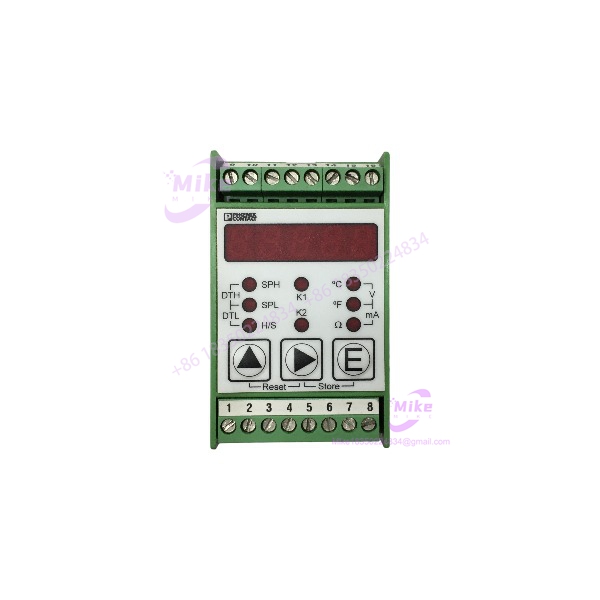
The Phoenix Contact MCR-PSP-DC 2811925 is a programmable industrial threshold switch designed to monitor an analog or sensor signal and generate relay switching actions when configured limits are reached. Phoenix Contact classifies it as an MCR limit value switch with an electrically isolated input and two relay contacts.
This is more flexible than a simple fixed-range comparator. The input can be configured for voltage, current, resistance, RTD or thermocouple measurements, allowing the same hardware platform to handle different process instrumentation signals. The device also provides a local five-digit 7-segment display and LEDs for status indication.
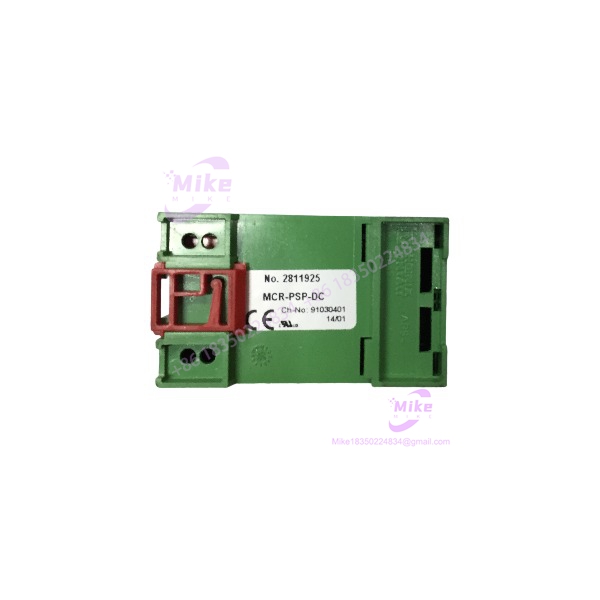
For industrial procurement, 2811925 is the key ordering identifier. The model should be specified as MCR-PSP-DC, not merely as an “MCR signal conditioner,” because Phoenix Contact has several MCR-series interface products with different functions.
The unit is intended for DIN-rail installation and accepts a 20–30 VDC supply. Phoenix Contact specifies a maximum nominal-condition power dissipation of 1.8 W and a measuring rate of 2 Hz.
MCR-PSP-DC
Key Technical Specifications
- Manufacturer: Phoenix Contact
- Model: MCR-PSP-DC
- Item number: 2811925
- Product category: Limit value switch
- Number of channels: 1
- Input isolation: Electrically isolated
- Input configuration: Programmable
- Voltage input: -30 to +30 V
- Current input: -30 to +30 mA
- Voltage-input impedance: 200 kΩ
- Current-input impedance: 50 Ω
- Resistance measurement: 0–8 kΩ
- RTD support: Multiple Pt and Ni sensor types, including Pt10, Pt100, Pt120, Pt500, Pt1000 and Ni variants
- Thermocouple support: Types B, E, J, K, L, N, R, S, T and U
- Power supply: 20–30 VDC
- Maximum current consumption: <60 mA
- Maximum nominal power dissipation: 1.8 W
- Measurement rate: 2 Hz
- Maximum transmission error: 0.1% of final value
- Maximum temperature coefficient: ≤0.01%/K
- Input/power test voltage: 1 kV AC for 60 seconds
- Output type: Relay
- Relay arrangement: 2 × changeover contacts
- Switching points: Two switching points per relay
- Maximum switching voltage: 250 VAC
- Maximum switching current: 2 A AC
- Mechanical relay life: 2 × 10⁷ cycles
- Response-delay adjustment: 0–2 seconds
- Display: Five-digit 7-segment display plus LEDs
- Connection: Pluggable screw terminals
- Conductor range: 0.2–2.5 mm² / AWG 24–14
- Dimensions: 45 × 75 × 110 mm
- Mounting: DIN rail
- Operating temperature: -20°C to +65°C
- Approvals: CE and cULus
- EMC classification: Class A product
These values are from Phoenix Contact’s published product data for item 2811925.
Input and Measurement Capability
The main procurement advantage of the MCR-PSP-DC is its configurable input stage.
The electrically isolated input can accommodate:
- Voltage signals from -30 to +30 V
- Current signals from -30 to +30 mA
- Resistance from 0 to 8 kΩ
- 2-, 3- or 4-wire RTDs
- Multiple Pt resistance-temperature detectors
- Multiple Ni resistance-temperature detectors
- Thermocouples including B, E, J, K, L, N, R, S, T and U types
Phoenix Contact specifies freely adjustable measurement ranges for the supported temperature sensors. For example, the published range for Pt100 is -200°C to +850°C, while Type K thermocouple measurement is specified from -200°C to +1372°C.
This makes the MCR-PSP-DC useful where a control panel needs a local threshold function without adding another PLC analog-input point.
Relay Output Function
The output stage provides two changeover relay contacts, with two switching points associated with each relay. Phoenix Contact specifies configurable energized/de-energized switching behavior and an adjustable response delay from 0 to 2 seconds.
The published maximum switching rating is:
- 250 VAC maximum switching voltage
- 2 A AC maximum switching current
- AgNi contact material with hard-gold plating
- 2 × 10⁷ mechanical switching cycles
Do not interpret these figures as permission to switch any arbitrary industrial load directly. Motor contactors, solenoid valves and inductive loads may require additional suppression or an interposing relay depending on the actual circuit.
Global Sourcing & Incoming-Test SOP
For a surplus or marketplace 2811925, the inspection should establish both identity and configuration.
Recommended incoming procedure:
- Photograph the front label and product markings.
- Confirm MCR-PSP-DC and 2811925.
- Record serial number and any manufacturing information available.
- Inspect the enclosure for cracks, deformation or evidence of impact.
- Inspect the pluggable screw terminals for damaged contacts or stripped hardware.
- Check the display and LEDs for physical damage.
- Inspect the DIN-rail mounting mechanism.
- Check for contamination, corrosion or moisture ingress.
- Verify the unit’s configured input type before applying a simulated signal.
- Apply a controlled 20–30 VDC supply.
- Confirm the display initializes normally.
- Apply a calibrated voltage, current, resistance, RTD or thermocouple simulator appropriate to the selected configuration.
- Verify the displayed process value.
- Exercise both configured threshold points.
- Verify relay transition and return behavior with an appropriate test load.
- Check the response-delay setting where applicable.
- Record the test configuration and results.
- Package the unit in ESD-safe protective material for shipment.
Important: This is a recommended incoming-test procedure. It does not mean that a particular eBay or surplus unit has been tested.
Field Engineer’s Pitfall Guide
1. Confirm the programmed input type before troubleshooting the signal.
The MCR-PSP-DC can accept many different signal types, but it must be configured for the sensor or process signal actually connected. A unit configured for a thermocouple should not be treated as though it were configured for a 4–20 mA transmitter.
2. Do not confuse the two relay outputs with two independent analog channels.
The MCR-PSP-DC is a single-channel measurement device. Its two relay outputs are threshold/control outputs associated with that measured signal. Phoenix Contact specifies one input channel and two relay changeover outputs.
3. Watch the relay load, especially with inductive equipment.
The published 2 A AC rating is a relay contact rating, not a recommendation to connect a motor or large inductive load directly. For industrial control panels, use an interposing relay or appropriate suppression where the load characteristics require it.
FAQ
Q: What is Phoenix Contact MCR-PSP-DC?
A: It is a programmable MCR limit-value switch with one electrically isolated configurable input and two relay changeover outputs. Its Phoenix Contact item number is 2811925.
Q: What signals can the MCR-PSP-DC measure?
A: It supports voltage, current, resistance, RTD and thermocouple inputs. Published input limits include -30 to +30 V, -30 to +30 mA and 0–8 kΩ, along with numerous RTD and thermocouple types.
Q: What power supply does 2811925 require?
A: Phoenix Contact specifies 20–30 VDC, with maximum current consumption below 60 mA.
Q: How many relay outputs does it have?
A: It has two relay outputs, each implemented as a changeover contact arrangement with configurable switching behavior. Phoenix Contact specifies a maximum switching voltage of 250 VAC and maximum switching current of 2 A AC.
Q: Can it be used as a general analog signal conditioner?
A: It is better classified as a programmable limit-value/threshold switch. Its primary job is to monitor a configured process variable and provide threshold-based relay outputs, rather than simply retransmitting an analog signal.
Q: Is the MCR-PSP-DC DIN-rail mountable?
A: Yes. Phoenix Contact specifies DIN-rail mounting, with dimensions of 45 × 75 × 110 mm.
Q: What should I request from an eBay or surplus supplier?
A: Request clear photographs showing MCR-PSP-DC / 2811925, the terminal condition, display, enclosure and mounting mechanism. If the seller claims the unit is tested, request the actual power-up and input/output test details rather than accepting a generic “tested” description.





