


Description
PFEIFFER EVR116 Motorized Gas Regulating Valve
Product Introduction
A vacuum system can have the right pump, gauge, and chamber and still miss its pressure-control target if the gas admission is not regulated correctly. That is the job of the PFEIFFER EVR116.
The PFEIFFER EVR116 is a motorized gas regulating valve designed for vacuum pressure control. Pfeiffer documentation specifies DN 16 ISO-KF process connections, integrated motor-drive electronics, and compatibility with control hardware such as the RVC 300. The valve can regulate gas flow either upstream or downstream depending on the vacuum-system arrangement.
This is a control valve, not a vacuum pump or standalone pressure controller. Its actuator converts the control signal into a defined valve position, allowing the connected vacuum-control system to adjust conductance and therefore process pressure.
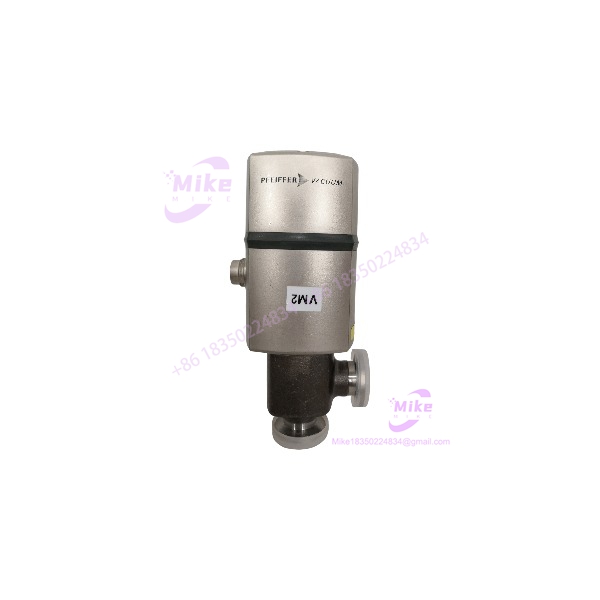
EVR116
Key Technical Specifications
- Model: PFEIFFER EVR116
- Order designation: EVR 116
- Product category: Motorized gas regulating valve
- Nominal connection: DN 16 ISO-KF
- Inlet flange: DN 16 ISO-KF
- Outlet flange: DN 16 ISO-KF
- Operating voltage: 24 VDC ±10%
- Maximum power consumption: 12 VA
- Typical current consumption: 500 mA
- Rest current: 20–30 mA
- Control voltage: 0–10 VDC
- Recommended controller: PFEIFFER RVC 300
- Alternative control interface: IF 200
- Pressure range: 1 × 10⁻⁸ mbar to 2.5 bar absolute
- Leak tightness: 1 × 10⁻⁹ mbar·l/s
- Maximum controllable flow: 1,250 mbar·l/s
- Minimum controllable flow: 5 × 10⁻⁶ mbar·l/s
- Flow specification basis: Air at approximately 1 bar differential pressure
- Needle stroke: 11.5 mm
- Closing time: Approximately 3 seconds
- Opening time: Approximately 4 seconds
- Protection rating: IP40
- Ambient operating temperature: 5–40 °C
- Valve housing material: Stainless steel 1.4435
- Valve needle material: Stainless steel 1.4301
- Filter material: Stainless steel 1.4404
- Seal material: FPM
- Dosing sleeve: Fluoroplastomer
- Weight: Approximately 0.75 kg
- Dead volume: Approximately 0.03 cm³
These values are taken from Pfeiffer’s EVR 116 operating documentation and technical data; configuration-specific accessories and system interfaces should be verified against the actual unit.
Application Scenarios & Engineering Pain Points
1. Vacuum Chamber Pressure Regulation
The EVR116 can regulate the gas flow into or through a vacuum process to maintain a controlled pressure setpoint. This is particularly useful where a fixed orifice cannot provide the required dynamic range.
2. Upstream Pressure Control
Installed upstream of the vacuum chamber, the valve can meter process gas into the system. A compatible controller can continuously adjust the valve position according to the pressure measurement.
3. Downstream Conductance Control
The valve can also be incorporated downstream of the process chamber to vary conductance toward the vacuum pump. This arrangement is useful where pressure must be controlled independently of pump capacity.
4. Research and Process Vacuum Equipment
The combination of DN 16 ISO-KF connections, 24 VDC operation, and analog 0–10 VDC control makes the EVR116 suitable for integration into engineered vacuum-control assemblies rather than simple on/off vacuum isolation.
5. Legacy Pfeiffer Vacuum Systems
For older equipment, the can be particularly relevant when maintaining the original control architecture is preferable to redesigning the entire vacuum-control loop. The RVC 300 documentation specifically describes automatic identification of an when connected.
QA & Live Testing SOP
For a used , cosmetic inspection alone is not enough.
Our recommended incoming inspection sequence is:
- Verify the model marking and nameplate.
- Inspect both DN 16 ISO-KF sealing surfaces for scratches, dents, contamination, or corrosion.
- Check the actuator housing and electrical connector for mechanical damage.
- Verify that the valve mechanism is not mechanically seized.
- Apply the specified 24 VDC supply through a controlled test setup.
- Confirm the actuator responds progressively to the 0–10 VDC command.
- Check the valve-open, valve-closed, and needle-motion feedback where the applicable control configuration provides these signals.
- Verify that opening and closing behavior is consistent with the documented approximately 3/4-second closing/opening times.
- Where vacuum equipment is available, perform a leak and pressure-control test rather than relying solely on electrical movement.
- Inspect FPM seals and other wear components before placing a used unit into a critical vacuum process.
Pfeiffer specifically notes that contamination, wear, and consumable sealing components can affect operation and are not equivalent to an electrical functionality check.
Field Engineer’s Pitfall Guide
❗ Do not treat the as an isolation valve. It is a motorized regulating valve intended for controlled gas flow and conductance adjustment.
❗ Do not connect it to an arbitrary 24 VDC control circuit and assume full functionality. The actuator uses integrated electronics and the specified control architecture includes 0–10 VDC control and compatible Pfeiffer control equipment.
❗ Check the actual vacuum-side seals before installation. A valve can pass an electrical bench test and still fail to meet the required vacuum performance because of contamination, seal degradation, or damage to the sealing surfaces.
❗ Verify the flange standard. The documented uses DN 16 ISO-KF connections. Do not assume that a visually similar vacuum valve has the same interface.
Intent-Driven FAQ
What is the PFEIFFER ?
The PFEIFFER is a motorized gas regulating valve for vacuum pressure-control applications. It uses integrated motor-control electronics to position the valve according to an external control signal.
Is the a vacuum pump?
No. The is a gas regulating/control valve. It is normally used together with a vacuum pump, pressure sensor, and suitable control system.
What voltage does the require?
The documented supply is 24 VDC ±10%, with maximum power consumption specified at approximately 12 VA.
What signal controls the PFEIFFER ?
The documented analog control signal is 0–10 VDC. Pfeiffer identifies the RVC 300 as a compatible control unit and also documents an IF 200 interface for applications.
What flange does the use?
The uses DN 16 ISO-KF vacuum connections.
What is the pressure range of the ?
The documented operating pressure range is 1 × 10⁻⁸ mbar to 2.5 bar absolute.
What is the maximum gas flow of the ?
For the documented test conditions, the maximum controllable gas flow is approximately 1,250 mbar·l/s, while the minimum controllable flow is approximately 5 × 10⁻⁶ mbar·l/s. The published flow data are based on air and a 1-bar pressure differential, so process-specific performance should be evaluated separately.
Procurement Note
When sourcing a , confirm more than the model number. The most important checks are the physical valve condition, DN 16 ISO-KF sealing surfaces, actuator response, electrical interface, seal condition, and actual vacuum leak performance.
For a used unit, request a clear photo of the nameplate and connector area if the exact configuration, revision, or included accessories matter. A marketplace listing may identify the item simply as while omitting configuration details that affect system compatibility.
Important: The marketplace listing supplied for this item identifies it as a used PFEIFFER , but its marketplace metadata contains unrelated/inconsistent fields. The manufacturer documentation is therefore the appropriate source for technical specifications.





