

Description
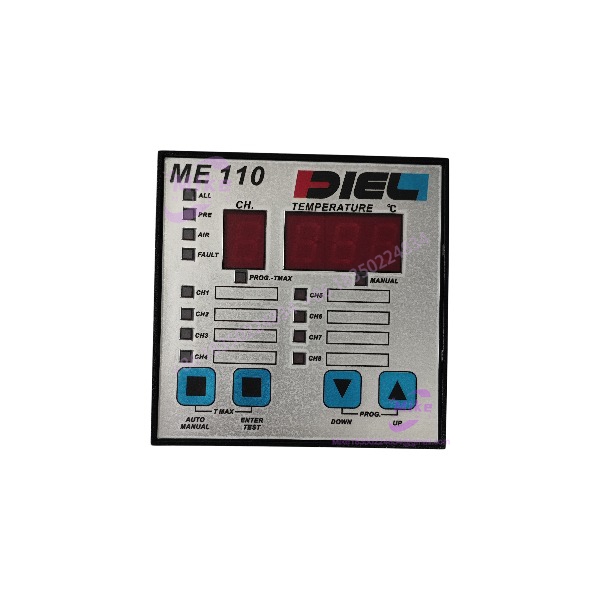
DIEL ME110 | 8-Channel Temperature Monitor
Product Introduction
The DIEL ME110 is a dedicated microprocessor temperature monitoring system designed for equipment where several temperature points must be supervised from one panel-mounted controller. It accepts eight three-wire PT100 sensors, displays the highest measured temperature and its associated channel, and provides configurable pre-alarm, alarm, sensor-fault, and ventilation functions.
This is particularly useful on rotating or thermally sensitive equipment where temperature monitoring needs to trigger both operator indication and hardwired control actions. The ME110 supports a -10 to +200 °C measurement range, 1 °C resolution, five relay outputs, and an isolated 4–20 mA output referenced to the hottest channel. The universal 24–240 VAC/DC supply also makes it suitable for a range of existing control-panel power architectures.
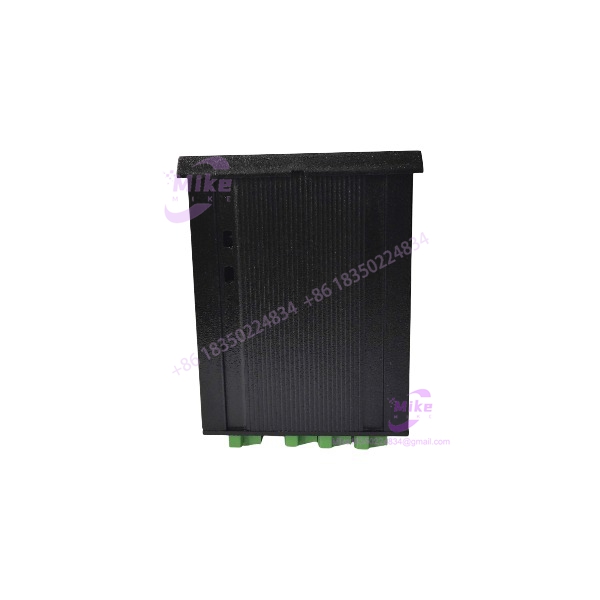
ME110
Key Technical Specifications
- Manufacturer: DIEL
- Model: ME110
- Product Family: ME-100
- Controller Type: Microprocessor temperature monitor/control unit
- Temperature Sensors: PT100, three-wire configuration
- Number of Temperature Channels: 8
- Temperature Range: -10 to +200 °C
- Resolution: 1 °C
- Accuracy: ±1% of full scale ±1 digit
- Power Supply: 24–240 VAC/DC ±10%
- Frequency: 50/60 Hz
- Maximum Power Consumption: 4 VA
- Relay Outputs: 5
- Relay Rating: 250 VAC, 10 A maximum for resistive load
- Relay Contact: Dry contact
- Analog Output: Isolated 4–20 mA
- 4–20 mA Load: Maximum 500 ohms
- 4–20 mA Scaling: -10 °C = 4 mA; +200 °C = 20 mA
- Front Protection: IP65
- Rear Terminal Area: IP20
- Operating Temperature: -20 to +60 °C
- Maximum Relative Humidity: 90%, non-condensing
- Housing: Self-extinguishing NORYL
- Approximate Weight: 0.6 kg
- Panel Cutout: 91 × 91 mm
- Front Panel: Approximately 96 × 96 mm
- Overall Housing: Approximately 90 × 90 × 130 mm including terminal blocks
These specifications come directly from DIEL’s ME110/ME110 V3 installation and operating manual.
Application Scenarios & Pain Points
Electric Motor and Machine Temperature Protection
The eight PT100 inputs allow multiple bearing, winding, housing, or machine temperature points to be monitored by one controller.
The can independently monitor channels and retain programmed thresholds and historical maximum values.
Cooling-Fan Control
Two dedicated fan-control relay functions, identified as FnA and Fnb, can be configured for cooling equipment.
Fan operation can use upper and lower temperature thresholds, creating hysteresis rather than repeatedly switching the fan at one temperature point. The controller also supports a minimum fan activation time in applicable operating modes.
Pre-Alarm and Alarm Protection
The controller supports separate pre-alarm and alarm thresholds.
This allows a maintenance or control system to distinguish between an approaching thermal limit and an actual alarm condition rather than treating every temperature excursion identically.
PLC/DCS Analog Integration
The standard provides an isolated 4–20 mA output corresponding to the hottest monitored temperature.
The output is scaled from 4 mA at -10 °C to 20 mA at +200 °C, with a maximum permitted load impedance of 500 ohms.
Sensor-Fault Monitoring
The identifies PT100 sensor failures, including open-circuit/absent-sensor and short-circuit conditions.
That distinction matters in machinery protection: a missing sensor should not silently appear as a normal low-temperature reading.
QA & Live Testing SOP
Step 1 — Identity and Revision Check
Verify the front and rear labels for:
- DIEL
- ME-100 series
- Model/revision information
- Terminal arrangement
Do not automatically treat and as the same communications configuration.
The DIEL manual explicitly distinguishes the original version from the V3 RS485/Modbus-RTU version.
Step 2 — Visual Inspection
Inspect:
- Front display
- Pushbuttons
- Terminal blocks
- Terminal screws
- Relay contacts
- Housing
- PCB condition
- Connector integrity
- Signs of moisture or corrosion
Pay particular attention to the removable polarized terminal blocks.
Step 3 — Controlled Power Test
The accepts 24–240 VAC/DC ±10%, without polarity requirement, at 50/60 Hz.
Apply the correct test voltage through a current-limited and protected test setup. Confirm normal display initialization and absence of fault indications.
Step 4 — PT100 Input Test
Use calibrated three-wire PT100 simulators or precision resistance sources on all eight channels.
Verify:
- Channel recognition
- Temperature indication
- Channel selection
- Temperature scaling
- Alarm thresholds
- Pre-alarm thresholds
- Sensor-fault detection
Do not rely on a single-channel test for an eight-channel controller.
Step 5 — Relay Test
Use the controller’s relay-test function to verify the five relay outputs.
Check the actual relay contacts rather than relying only on front-panel indication. DIEL specifically documents a relay test function intended to simulate operation and verify contact reliability.
Step 6 — Analog Output Test
For the standard , verify the isolated 4–20 mA output.
Check the expected scaling:
- -10 °C → 4 mA
- +200 °C → 20 mA
Use a calibrated current meter and confirm the connected load remains within the documented 500-ohm maximum impedance.
Step 7 — Packaging
Protect the display, pushbuttons, removable terminal blocks, and rear terminals from impact.
Use ESD-conscious handling when accessing the electronics and prevent conductive packing material from contacting exposed terminals.
Field Engineer’s Pitfall Guide
❗ Do not confuse with V3.
The standard uses an isolated 4–20 mA output, while V3 uses an RS485 full-duplex interface with Modbus-RTU. These are different communication/output configurations.
❗ Do not assume every terminal is an alarm output.
The controller has eight three-wire inputs occupying terminals 1–24. The analog output occupies terminals 25–26 on the standard .
❗ Do not substitute arbitrary RTD wiring.
The documented sensor configuration is three-wire . Two-wire or four-wire RTD arrangements should not be connected without confirming the measurement architecture.
❗ Check the relay load type.
The published 10 A rating is for resistive load at 250 VAC. Do not interpret that number as a universal motor, solenoid, or inductive-load switching rating.
❗ The 4–20 mA output represents the hottest channel.
It is not eight independent analog outputs. The standard ‘s analog output is referenced to the highest-temperature channel.
Intent-Driven FAQ
Q1. What is the DIEL ?
The is an eight-channel microprocessor temperature monitoring and control unit designed for temperature sensors.
Q2. How many temperature sensors can it monitor?
The supports eight three-wire inputs.
Q3. What temperature range does it measure?
The documented measurement range is -10 to +200 °C, with 1 °C resolution.
Q4. What power supply does the require?
It accepts 24–240 VAC/DC ±10%, 50/60 Hz, with a maximum consumption of approximately 4 VA. Polarity does not matter for the specified AC/DC supply arrangement.
Q5. Does the have a 4–20 mA output?
Yes. The standard has an isolated 4–20 mA output corresponding to the hottest monitored channel. The documented output load limit is 500 ohms.
Q6. Does the use Modbus?
The standard does not use the RS485/Modbus-RTU interface described for the V3 version. DIEL identifies separately as the RS485 full-duplex Modbus-RTU version.
Q7. What relay functions are available?
The has five relay outputs. These support alarm, pre-alarm, fault-status, and cooling-fan functions depending on configuration. DIEL documents relay testing through the front-panel menu.
Q8. What should I verify before buying a replacement?
Verify the complete designation, terminal layout, revision, sensor configuration, output type, and physical condition. Most importantly, confirm whether the existing installation requires the standard 4–20 mA or the separate V3 RS485/Modbus-RTU version.





