


Description
Dart Controls 123D-C | Low-Voltage DC Motor Speed Control
Dynamic Product Introduction
Speed fluctuations, motor stalling, and precise torque loss in low-voltage automation applications frequently stem from aging controller boards or failing output components. When a compact conveyor, office machine, or medical device drive starts exhibiting erratic speed regulation, attempting software or mechanical tweaks rarely fixes underlying hardware wear. Deploying the Dart Controls 123D-C resolves this performance constraint directly, swapping in an OEM-spec open-chassis motor controller engineered to restore precise low-voltage speed regulation and dependable torque profiles.
In crucial maintenance windows, installing this exact replacement control module re-establishes normal equipment operation without requiring an expensive, full-scale mechanical or electrical redesign. (Though verifying trim potentiometer adjustments, input transformer voltage, and current limit settings prior to startup remains essential.) It handles demanding continuous-duty cycles cleanly, keeping specialized fractional horsepower DC equipment running safely.
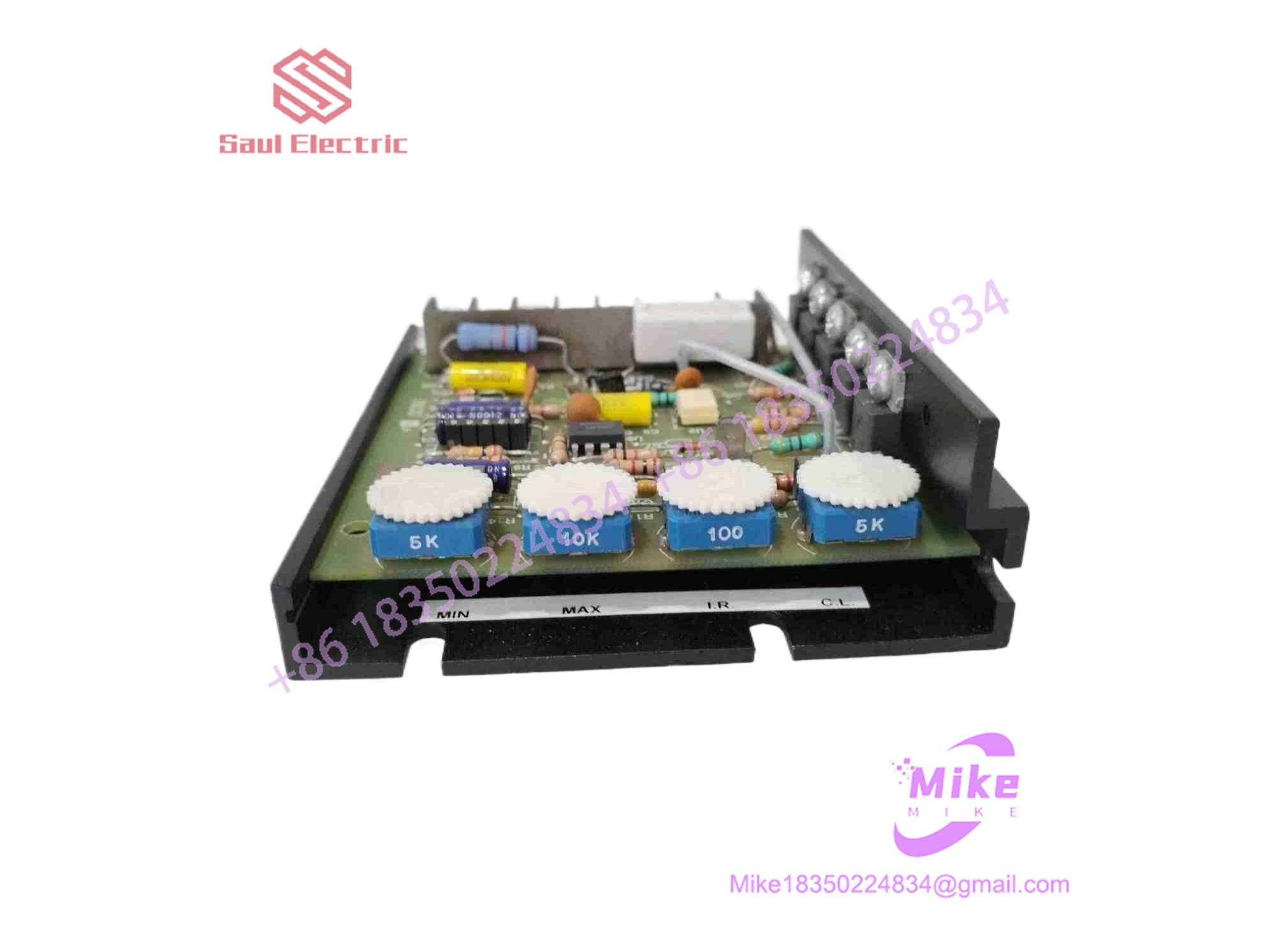
123D-C
Key Technical Specifications
| Technical Parameter | Specification Detail |
| Device Category | Low-Voltage Open Chassis DC Motor Speed Controller |
| Input Voltage | 24 to 36 VAC, 50/60 Hz |
| Output Voltage Range | 0 to 24 / 0 to 36 VDC (Full-wave rectified) |
| Continuous Output Amps | Up to 5.5 ADC |
| Speed Regulation | 1% of base speed over a 50:1 speed range |
| Adjustable Trimpots | MIN, MAX, IR COMP, CUR LIM (Current Limit) |
| Enclosure Type | Open-chassis board style with barrier terminal strip |
Global Sourcing & Live-Test SOP (Transparency Core)
Procuring critical industrial motor control hardware demands rigorous bench testing and static protection to guarantee absolute reliability upon installation.
- Inbound Verification: Incoming controllers undergo strict serial tracking, OEM label authentication, and anti-counterfeit batch audits against production specifications.
- Live Simulation: Qualified units are mounted onto a dynamometer or resistive motor test fixture to evaluate acceleration smoothness, IR compensation stability, and full-load current delivery.
- Diagnostics: Technicians check gate-firing pulse accuracy, thermal performance under max load, and potentiometer response linearity to isolate latent component drift.
- Final Prep: Terminal blocks are cleaned to remove oxidation, and the controller is sealed inside heavy-duty anti-static barrier packaging alongside its matching speed potentiometer kit.
The Field Engineer’s Pitfall Guide
❗ Incorrect Transformer Input: Supplying improper AC voltage outside the 24–36 VAC rating window to the 123D-C will cause immediate regulation failure or internal component damage. Always verify step-down transformer secondary outputs prior to connection.
❗ Exceeding Current Limits: Pushing motors that draw higher locked-rotor or running current than the controller’s 5.5A rating will prematurely trip internal protection or overheat the output stage. Always confirm motor nameplate FLA specifications.
❗ Unshielded Control Wiring: Running low-level potentiometer or inhibit signal wires parallel to high-voltage power lines can induce electrical noise, causing erratic speed surging. Always use shielded twisted-pair cabling for control connections.
Intent-Driven FAQ
Will the 123D-C integrate directly into my existing panel mounting pattern?
Yes, the 123D-C features standard open-chassis physical dimensions and layout footprints designed to match legacy Dart low-voltage mounting configurations.
Does the controller come packaged with a speed potentiometer?
Yes, units typically ship complete with a matching 5K ohm speed potentiometer, knob, and dial plate for immediate panel installation.
What adjustments can be made via the onboard trimpots?
Field adjustments include Minimum speed, Maximum speed, IR Compensation (for load-induced speed drop), and Current Limit protection.
What kind of warranty coverage is included with this replacement part?
Every unit is backed by our comprehensive operational warranty, covering electrical component health, control stability, and functional performance from day one.





