


Description
Aerotech BAI20-320 | High-Voltage Sinusoidal Servo Drive
Product Introduction
When a multi-axis motion platform requires clean torque delivery under high-voltage bus conditions, standard PWM drives often introduce current ripple that degrades positioning accuracy. The Aerotech BAI20-320 is not an off-the-shelf generic inverter; it is a specialized, high-voltage sinusoidal servo amplifier engineered to extract maximum high-speed performance from demanding brushless motor systems—though cabinet thermal planning is critical given its elevated operating output.
This drive utilizes advanced analog and digital hybrid circuitry to map standard controller inputs into smooth, low-cogging three-phase current outputs. By bridging high line voltages down to controlled motor phases, it minimizes thermal heating in the winding coils, ensuring long-term trajectory stability for precision automation cells and high-load industrial positioning stages.
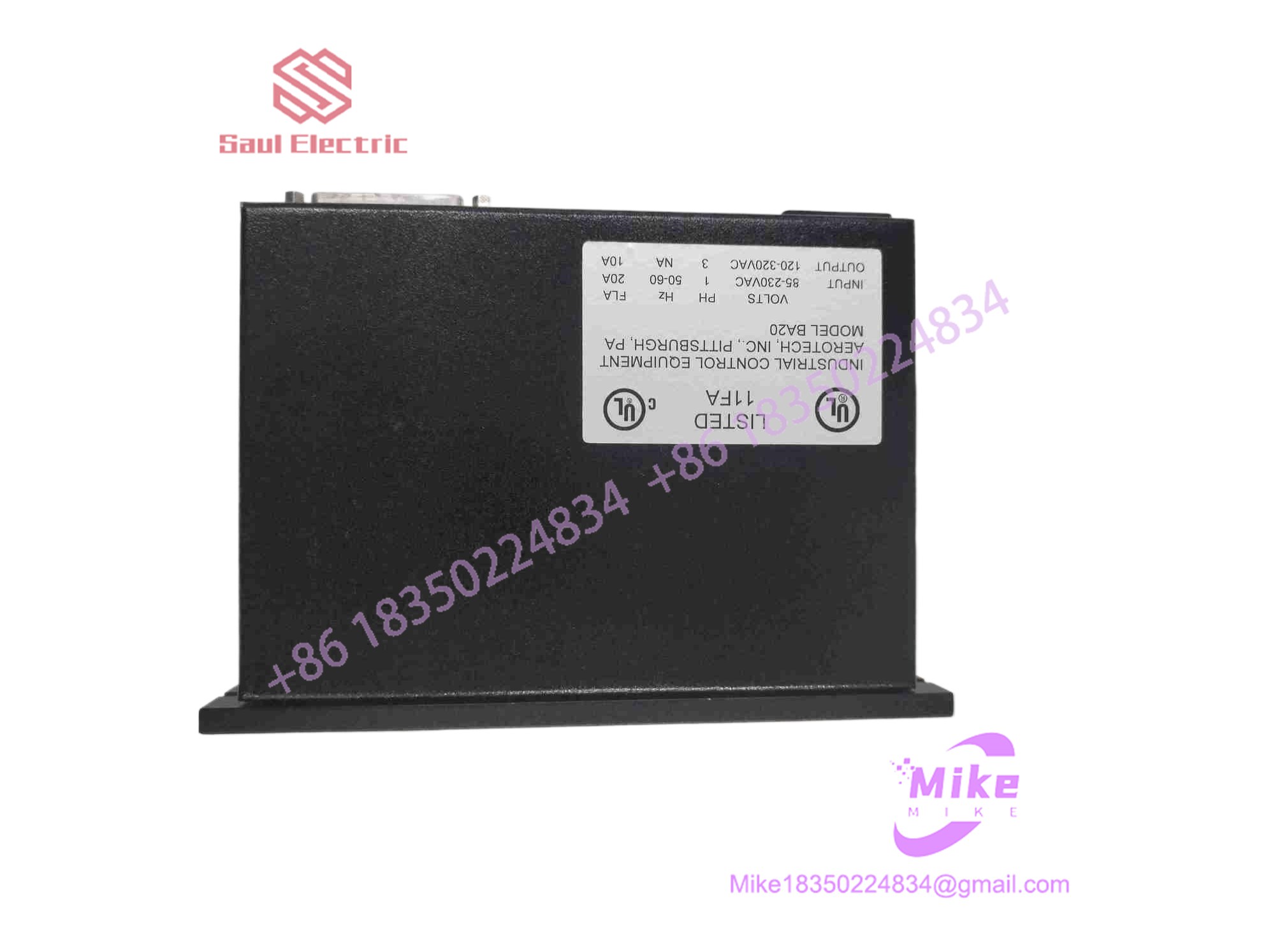
BAI20-320
4. Key Technical Specifications
| Parameter | Value |
| Input Supply Voltage | 85–230 VAC, 1-Phase, 50/60 Hz (10 A max draw) |
| Output Voltage Range | 120–320 VAC, 3-Phase |
| Continuous Output Current | 5 Amps |
| Command Interface | Standard ±10 VDC (Velocity or Torque/Current mode) |
| Commutation Type | Sinusoidal (with Hall-effect or encoder feedback support) |
| Mounting Configuration | Panel / Screw-mounted chassis format |
| Enclosure Protection | Open-type IP00 rack-mount module (requires NEMA enclosure) |
| Operating Temperature | 0°C to 50°C standard industrial ambient limits |
5. Application Scenarios & Pain Points
- High-Speed Laser Micromachining: Laser positioning gantries require instantaneous velocity reversals without path distortion. The high-voltage bus capability of the BAI20-320 forces current rapidly through inductive motor windings, eliminating tracking lag during sharp directional changes.
- Semiconductor Wafer Inspection Stages: Sub-micron positioning stages cannot tolerate mechanical velocity ripple. The sinusoidal commutation architecture eradicates low-speed torque notches, ensuring ultra-smooth constant-velocity sweeps.
- Upgrading Legacy Aerotech Racks: When an older amplifier fails in a legacy multi-axis cabinet, replacing the entire control architecture triggers massive software rewrites. Dropping in a verified surplus BAI20-320 restores exact loop behavior without altering motion controller code.
QA & Live Testing SOP (Trust Signal)
Because these high-voltage amplifiers manage considerable energy loads, every surplus unit undergoes strict bench evaluation. We power the drive through an isolated variable autotransformer, checking the primary 85-230VAC input rectification stage for capacitor leakage. We simulate a +/-10VDC command profile under a dynamic test motor load, measuring phase-to-phase balance on an isolated oscilloscope to confirm clean sinusoidal output waveforms without distortion or thermal runaway.
Field Engineer’s Pitfall Guide
- ❗ High-Voltage Bus Hazards: The output stage reaches up to 320 VAC. Never touch power terminals or disconnect motor leads while the input mains are energized, as residual energy stored in the internal bus capacitors can cause severe electrical shock.
- ❗ Inadequate Heat Sink Clearance: The BAI20-320 relies heavily on conduction through its chassis mount. Cramming it into a sealed, unventilated backplate pocket will cause internal switching transistors to overheat and prematurely trigger thermal fault protection.
- ❗ Feedback Shielding Failures: Failing to ground the motor encoder and Hall-effect cable shields completely at the backshell clamp will inject high-frequency switching noise into the control loop, resulting in erratic motor jitter.
8. Intent-Driven FAQ
- Can I substitute a lower-voltage BA20-160 model with a BAI20-320?
No. The handles higher input and output voltage thresholds (up to 320 VAC). Dropping a low-voltage unit into a high-bus application will instantly destroy the output stage power MOSFETs.
- What kind of motion controller can command this amplifier?
Any controller capable of supplying an isolated analog ±10VDC velocity or torque command signal, along with standard enable and fault-reset discrete lines.
- Are brand-new units still manufactured by Aerotech?
No, the BAI20 series has reached end-of-life status by the OEM. Replacement units are sourced primarily via tested surplus, refurbished inventory, or specialized exchange programs.
- What causes the amplifier to trip immediately upon an “Enable” signal?
Check for a shorted motor winding, ungrounded feedback shields, or an active fault input line. If the internal overvoltage or overcurrent threshold is tripped, the amplifier latches off to protect the switching bridge.
- Does this drive require external setup software?
Traditional tuning and scaling are primarily handled via onboard precision hardware potentiometers and jumper configurations, depending on the exact sub-revision of your board.





