


Description
MKS 220DD-00100A2B | Baratron General Purpose Pressure Transducer
Dynamic Product Introduction
When a vacuum process shifts midway through a semiconductor deposition run, the root cause is rarely the pump—it is almost always drift in an unheated gauge. The MKS Baratron 220DD-00100A2B capacitance manometer solves gas-dependence errors by directly measuring physical force per unit area on a tensioned Inconel® diaphragm.
Unlike thermal conductivity gauges (Pirani/Convectron) that shift dramatically when switching from Nitrogen to Argon or process gases, this 100 Torr absolute pressure transducer delivers reliable 0–10 VDC output proportional to total pressure. Upgrading from lower-tier strain gauges to a true capacitance sensor prevents chamber pressure fluctuations, protects batch yields, and stabilizes vacuum control loops across critical processing lines.
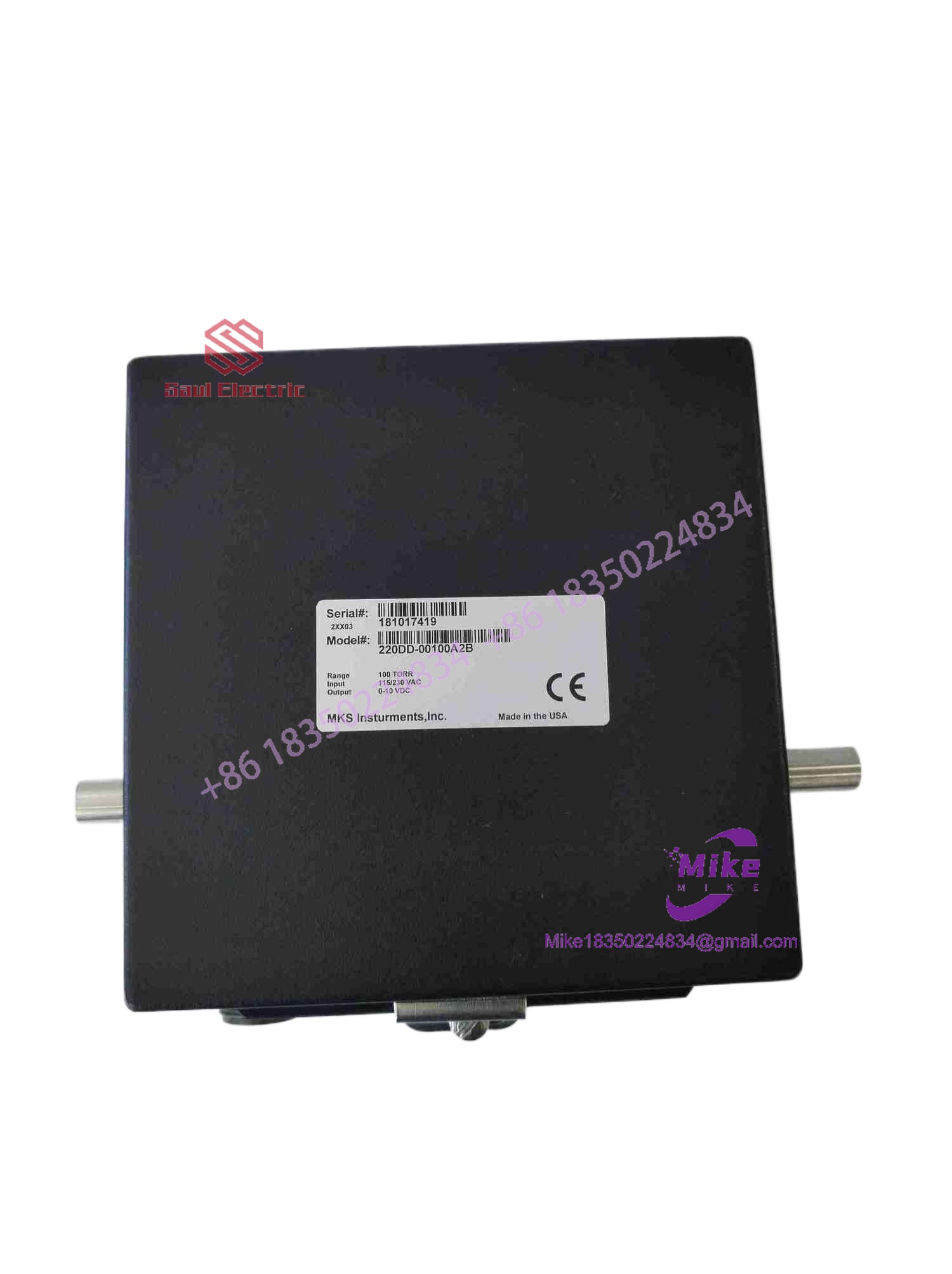
220DD-00100A2B
Key Technical Specifications
| Parameter | Specification Detail |
| Full Scale Range | 100 Torr (mmHg) |
| Measurement Accuracy | ±0.15% of Reading (standard high-accuracy option) |
| Output Signal | 0 to 10 VDC (linear with pressure) |
| Operating Temperature | Unheated / Ambient (0°C to 50°C) |
| Fitting / Process Port | 8 VCR® Female (1/2″ Metal Gasket Face Seal) |
| Electrical Connector | 15-pin D-subminiature connector |
| Power Requirements | ±15 VDC (±5%) @ < 35 mA |
| Wetted Materials | Inconel® and Stainless Steel (corrosion resistant) |
| Resolution | 0.001% of Full Scale |
Global Sourcing & Live-Test SOP (Transparency Core)
Capacitance manometers can suffer from diaphragm contamination, zero drift, or mechanical shock if handled improperly in secondary markets. Here is the bench test workflow used to validate every 220DD-00100A2B unit before deployment:
Inbound Verification
- Inspection of the 8 VCR sealing face under 10x magnification for scratches, pitting, or particulate buildup.
- Verification of OEM seal labels, serial numbers, and model suffix breakdown (confirming
00100= 100 Torr,A= 0.15% accuracy,2= 8 VCR female,B= 15-pin D-sub).
Live Simulation & Calibration Test
- The transducer is mounted onto a multi-port vacuum calibration manifold equipped with a turbomolecular pump and a calibrated primary reference standard.
- Powered with clean ±15 VDC supply rails and allowed a 30-minute warm-up period to stabilize thermal equilibrium.
- The vacuum chamber is pumped down below 10^{-4} Torr to establish true zero; zero-potentiometer adjustment is verified and logged.
Diagnostics & Linearity Run
- High-purity Nitrogen is incremental-bled into the manifold across 5 calibration points (10, 25, 50, 75, and 100 Torr).
- Output voltages are measured via a calibrated 6.5-digit precision multimeter (e.g., Keysight 34465A) to verify linearity within the ±0.15% specification window.
- Helium leak testing is performed at the VCR interface using a mass spectrometer leak detector to ensure a seal tightness better than 1 \times 10^{-9} atm·cc/sec.
Final Prep
- Protective vinyl caps are installed over the VCR fitting and D-sub connector.
- The unit is double-sealed in ESD and vacuum-safe cleanroom packaging with thermal calibration logs enclosed.
The Field Engineer’s Pitfall Guide
❗ Zeroing the Transducer Above Its Resolution Floor:
The most frequent mistake in field service is pressing the zero-adjust screw when the chamber is only at 0.1 Torr. For a 100 Torr gauge, true zero must be calibrated at a vacuum level lower than the gauge’s resolution limit (below 10^{-3} Torr). Zeroing a 100 Torr sensor at a rough vacuum introduces an offset error across your entire 0–10V output curve.
❗ Incompatible Power Cable Pinouts:
MKS uses multiple 15-pin D-sub wiring configurations depending on whether the unit connects to a controller (e.g., MKS 600-series) or a generic PLC analog input card. Connecting a standard off-the-shelf DB15 VGA cable will route ground lines into the ±15 VDC power pins—honestly, I’ve seen technicians blow out power supply rails on control racks simply assuming all DB15 connectors share standard serial pinouts.
❗ Thermal Drift from Process Heat Radiation:
Because the 220DD is an unheated (ambient) Baratron, mounting it directly onto a heated vacuum chamber wall without a thermal isolation bend or cooling block causes ambient temperature swings. Environmental fluctuations past 25°C alter the internal sensor dimensions, creating zero-drift readings that mimic actual pressure loss.
Intent-Driven FAQ
What does the “220DD” model suffix mean compared to standard 220D units?
The “DD” designator denotes specific revision builds or customized connector/accuracy options within the 220D family. In this specific configuration (220DD-00100A2B), it specifies a 100 Torr full-scale range with 0.15% reading accuracy, 8 VCR female process connection, and a standard 15-pin D-sub interface.
Can I use this gauge with corrosive process gases like Cl2 or Fluorine?
Yes, within reason. All wetted surfaces in the Baratron 220D are constructed from Inconel® and 300-series stainless steel, which resist most common semiconductor etch and CVD gases. However, avoid condensation of liquid chemicals inside the sensor cavity.
Is a dedicated MKS power supply required to run the 220DD-00100A2B?
No. While it pairs natively with MKS single-channel or multi-channel readout controllers, you can operate it using any clean dual DC power supply providing +15 VDC and -15 VDC (at ~35 mA). The output signal is a standard 0–10 VDC linear voltage that maps directly into any PLC/DCS analog input module.
How often does an ambient Baratron require zero adjustment?
In clean gas applications, zeroing once every 3 to 6 months is standard practice. If deployed in dirty processes with heavy particulate loading or wide ambient temperature variations, monthly zero-checks at base vacuum are recommended.
What is the difference between a 220D ambient gauge and a 627D heated Baratron?
The 220D operates at ambient temperature, making it cost-effective for general vacuum applications where process gas condensation is not an issue. The 627D series is internally heated (typically to 45°C or 100°C) to prevent volatile process vapors from condensing on the internal sensor diaphragm.





