Description
NI 9227 | National Instruments 4-Channel Current Input Module
Dynamic Product Introduction
Tracking down transient power anomalies or testing motor load profiles in automated test benches requires precise, synchronized current measurements. When an existing acquisition node stops reporting phase currents or throws channel overload errors, swapping out the faulty hardware quickly is essential to keep testing schedules on track. Deploying a verified direct-fit NI 9227 current input module restores high-speed data acquisition without forcing you to rewrite LabVIEW application code or modify chassis wiring.
The NI 9227 operates as a high-density, simultaneous-sampling input module designed for CompactDAQ and CompactRIO backplanes. Built with channel-to-channel isolation, it safely captures multi-phase current waveforms in high-voltage environments while delivering the 24-bit resolution needed for detailed power quality and harmonic analysis.
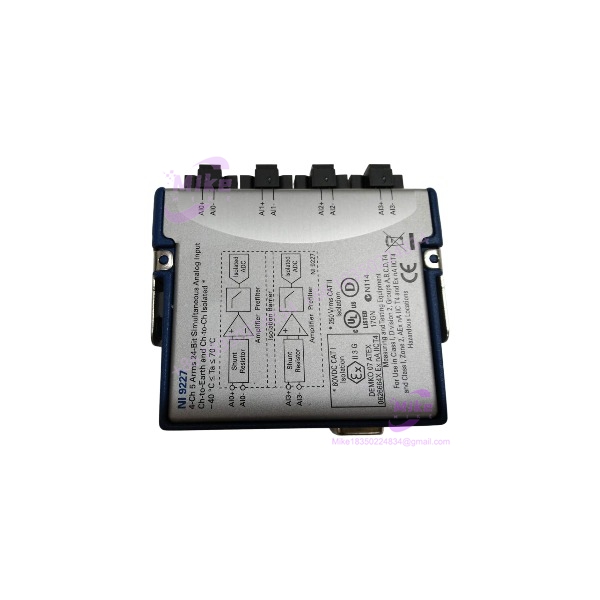
NI 9227
Key Technical Specifications
- Model Number: NI 9227
- Manufacturer: National Instruments
- Module Classification: 4-Channel Current Input Module
- Current Measurement Range: 5 Arms (14 A peak)
- Sampling Rate: Up to 50 kS/s per channel simultaneously
- ADC Resolution: 24 bits
- Isolation Rating: 250 Vrms Channel-to-Earth Ground (Double Insulation)
- Connector Type: 4-position screw terminal plug (detachable)
- Compatible Chassis: National Instruments CompactDAQ (cDAQ) and CompactRIO (cRIO) systems
- Operating Temperature Range: -40°C to +70°C (-40°F to 158°F)
Global Sourcing & Live-Test SOP (Transparency Core)
To guarantee measurement accuracy and electrical safety when sourcing surplus or replacement data acquisition hardware, every unit undergoes a rigorous verification workflow.
1.Inbound Visual & Terminal Audit:Prerequisite。
Inspect the plastic housing for thermal stress, check the front detachable terminal block screws for wear, and examine the backplane connector pins for oxidation.
2.Chassis Insertion & Boot Check:5 min。
Insert the NI 9227 into a verified cDAQ chassis slot. Power on the system and confirm that the chassis software recognizes the module and reports normal status LEDs.
3.Simultaneous Channel Signal Sweep:20 min。
Connect a calibrated multi-channel current calibrator to the input terminals. Source known AC and DC current values across the 5 A range while logging digitized output values in NI MAX to verify 24-bit conversion accuracy.
4.Thermal Burn-In & ESD Sealing:24 Hours。
Operate the module under continuous signal load inside a temperature-controlled chamber at 55°C for 24 hours. Seal the unit in an anti-static bag with desiccant upon passing.
The Field Engineer’s Pitfall Guide
Critical Installation Warnings
Verify channel input ratings, terminal block wiring torque, and chassis ground isolation before connecting live current loops.
❗ 1. Exceeding the 5 Arms Continuous Input Limit
—In test setups, technicians sometimes route high transient currents exceeding the 14 A peak limit directly through the NI 9227 without proper attenuating current transformers (CTs). Over-range currents can permanently damage the internal shunt resistors and open the measurement channels.
❗ 2. Loose Detachable Screw Terminal Connections
I’ve seen test benches log intermittent signal dropouts during mechanical vibration tests simply because the wires inserted into the front screw terminal plug were under-torqued or stripped too long. Always use insulated wire ferrules and secure terminal screws firmly.
❗ 3. Hot-Swapping in Non-Supported Chassis Configurations
While many CompactDAQ systems support module hot-swapping, doing so without verifying system software state or while high common-mode voltages are present on the terminals can cause electrical arcing and damage backplane interface pins.
Intent-Driven FAQ
Will swapping out the NI 9227 require modifying my LabVIEW code?
No. As long as the replacement module occupies the same slot number in your CompactDAQ or CompactRIO chassis and uses the same NI-DAQmx device alias, your existing LabVIEW program will communicate with it without code modifications.
What causes an open-circuit or zero-reading on a specific channel?
An unexpected zero-reading typically points to a broken wire in the external current loop, a loose screw terminal connection on the front plug, or a blown internal protection fuse caused by an over-current event.
Can I measure voltages directly with the NI 9227?
No. The NI 9227 is engineered strictly as a current input module with low internal shunt resistance designed to measure current signals. Connecting a voltage source directly across the terminals will create a near short-circuit and damage the module.
How do I verify module calibration status?
You can check calibration dates and run self-test diagnostics using National Instruments Measurement & Automation Explorer (NI MAX) software connected to your host PC.
What warranty coverage applies to replacement data acquisition modules?
Standard procurement warranties cover functional performance, calibration stability, and hardware integrity for 12 months from the date of purchase.