Description
National Instruments NI-9853 | Dual-Port CAN Interface Module
Product Introduction
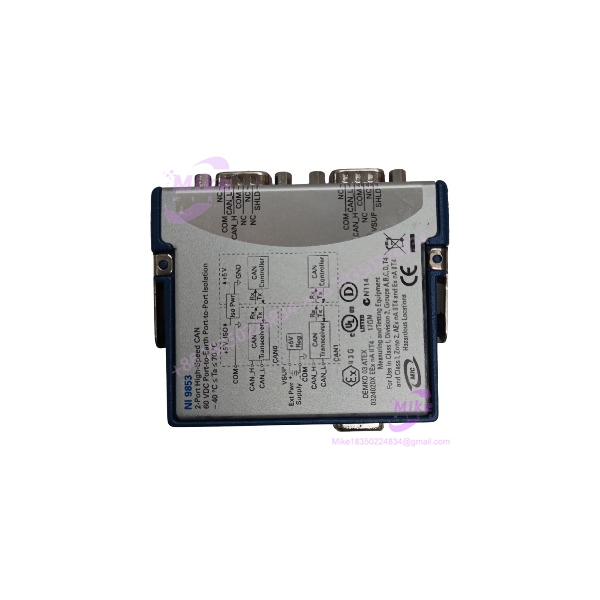
When a machine controller needs to exchange CAN frames with multiple devices, losing a communication channel can disrupt diagnostics, synchronization, and control. The NI-9853 is a two-port, high-speed Controller Area Network interface in the NI C Series family. It installs in a compatible CompactRIO chassis and supports low-level, FPGA-based CAN communication through the NI-RIO driver and LabVIEW FPGA Module.
Both channels support CAN 2.0B communication, including standard 11-bit and extended 29-bit identifiers, at data rates up to 1 Mbps. The ports are independent and electrically isolated from each other and from other modules in the system. That arrangement helps engineers separate CAN networks within one controller, although each bus still requires correct wiring, termination, and power. The operating temperature range is −40°C to 70°C, making the module suitable for a range of industrial and test-system environments.
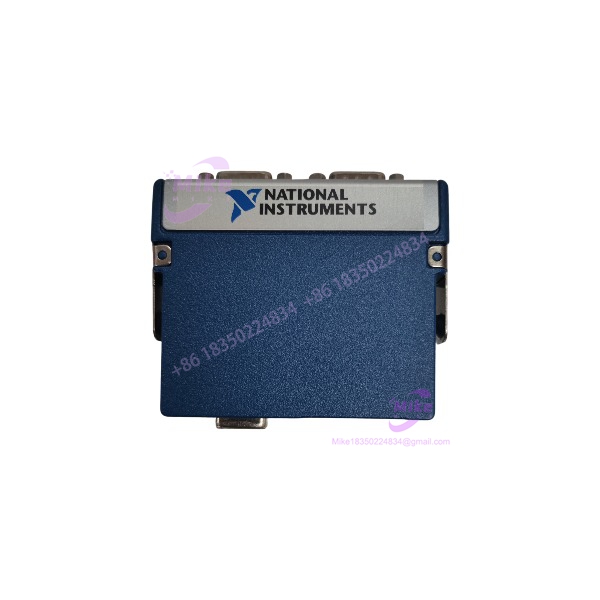
NI-9853
Key Technical Specifications
- Manufacturer: National Instruments
- Model: NI-9853
- Hardware family: NI C Series
- Module type: High-speed CAN communication interface
- Number of ports: 2 independent CAN channels
- Protocol support: CAN 2.0B
- Identifier formats: 11-bit standard and 29-bit extended identifiers
- Maximum baud rate: 1 Mbps
- CAN connectors: Two 9-pin male D-Sub connectors
- CAN0 power: Internally powered
- CAN1 power: External supply of 8–25 VDC required
- Operating temperature: −40°C to 70°C
- Maximum chassis power consumption: Up to 625 mW during transmission and 400 mW during reception, as specified in the operating documentation
- Isolation: Port-to-port and port-to-module isolation
- Software environment: NI-RIO and LabVIEW FPGA
- Supported platform: Compatible CompactRIO systems
The NI-9853 is available under part numbers 779429-01 and 780178-01. These variants differ in conformal coating, so verify the required part number before ordering.
Application Scenarios & Pain Points
Scenario A — Two CAN networks, one controller
A test rig needs to exchange messages with a device network while independently monitoring another CAN segment. The NI-9853 provides two isolated CAN channels in one CompactRIO chassis, reducing the need for separate communication hardware. Engineers can develop FPGA-level handling for message bytes, triggering, and application-specific control.
Scenario B — High-speed communication at 1 Mbps
- Condition: The CAN bus operates at 1 Mbps.
- Risk: Excessive cable length, long stubs, or incorrect termination can cause reflections and intermittent frame errors.
- Engineering response: Follow the applicable CAN wiring requirements. NI documentation specifies a 120 Ω nominal cable impedance and describes a 40 m total cable-length guideline with a maximum 0.3 m stub at 1 Mbps. Actual allowable lengths depend on topology and network characteristics.
Scenario C — CAN1 appears offline after installation
A replacement module powers up, but the second CAN channel does not communicate. Before condemning the hardware, check the external supply to CAN1. This port requires 8–25 VDC at its supply connection, unlike CAN0, which is internally powered. A missing supply can look like a failed transceiver.
Scenario D — Industrial test equipment operating in demanding environments
The specified −40°C to 70°C operating range supports a broad range of test and automation installations. For enclosures exposed to condensation, dust, or corrosive conditions, confirm whether the required conformal-coated version is installed. Coating offers additional protection, but it does not make every environmental exposure acceptable.
QA & Live Testing SOP
For a replacement NI-9853, request a documented inspection rather than relying on a product photograph.
- Origin verification: Check the manufacturer label, exact part number, connector condition, and available packaging or provenance records.
- Visual inspection: Examine both D-Sub ports, the enclosure, and any signs of corrosion, impact, or unauthorized repair.
- Power checks: Verify the module in a compatible CompactRIO test system and confirm the external supply requirements for CAN1.
- Live communication test: Use a compatible CAN test setup to transmit and receive frames on both ports. Confirm the selected baud rate, standard and extended identifiers, and expected frame behavior.
- Loopback validation: Where supported by the test setup, connect CAN0 and CAN1 through an appropriately terminated CAN bus and verify transmission and reception. Supply CAN1 externally as required.
- Software validation: Confirm that the installed NI-RIO software, LabVIEW FPGA project, and controller configuration support the module.
- Packaging: Use ESD-protective packaging and protect the D-Sub connectors against mechanical damage.
These are recommended acceptance checks, not confirmation that any specific unit has been tested. Obtain actual test records, condition details, and warranty terms from the supplier.
Field Engineer’s Pitfall Guide
- ❗ CAN1 needs external power. Do not assume both ports draw everything they need from the CompactRIO chassis. Verify the required 8–25 VDC supply at the CAN1 connector before diagnosing a dead channel.
- ❗ A matching connector does not guarantee a compatible module. The NI-9853 is intended for supported CompactRIO configurations using NI-RIO and LabVIEW FPGA. Ordinary CompactDAQ compatibility should not be assumed. Check the controller, chassis, driver versions, and FPGA project before installation.
- ❗ Do not overlook termination or coating differences. A bus that works intermittently at 1 Mbps may have a wiring or termination problem rather than a defective module. Also, part numbers 779429-01 and 780178-01 differ in conformal coating; confirm the environmental requirement and exact replacement variant.
Intent-Driven FAQ
Q1: Is the NI-9853 compatible with my CompactRIO controller?
It is designed for supported CompactRIO systems, but the exact chassis, controller, NI-RIO software, and LabVIEW FPGA project must be checked. Do not approve a replacement based on physical fit alone.
Q2: Can I use the NI-9853 with CompactDAQ?
No, not as a standard supported configuration. The NI-9853 is designed for CompactRIO systems. If your application uses CompactDAQ, select a communication interface explicitly supported by that platform.
Q3: What is the maximum communication speed of the NI-9853?
The maximum specified CAN baud rate is 1 Mbps. Both ports support CAN 2.0B, including 11-bit standard and 29-bit extended identifiers. Correct cable impedance, termination, and network topology remain necessary at high speeds.
Q4: Why does CAN0 work while CAN1 does not?
Check the external power supply first. CAN0 is internally powered, while CAN1 requires an external 8–25 VDC supply. Then inspect the connector pinout, bus termination, software configuration, and error status.
Q5: What is the difference between NI-9853 part numbers 779429-01 and 780178-01?
Both identify two-port high-speed CAN modules. NI’s product information distinguishes them by conformal coating: one version is coated and the other is not. Match the full part number to the environmental requirements of your installation.
Q6: How do I verify that a replacement NI-9853 is functional?
Request a documented test in a compatible CompactRIO system. Ideally, the test should demonstrate frame transmission and reception on both CAN ports, including correct CAN1 external power, the required baud rate, and suitable bus termination. Visual inspection alone cannot establish functional condition.
Q7: What warranty is available for the NI-9853?
Warranty coverage depends on the seller and the unit’s condition. Confirm the warranty period, return window, test documentation, and coverage for communication faults before purchase. Do not assume that third-party stock carries the same terms as a direct manufacturer purchase.
Procurement recommendation: For the NI-9853, prioritize exact part-number matching, CompactRIO compatibility, CAN1 power verification, and documented two-port communication testing. These checks help prevent a replacement from becoming the next source of downtime.