Description
Kongsberg DPS112 | DGNSS Marine Sensor, New Surplus
Architect’s Product Breakdown
The Kongsberg DPS112 sits as a critical node in marine automation architecture, serving as a dual-constellation DGNSS sensor engineered explicitly for dynamic positioning (DP) and offshore support vessels. Its primary operational role is ingesting multi-constellation satellite signals to deliver reliable position, velocity, and time vector feeds directly to vessel management systems.
When planning legacy migrations or swapping out older single-frequency units, engineers must evaluate backplane bus formats and serial/Ethernet port allocations. The hardware integrates an embedded display and keypad for localized diagnostics, reducing the need to pull telemetry via laptop in cramped bridge consoles. Firmware handling requires strict version matching with existing Kongsberg bridge configurations to prevent handshake latency over NMEA or Ethernet streams. Space constraints inside cabinet housings are minimal given its compact footprint, but thermal limits demand careful clearance if mounted near heat-generating power distribution blocks.
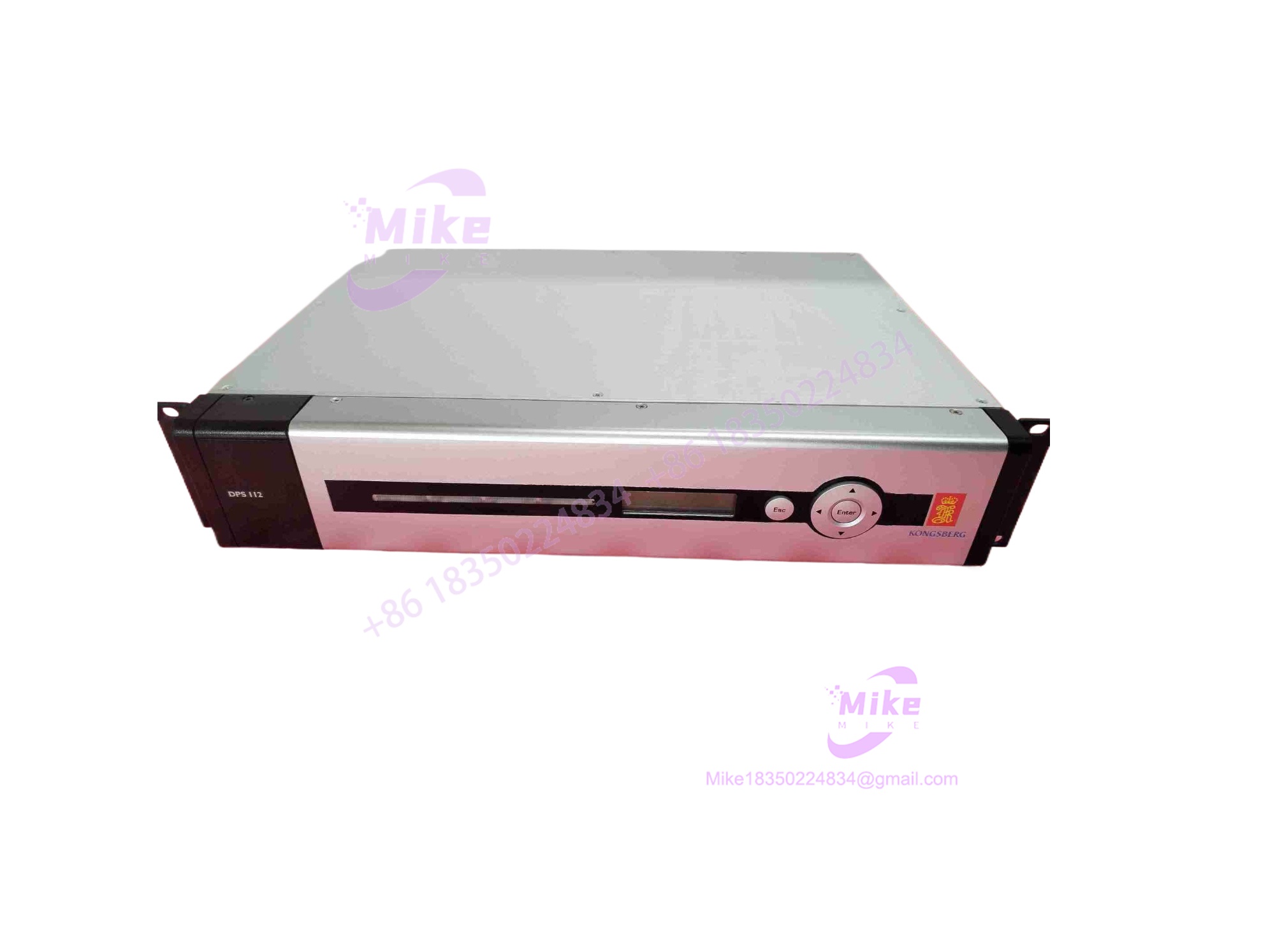
DPS112
Key Technical Specifications
| Parameter | Specification |
| Receiver Type | Combined GPS L1/L2, GLONASS L1/L2, SBAS |
| Correction Services | IALA Beacon, Fugro Seastar G2/SGG (L-band), optional RTCM |
| Position Accuracy | Sub-meter to decimeter level (depending on correction service) |
| Interfaces | Ethernet, USB (for software updates), configurable serial outputs |
| Local HMI | Embedded display and operational keypad |
| Input Voltage | 24 VDC nominal |
| Operating Temperature | -15°C to +55°C (marine grade) |
| Enclosure Rating | IP20 (Console / Rack Mount) |
Field Engineer’s Pitfall Guide
- WARNING: Firmware Revision Mismatches. Dropping a newer revision DPS112 into an older vessel network without updating the central DP controller software can trigger severe communication timeouts or drop position data entirely. Always verify the software stream compatibility prior to rolling out to sea.
- WARNING: L-Band Antenna Multipath Interference. Ensure the dedicated L-band/GNSS antenna splitters and coax cable runs (RG-214 or low-loss equivalent) are checked for attenuation. I’ve tracked down intermittent Seastar lock drops across 48 hours of troubleshooting only to find water ingress in an unsecured deck-mounted N-connector.
- WARNING: USB Port Logic Lockouts. Never yank the USB drive during an active firmware flash sequence. Doing so will corrupt the bootloader partition, forcing a factory bench reset via internal service pins.
QA & Testing SOP (Transparency)
To guarantee operational readiness in safety-critical marine environments, every unit undergoes a multi-stage Quality Assurance protocol:
- Visual & Origin Verification: Inspection of OEM tamper seals, serial number plate matching against historical factory logs, and physical check for chassis corrosion or pin bending.
- Bench Test Rig Power-Up: Powered via an isolated 24 VDC lab supply to test cold-start sequences, internal power regulation, and current draw stability.
- RF Signal & Constellation Simulation: Injection of live or simulated GPS/GLONASS RF signals to verify lock times, carrier-to-noise ratios, and dual-frequency tracking efficiency.
- Interface & Handshake Diagnostics: Verification of Ethernet port data throughput, NMEA sentence generation accuracy, and USB firmware flashing functionality before anti-static vacuum sealing.
Technical FAQ
Can I hot-swap this module while the DP system is running?
No. Hot-swapping the DPS112 during active station-keeping operations risks dropping a primary position reference feed. Maintenance must be executed during vessel port stays or when redundant reference sensors are fully active and selected.
Does the unit retain configuration data after total power loss?
Yes. Internal non-volatile flash memory securely retains network configurations, user offsets, and station parameters indefinitely without requiring an internal backup battery.
What is the direct upgrade path since this unit is discontinued?
Kongsberg typically points users toward newer generation units in the DPS product line (such as the DPS i1 series) which feature updated processing cores and expanded multi-constellation tracking capabilities.
Are software updates applied via serial connection?
No. Software updates are streamlined through the integrated USB interface located on the front panel, bypassing legacy serial flash tools.