


Description
Honeywell 8C-PAINA1 | 16-Pt 4-20mA High-Level AI Module
Architect’s Product Breakdown
The Honeywell 8C-PAINA1 is a high-density, 16-channel analog input module designed for process control within Honeywell’s Series 8 I/O family, operating seamlessly alongside the C300 Controller and Experion PKS platform. By mounting directly onto a matching Input Output Termination Assembly (IOTA) block, it converts standard 4–20 mA field loops, transmitter outputs, and 1–5 VDC signals into high-resolution 16-bit digital values for real-time process monitoring, alarm monitoring, and PID loop calculation.
The “8C” designation confirms factory conformal coating, providing harsh-environment protection against airborne pollutants, moisture, and corrosive gases (ISA S71.04 G3 class). The module processes signals across 16 single-ended channels, drawing logic power directly from the 24 VDC IOTA bus while utilizing on-board filtering to suppress high-frequency noise and 50/60 Hz line interference before signal conversion.
In continuous process installations—such as oil refineries, power stations, and chemical plants—the 8C-PAINA1 provides a dependable channel-to-space density ratio on cabinet DIN rails. The module supports online insertion and removal (hot-swapping) on redundant IOTA baselines, enabling hardware maintenance without taking active control loops or safety interlocks offline.
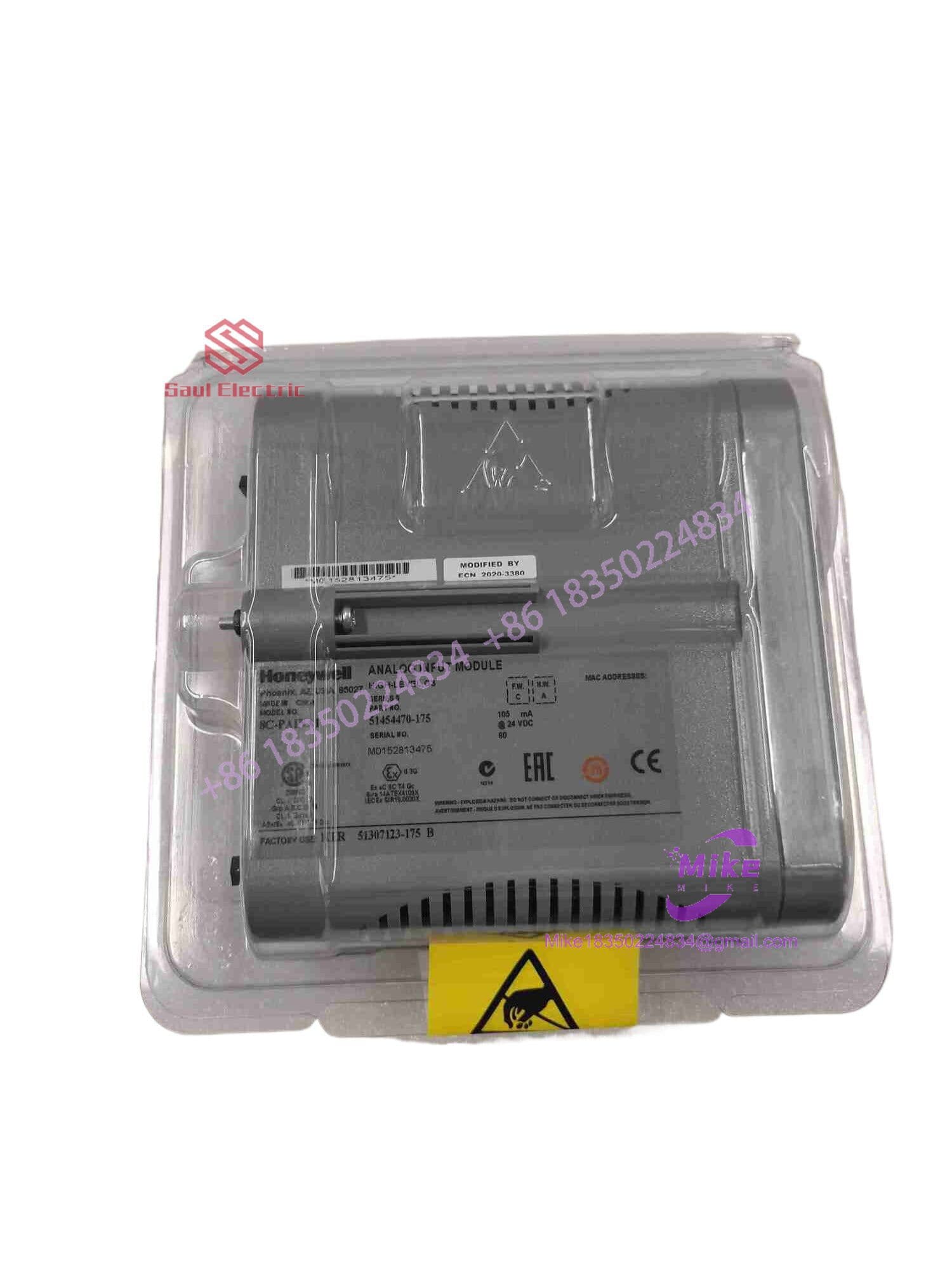
8C-PAINA1
Key Technical Specifications
| Parameter | Specification |
| Number of Channels | 16 Single-Ended Analog Inputs |
| Input Signal Range | 4-20 mA DC or 1-5 VDC |
| A/D Conversion Resolution | 16-Bit Sigma-Delta |
| Input Impedance | 250 Ω (Internal precision sampling resistor) |
| Module Voltage Rating | 24 VDC nominal (Supplied via IOTA bus) |
| Accuracy | ±0.1% of full scale at 25°C |
| Common Mode Rejection | > 90 dB at 50/60 Hz |
| Conformal Coating | Standard (ISA S71.04 Class G3 Compliant) |
| System Compatibility | Honeywell Series 8 / Experion C300 / Experion LX |
| Operating Temperature | 0°C to +60°C |
Field Engineer’s Pitfall Guide
WARNING: Missing 250 Ω Precision Resistor on Voltage Loops
When migrating field loops from voltage signals (1-5 VDC) to current loops (4-20 mA), technicians sometimes forget that the module relies on the matching IOTA termination board to complete the loop current path. Verify whether the installed IOTA (e.g., 8C-TAIXA1) utilizes internal electronically switched precision 250 Ω sense resistors or physical plug-in terminal blocks before applying loop power.
WARNING: Common Ground Loop Creation on 4-Wire Transmitters
Because the 8C-PAINA1 utilizes single-ended input channel architecture, all 16 channel negative returns are internally referenced to a common module ground. Wiring self-powered 4-wire transmitters with unisolated ground potentials into the same module as 2-wire loop-powered instruments will introduce ground loops, causing signal offset errors across multiple adjacent channels.
WARNING: Mechanical Pin Bending During Blind IOTA Mating
Inserting the 8C-PAINA1 onto the Series 8 IOTA backplane without aligning the plastic guide pins can bend or recess the multi-pin header pins on the rear PCB interface. Align the top and bottom latch guides firmly before applying thumb pressure to seat the card.
QA & Testing SOP
- Visual & Structural Inspection:
- Verify genuine Honeywell original labeling, OEM serial numbers, and conformal coating coverage.
- Check rear multi-pin connector headers for bent, corroded, or displaced pin contacts.
- Confirm faceplate mechanical latching handles operate smoothly with positive engagement.
- Power & Isolation Bench Verification:
- Apply 24 VDC regulated auxiliary power to test IOTA harness.
- Measure internal power rail generation and verify current draw remains within normal idle limits.
- Perform high-potential insulation testing between the 24 VDC logic ground and chassis ground earth.
- Multi-Channel Calibration & Signal Inject Test:
- Mount module on an active Series 8 test bench connected to an Experion C300 controller running Control Builder.
- Using a calibrated precision current source (e.g., Fluke 754), inject 4.00 mA, 12.00 mA, and 20.00 mA across all 16 channels individually.
- Confirm software point values in Experion match injected calibration points within ±0.1% full-scale tolerance.
- Dynamic Thermal Burn-In Cycle:
- Execute continuous 16-channel analog data acquisition for 24 hours inside a thermal chamber maintained at 50°C.
- Monitor for drift, ADC quantization errors, or thermal shutdown faults under elevated ambient conditions.
- ESD Cleaning & Storage Preparation:
- Clear fault logs, reset module hardware to factory defaults, and wipe contacts with non-conductive cleaner.
- Seal in anti-static ESD shielding bags containing fresh desiccant before packaging in heavy-duty foam boxes.
Technical FAQ
What is the difference between the 8C-PAINA1 and the 8U-?
The core processing circuit and firmware are identical. The features factory conformal coating on all internal printed circuit boards for deployment in corrosive or high-humidity environments (ISA S71.04 G3 class). The is the uncoated standard model meant for clean, climate-controlled control rooms.
Does the 8C- support HART protocol pass-through?
No. The 8C- is a high-level analog input module focused strictly on standard 4-20 mA and 1-5 VDC analog signal digitization. If your field instruments require HART digital communications (e.g., HART asset management via Honeywell FDM), you must use the dedicated HART-enabled analog input module model 8C-PAIH51.
Can I replace an 8C- module while the C300 controller is actively running?
Yes. When mounted on a Series 8 IOTA, the module supports hot-swapping (Online Insertion and Removal). Removing or inserting the module will generate a hardware alert in Experion, but it will not disrupt adjacent modules or fault the C300 controller.
Does this module provide transmitter power loop supplies directly?
Power for 2-wire field transmitters (24 VDC loop power) is handled through the field wiring terminals on the matching Series 8 IOTA board rather than generated internally by the 8C- card itself. Ensure the 24 VDC bus supply feeding the IOTA terminal strip is adequately fused.





