


Description
HIMA F8650 | H51q Central Module Replacement
Product Introduction
In the H51q architecture, the central module is where the safety application actually executes. HIMA F8650 is the central processing module responsible for executing the operating system and user program while maintaining the redundant processing architecture required by the safety system.
The F8650 uses two clock-synchronized Intel 386EX 32-bit microprocessors operating at 25 MHz. Each processor has its own memory resources, and the safety architecture uses comparison and diagnostic mechanisms to detect processor or memory discrepancies. HIMA documentation identifies the F8650 as a central module for the H51q-MS, H51q-HS, and H51q-HRS systems.
This is an important distinction when sourcing legacy HIMA hardware. F8650 should not be substituted simply because another HIMA module fits the same central rack. The processor architecture, operating-system version, application configuration, redundancy arrangement, and associated communication modules all have to be considered.
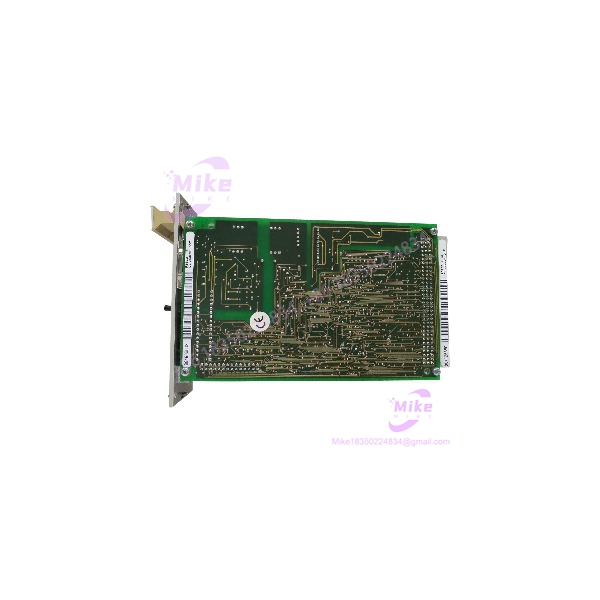
F8650
Key Technical Specifications
- Manufacturer: HIMA Paul Hildebrandt GmbH + Co. KG
- Model: F8650
- Product Type: Safety-related central module
- System Compatibility: H51q-MS, H51q-HS, H51q-HRS
- Processor Architecture: 2 × clock-synchronized processors
- Processor: Intel 386EX
- Processor Width: 32 bit
- Clock Frequency: 25 MHz
- Operating-System Memory: Flash EPROM, 1 MB per processor
- User-Program Memory: Flash EPROM, 512 kB per processor
- Data Memory: SRAM, 256 kB per processor
- Serial Interfaces: 2 × RS-485
- RS-485 Isolation: Electrical isolation
- Diagnostic Display: 4-digit matrix display
- Safety Watchdog: Fail-safe watchdog with 24 VDC output
- Watchdog Load: Up to 500 mA
- Watchdog Protection: Short-circuit protected
- Space Requirement: 8 TE
- Operating Supply: 5 VDC
- Typical Operating Current: 2 A
The above core specifications are consistent with the data sheet and HIMA safety documentation.
Safety Processing Architecture
The uses two microprocessors running with synchronized clocks. Each processor has its own memory, with the safety architecture maintaining complementary representations of program and data information for comparison.
The central module incorporates:
- CPU self-testing
- Memory testing
- Hardware comparison
- SRAM testing
- Flash/CRC checking
- Fail-safe watchdog monitoring
- I/O bus communication
- Dual-port RAM communication with the redundant central module
- Power-supply monitoring
- Battery monitoring
The watchdog is particularly important. When the required processor conditions are not satisfied, the system drives the watchdog into its safe state rather than allowing uncontrolled continued operation.
RS-485 Communication
provides two electrically isolated RS-485 interfaces for system-level serial communication.
The HIMA safety documentation describes 57,600 bps operation, with 9,600 and 57,600 bps selectable by switch or software; other baud rates may also be possible depending on the software environment. Software settings have priority where applicable.
These interfaces should not be mistaken for generic PLC serial ports. Station addressing, transmission speed, software version, and the HIMA system architecture all need to be considered when commissioning a replacement.
For Ethernet-based communication, the architecture can use a dedicated F8627X communication module rather than treating the ‘s RS-485 ports as an Ethernet substitute.
Diagnostic Architecture
The includes a four-digit matrix diagnostic display.
Additional indicators provide information associated with:
- Central CPU faults
- I/O-area faults
- System diagnostic conditions
- User-program conditions
The diagnostic interface allows maintenance personnel to request additional information using the front-panel controls. The ACK function can reset an error indication; under failure-stop conditions, its behavior is associated with restarting the system.
For a replacement module, recording diagnostic behavior during the incoming inspection is therefore more useful than simply checking whether the front panel illuminates.
Global Sourcing & Live-Test SOP
1. Inbound Verification
- Confirm the exact designation on the front label.
- Do not confuse with F8650A, F8650E, or the later F8650X family.
- Record serial number, hardware revision, and operating-system information where accessible.
- Inspect both PCB assemblies and the front-panel diagnostic section.
- Check the module edge connector for oxidation, contamination, or damaged contacts.
- Inspect the battery area for leakage or corrosion.
- Check the module for unauthorized component replacement or PCB rework.
- Preserve the original serial-number and traceability records.
2. Live Simulation
A meaningful test requires a compatible H51q test environment.
Recommended checks include:
- Verify the 5 VDC supply.
- Confirm current consumption is consistent with the applicable documentation.
- Perform controlled startup.
- Confirm both processors enter the expected operating state.
- Exercise the diagnostic display.
- Test the RS-485 interfaces.
- Verify communication with the applicable central/rack architecture.
- Verify I/O-bus communication when a compatible test rack is available.
- Test redundant central-module communication where the complete redundant architecture is available.
- Perform controlled power-cycle testing.
A generic power-on test should not be represented as proof of functional-safety performance.
3. Diagnostics
- Record startup diagnostic indications.
- Check CPU and I/O diagnostic status.
- Verify watchdog behavior under the approved test procedure.
- Check battery-monitoring status.
- Verify RS-485 communication stability.
- Record software/firmware identification.
- Monitor for intermittent backplane or connector faults.
- Perform an extended heat/run test according to the customer’s approved refurbishment SOP.
4. Final Preparation
- Clean the module using approved electronics-handling procedures.
- Package in ESD-safe material.
- Protect the module edge connector against mechanical damage.
- Record serial number and hardware revision.
- Document battery condition.
- Preserve configuration and test records.
- Do not erase or overwrite application data during refurbishment unless explicitly authorized.
Field Engineer’s Pitfall Guide
❗ Do not confuse with F8650X. The later F8650X uses a different memory configuration and cooling concept. The F8650X documentation specifies 1 MB user-program Flash and 1 MB SRAM per processor, whereas the original documentation specifies 512 kB user-program Flash and 256 kB SRAM. Treat the suffix as a hardware-selection parameter, not cosmetic labeling.
❗ Check the battery before putting a stored module into service. The uses battery-backed memory/clock functions. A module that powers up successfully can still require battery maintenance before being returned to a safety installation.
❗ Do not evaluate the as an ordinary PLC CPU. Its two synchronized processors, complementary memory architecture, hardware comparator, watchdog, and diagnostic mechanisms are part of the safety architecture. A normal CPU boot test does not validate the complete safety function.
Intent-Driven FAQ
What is HIMA ?
HIMA is a safety-related central module used in the H51q-MS, H51q-HS, and H51q-HRS PES platforms.
Is a PLC CPU?
Functionally, it is the central processing module of the HIMA safety system, but it should not be treated as a conventional commercial PLC CPU. It implements HIMA’s safety-related dual-processor architecture.
How many processors does have?
It has two clock-synchronized Intel 386EX 32-bit processors, each operating at 25 MHz.
How much memory does have?
Per processor, the documented configuration provides 1 MB Flash EPROM for the operating system, 512 kB Flash EPROM for the user program, and 256 kB SRAM for data.
How much power does consume?
The documented operating data is 5 VDC / 2 A. Actual system power planning should account for the complete central rack and redundant power-supply configuration.
Does have Ethernet?
The original is documented with two isolated RS-485 interfaces, not an integrated Ethernet port. Ethernet communication in the H51q architecture can be provided through an appropriate HIMA communication module such as F8627X.
Can be replaced by F8650X?
Do not assume a direct drop-in substitution. Although both are central modules for the H51q family, their memory configuration and hardware/cooling requirements differ. HIMA documentation for F8650X specifically notes a changed fan concept when upgrading from .
What should be checked before purchasing a used ?
Verify the exact suffix, H51q system variant, hardware revision, operating-system compatibility, battery condition, serial number, diagnostic behavior, and compatibility with the existing redundant central-module and I/O architecture.





