


Description
GE DS200RTBAG3AFB | Terminal Board Module, 3-Group Revision
Architect’s Product Breakdown
The GE DS200RTBAG3AFB operates as a Resistance Temperature Termination Board (RTBA) within the legacy Mark V Speedtronic turbine control architecture. Its core function is to aggregate, filter, and wire-terminate multiple Resistance Temperature Detector (RTD) inputs coming directly from critical mechanical monitoring points—such as turbine journal bearings, lube oil headers, and exhaust gas enclosures. By providing robust terminal blocks and internal noise filtering right at the cabinet boundary, the board isolates sensitive low-level analog temperature signals from severe electromagnetic interference generated by nearby variable frequency drives and high-voltage power cables.
Deploying this module requires strict adherence to hardware suffix and revision parity. Moving between different group revisions (such as shifting from an earlier ‘A’ or ‘G2’ variant to the ‘G3AFB’ iteration) can introduce subtle changes in trace routing, terminal spacing, or internal ribbon cable pinouts. When replacing a failed termination board in an active power generation unit, engineers must ensure that physical wiring jumper configurations and cable harnesses are mapped identically to prevent erratic temperature readings or spurious over-temperature trips.
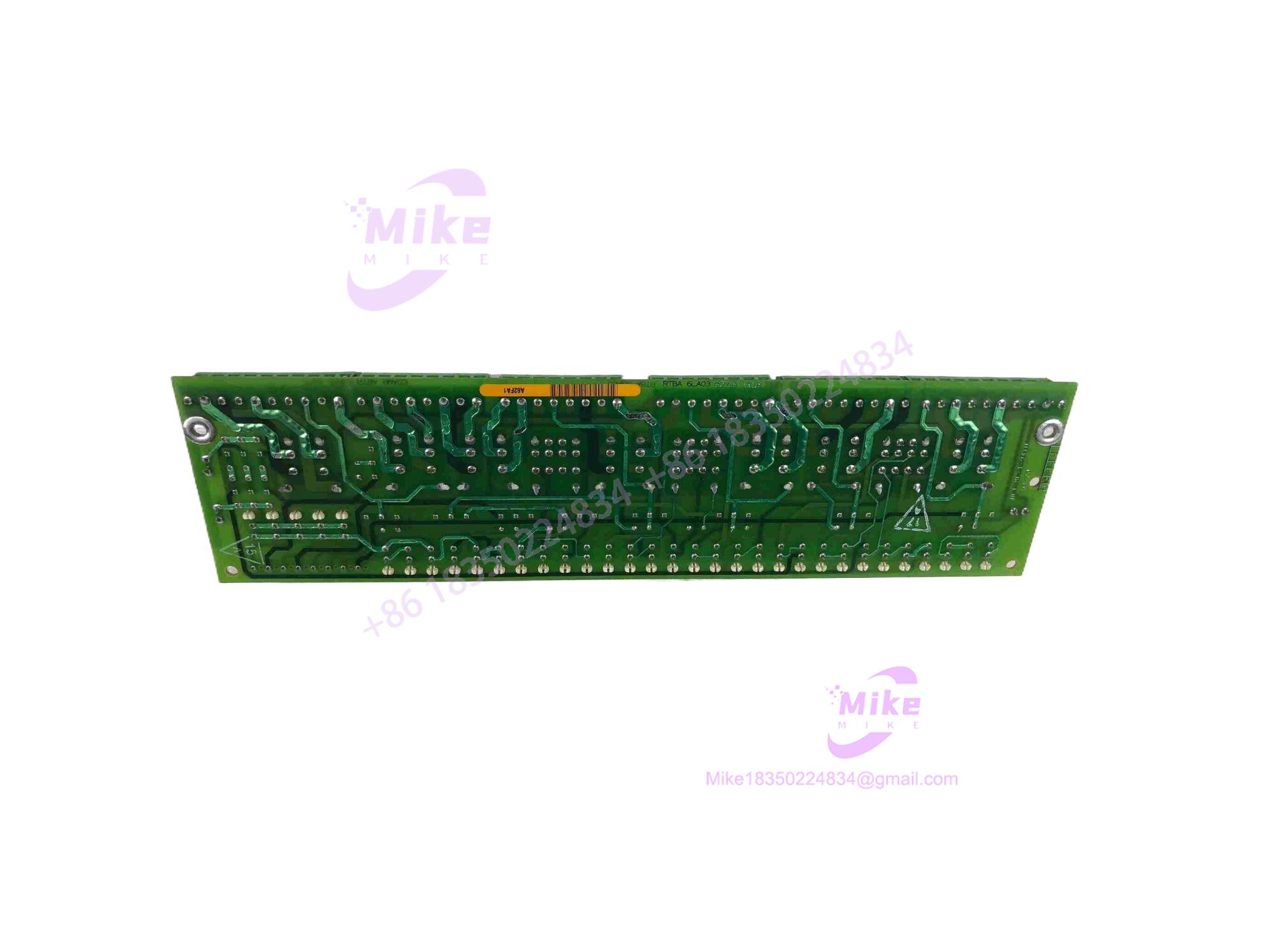
DS200RTBAG3AFB
Key Technical Specifications
| Parameter | Specification |
| Series | GE Mark V Speedtronic |
| Module Type | Resistance Temperature Board (RTBA) |
| Input Compatibility | Multiple RTD sensor inputs (typically Pt100 / Ni standard curves) |
| Interface Connectivity | Plug-in screw terminal blocks and multi-pin internal ribbon cable headers |
| Mounting | Cabinet backplane or internal sub-rack chassis |
| Operating Temperature | 0°C to +65°C |
| Environmental Protection | Factory conformal coating against humidity and corrosive gases |
| Diagnostic Indicators | On-board power and communication health status LEDs |
Field Engineer’s Pitfall Guide
- WARNING: Fragile Terminal Block Stripping. Over-tightening the small screw terminals on the RTBA board can easily crush the internal brass cages or crack the underlying PCB trace laminate, forcing a painful field rewire.
- WARNING: Ribbon Cable Pin Alignment Errors. The internal flat ribbon cables connecting the RTBA to the core processor boards become brittle over years of thermal cycling. Forcing an offset connector will bend gold pins and sever communication paths.
- WARNING: Ground Loop and Shielding Induced Noise. Leaving the RTD signal cable shields floating or improperly grounded at the cabinet bus bar introduces 50/60 Hz hum, resulting in unstable temperature spikes on the HMI display.
- Field Anecdote: I spent an overnight outage troubleshooting a persistent gas turbine trip caused by a “hot bearing” alarm. It turned out a technician replaced an older revision RTBA board with a G3 variant without matching the internal jumper settings for 3-wire versus 4-wire RTD compensation, completely skewing the temperature calculation algorithm.
QA & Testing SOP
- Visual & Origin Verification: Inspect the printed circuit board under magnification for trace micro-fractures, solder joint oxidation, and verify original GE manufacturing labels and revision codes.
- Live Test Bench Environment: Mount the card onto a certified Mark V static test fixture equipped with calibrated resistance simulators.
- Diagnostics & Calibration Testing: Inject precise simulated RTD resistance values across all input channels to verify linear conversion accuracy and validate internal bus handshakes.
- Anti-Static Packaging: Wrap the tested unit in high-shielding anti-static material and pack with dense corrugated structural foam to prevent terminal or pin damage during transit.
Technical FAQ
Can I substitute a DS200RTBAG3AFB for an older revision board without updating software?
Compatibility depends on the exact system build. While physical dimensions match, minor circuit changes on later ‘G3’ variants may require verification against the system configuration files to ensure proper sensor scaling.
Does this termination board store any configuration memory or firmware?
No. The RTBA is a passive/active analog termination and conditioning board; it does not contain non-volatile flash storage or programmable control logic. All processing occurs on the central controller.
What causes fluctuating temperature readings on individual channels?
Fluctuations are typically caused by loose terminal block screws, degraded wire insulation exposing conductors to cabinet moisture, or unshielded signal lines picking up electromagnetic interference.
Is the DS200RTBAG3AFB hot-swappable while the turbine is online?
No. Hot-swapping termination cards connected to live field sensors risks electrical shock, backplane bus corruption, and sudden controller faults due to loss of critical bearing telemetry.





