

Description
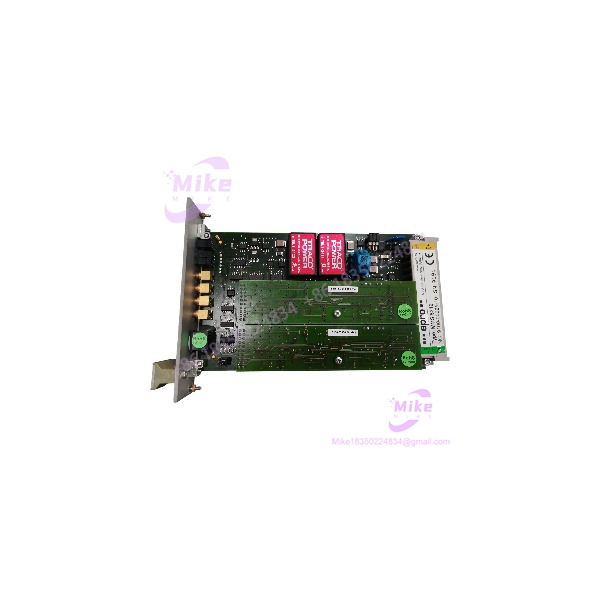
EPRO MMS6312 | Dual Channel Speed Monitor
Product Introduction
The EPRO MMS 6312 is a two-channel rotational speed monitoring module built for the MMS 6000 machine-monitoring architecture. Its job is straightforward but operationally important: process pulse signals from shaft-speed sensors, determine rotational speed or standstill, and provide the monitoring interface needed by turbine, compressor, fan, centrifuge, and other rotating-equipment systems.
The two channels can operate independently or work together. Depending on configuration, the MMS 6312 can monitor two shafts, detect two key-pulse signals, determine rotational direction, calculate speed differences between shafts, or participate in redundant/multichannel monitoring arrangements. EPRO documentation also specifies sensor-supervision functions and local configuration through RS-232, with RS-485 available for communication with the MMS 6850 analysis and diagnostic system.
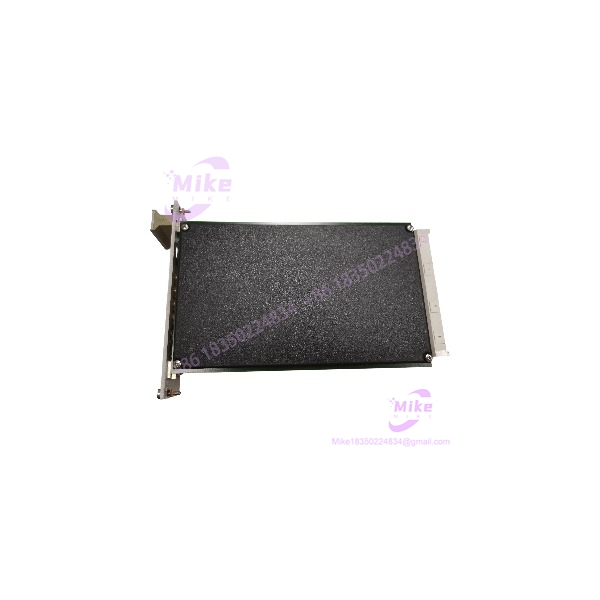
MMS6312
Key Technical Specifications
- Model: EPRO MMS 6312
- System: MMS 6000 Machine Monitoring System
- Function: Dual-channel rotational speed monitoring
- Measurement channels: 2
- Input principle: Pulse signals from compatible speed/eddy-current transducer systems
- Compatible sensor families: EPRO PR 6422 through PR 6425 with appropriate CON converters; PR 9376 and PR 6453 pulse-sensor systems are also identified in the product documentation.
- Input frequency range: 0 to 20,000 Hz
- Maximum configurable speed: Up to 65,535 RPM, depending on configuration and pulse-per-revolution relationship.
- Input resistance: Greater than 100 kΩ
- Input voltage: Approximately 0 to ±27.3 VDC, with a maximum permissible input range specified around 0 to 30 V / ±26.75 VDC, depending on the signal configuration.
- Automatic trigger tracking: Supported; minimum input level for automatic tracing is 2 V.
- Control functions: Reset-latched-alarm input, alarm inhibition, and configurable control/logic inputs.
- Current outputs: Galvanically separated current outputs for the monitoring channels.
- Relay outputs: Channel-related alarm/status outputs are provided at the connecting strip.
- Communication interface: RS-232 for local configuration and readout.
- System communication: RS-485 for connection to the EPRO MMS analysis/diagnostic architecture.
- RS-485 capacity: Up to 31 modules / 62 channels on one RS-485 bus under the documented system configuration.
- Supply architecture: Two redundant supply inputs, diode-decoupled.
- Supply voltage: 18 to 31.2 VDC, nominal 24 VDC.
- Power consumption: Maximum 6 W, approximately 250 mA at 24 VDC.
- Operating temperature: 0 to +65°C
- Storage/transport temperature: −30 to +85°C
- Relative humidity: 5–95%, non-condensing
- Module protection: IP00
- Front-plate protection: IP21
- Vibration: 0.15 mm amplitude from 10–55 Hz; 16.6 m/s² acceleration from 55–150 Hz.
- Shock: 98 m/s² peak acceleration with 16 ms nominal duration.
- EMC: Designed according to the documented EN 50081-1 / EN 50082-2 requirements.
- Card format: DIN 41494 Eurocard, 100 × 160 mm
- Width: 30.0 mm / 6 TE
- Height: 128.4 mm / 3 HE
- Length: 160 mm
- Approximate net weight: 320 g
- Rack density: Up to 14 modules / 28 channels in a 19-inch rack.
Application Scenarios & Pain Points
Turbine Speed Monitoring
For steam, gas, or hydro turbine systems, rotational speed is not just another process value. A bad speed signal can compromise sequencing, diagnostics, and protection logic. The MMS 6312 provides two independently configurable channels for speed or key-pulse monitoring.
Dual-Shaft Monitoring
Need to compare two rotating elements? The two channels can be configured independently for two shafts, or combined to determine a speed difference. This is useful where shaft synchronization or differential-speed monitoring matters.
Rotation-Direction Detection
Two channels can be used together to establish rotational direction from phase-related pulse signals. That can be useful during commissioning or on machinery where reverse rotation must be detected.
Standstill Detection
The module can monitor standstill conditions on two shafts. This is particularly useful in machine sequencing where a downstream operation should not begin until the monitored shaft has stopped.
Legacy MMS 6000 Replacement
This is where compatibility becomes more important than the label on the front panel. The MMS 6312 belongs to a configurable monitoring architecture, so replacing a card with another physically similar MMS 6000 module does not automatically establish functional equivalence.
QA & Live Testing SOP
A proper incoming inspection should focus on the measurement chain rather than simply powering the card and checking whether LEDs illuminate.
- Visual inspection: Check the PCB, front panel, terminal interface, connectors, mounting hardware, and component condition for corrosion, impact damage, contamination, or unauthorized rework.
- Power verification: Apply a controlled 24 VDC supply and verify that the module remains within its specified 18–31.2 VDC supply range.
- Current check: Confirm that idle/current consumption is consistent with the expected module behavior and does not indicate an internal supply fault.
- Dual-input verification: Where redundant supply operation is required, test each supply input independently before testing the redundant arrangement.
- Signal simulation: Use a calibrated pulse/signal source to inject representative frequency signals into Channel 1 and Channel 2.
- Frequency sweep: Verify response at several points rather than checking only one frequency — for example, low-frequency operation, mid-range operation, and a higher-frequency point within the 0–20 kHz range.
- Trigger test: Verify automatic/manual triggering and confirm that the module recognizes the intended pulse amplitude.
- Output verification: Check the corresponding current/status outputs while changing the simulated input frequency.
- Communication test: Verify RS-232 local configuration access and, where required, RS-485 communication.
- Sensor-supervision test: Confirm channel-clear/sensor-supervision behavior using a controlled test condition.
- ESD-safe handling: Store and package the card in an ESD-safe bag with mechanical protection around the PCB and connector area.
The manufacturer’s documentation identifies configuration through the RS-232 interface or RS-485 bus and provides specific sensor/interface requirements. That means a meaningful acceptance test should exercise the actual signal path, not just the power supply.
Field Engineer’s Pitfall Guide
❗ Do not substitute MMS 6310 for MMS 6312 simply because both are speed/key-pulse monitoring cards. The MMS 6312 is specifically a dual-channel rotational speed monitor with its own configurable operating functions. Confirm the required measurement mode before approving a replacement.
❗ Check the sensor and converter combination. The MMS 6312 is intended for particular EPRO transducer/converter arrangements, including PR 6422–PR 6425 systems with suitable CON electronics and specified pulse-sensor families. A connector that physically fits does not prove electrical compatibility.
❗ Verify the stored configuration before commissioning. MMS 6000 modules are configurable devices. Speed scaling, trigger behavior, channel functions, alarm behavior, and system communication parameters can affect how the replacement behaves in the plant.
❗ Do not ignore the redundant supply arrangement. The MMS 6312 uses two diode-decoupled supply inputs, but at least one supply input is required. Check both supply paths when troubleshooting intermittent module faults.
❗ Pay attention to sensor cable shielding. The documented connection diagram specifically warns against incorrectly connecting the transducer cable shield because doing so can short the sensor supply. Follow the applicable wiring diagram rather than assuming conventional shield-to-ground practice.
Intent-Driven FAQ
Q: What does the EPRO MMS 6312 actually monitor?
A: It is a dual-channel rotational speed monitor. Each channel can be used for shaft-speed, standstill, or key-pulse measurement. The channels can also be combined for functions such as rotational-direction detection or comparison of two shaft speeds.
Q: Is the MMS 6312 part of the MMS 6000 system?
A: Yes. The MMS 6312 is a dedicated MMS 6000 monitoring module and uses the system’s established sensor, communication, and rack architecture.
Q: What is the maximum input frequency?
A: The documented input frequency range is 0–20,000 Hz. The actual shaft-speed limit depends on the sensor’s pulse-per-revolution relationship and the configured measurement parameters.
Q: Can the two channels monitor two different shafts?
A: Yes. The channels can be used independently to measure two shaft speeds or two standstill conditions. They can also be combined for speed-difference or rotational-direction functions.
Q: What power supply does the MMS 6312 require?
A: The specified supply range is 18–31.2 VDC, with 24 VDC as the nominal value. The module has two redundant, diode-decoupled supply inputs and consumes up to approximately 6 W.
Q: Can I configure an MMS 6312 without installing the entire MMS 6000 rack?
A: The documentation supports standalone operation and configuration through the module’s RS-232 interface, while RS-485 provides system-level communication. However, the exact commissioning setup depends on the available configuration software, cabling, sensor chain, and application configuration.
Q: Is the MMS 6312 a direct replacement for any MMS 6000 speed-monitor card?
A: Not automatically. Physical compatibility and functional compatibility are separate issues. Before replacing an existing card, compare the exact model, sensor type, configuration, output requirements, alarm logic, communication setup, and supply arrangement.
Q: What should be verified before purchasing an MMS 6312 for a legacy installation?
A: Confirm the exact model, physical card format, sensor/converter combination, required speed range, pulse frequency, output configuration, communication requirements, and existing MMS 6000 configuration. For a legacy turbine or compressor system, matching the stored application configuration can be just as important as matching the hardware designation.





