Description
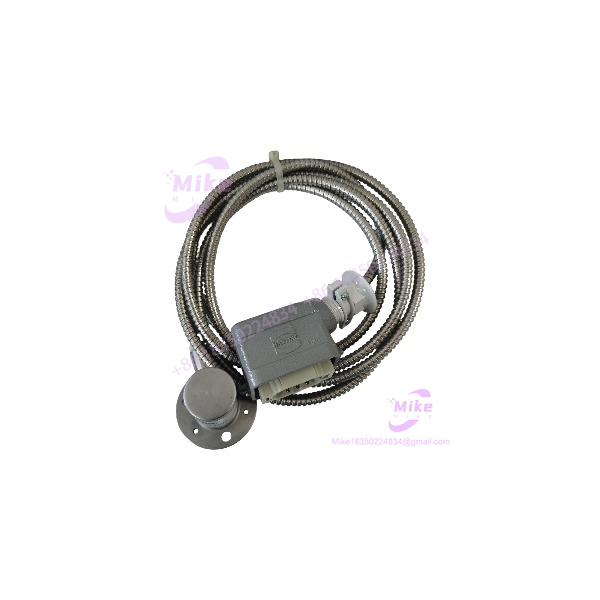
Emerson PR9268/601-000 | In-Stock Turbomachinery Velocity Sensor
Dynamic Product Introduction
Installing seismic transducers on complex turbomachinery often forces engineers into tight corners where standard vertical or horizontal sensors simply bind up mechanically. When tracking absolute bearing housing vibration near hot turbine casings or angled gearboxes, fixed-axis probes quickly hit their thermal and physical limits. The Emerson EPRO PR9268/601-000 solves this deployment headache by offering a true omnidirectional measuring axis combined with a high-temperature construction built for demanding plant environments.
Equipped with a stiffer internal suspension calibrated to a 14 Hz natural frequency, the PR9268/601-000 operates reliably in any spatial plane—vertical, horizontal, or mounted at an odd angle—without requiring internal mass adjustment. (Honestly, taking orientation guesswork out of field retrofits saves hours during tight outage schedules.) Capable of withstanding continuous casing surface temperatures up to +200°C (+392°F), the PR9268/601-000 delivers a linear 28.5 mV/mm/s output directly to MMS 6120 or AMS 6500 rack modules, ensuring your safety systems maintain continuous absolute vibration coverage.
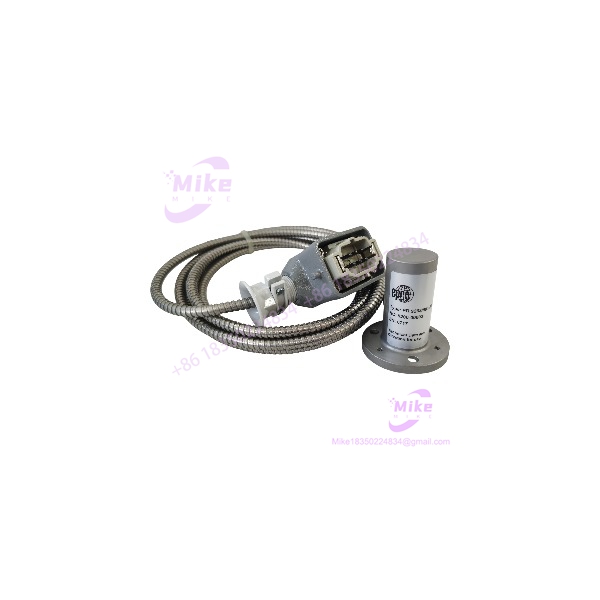
PR9268/601-000
Key Technical Specifications
- Measurement Principle: Electrodynamic moving-coil seismic transducer (passive self-generating)
- Mounting Orientation: Omnidirectional / Universal (0^\circ to 360^\circ continuous mounting angle)
- Linear Frequency Range: 14 Hz to 1,000 Hz (-3 dB cutoff point)
- Natural Frequency (f_0): 14 Hz ± 1.0 Hz at 20°C (68°F)
- Nominal Sensitivity: 28.5 mV/mm/s (723.9 mV/in/s) at 80 Hz with a 100 kΩ load
- Maximum Vibration Amplitude: 2,000 µm peak-to-peak continuous limit; 3,000 µm mechanical limit
- Acceleration Limits: 10g continuous peak-to-peak; 20g intermittent peak-to-peak
- Transverse Sensitivity Ratio: ≤ 0.20 at 110 Hz
- Internal Coil Resistance: 1,875 Ω ± 10% nominal resistance
- Cable Construction & Length: Integrated 3-meter stainless steel flexible armor over high-temp PTFE core
- Termination Interface: Heavy-duty Harting aviation plug connector
- Operating Temperature Range: -20°C to +200°C (-4°F to +392°F) continuous
- Enclosure Rating: IP65 / IP67 heavy industrial stainless steel housing
Global Sourcing & Live-Test SOP (Transparency Core)
Procuring surplus or pre-owned high-temperature TSI hardware requires thorough bench verification before installation on critical turbomachinery. Every PR9268/601-000 entering inventory undergoes a detailed five-stage quality control routine:
- Inbound Verification: Serial numbers on the PR9268/601-000 stainless casing and Harting connector plug are cross-checked against OEM records. We inspect the flexible stainless armor for heat discoloration or crushing and verify that the high-temperature seals show no signs of thermal embrittlement.
- Live Simulation: The sensor is mounted onto an electrodynamic shaker table and rotated across multiple angular positions (0^\circ, 45^\circ, 90^\circ, 180^\circ). The 3-meter armored cable connects directly to a bench-mounted MMS 6120 dual-channel vibration monitor.
- Diagnostics: The shaker sweeps frequencies from 14 Hz to 1,000 Hz. Output voltage is captured across the Harting connector pins using a Fluke 87V multimeter to confirm that sensitivity holds steady at 28.5 mV/mm/s regardless of the mounting angle.
- Thermal & Insulation Soak: The PR9268/601-000 undergoes a thermal chamber soak test at +180°C while monitoring insulation resistance. High-voltage insulation testing at 500 VDC between internal coil conductors and the outer armor must maintain a minimum threshold of 100 MΩ.
- Final Prep: Baseline calibration curves are generated, protective dust caps are locked onto the Harting connector plug, and the PR9268/601-000 unit is sealed in an anti-static moisture-barrier pouch.
The Field Engineer’s Pitfall Guide
❗ Expecting Low-Frequency Coverage Below 14 Hz: Because the PR9268/601-000 uses a stiffer internal suspension to enable omnidirectional mounting, its natural frequency shifts up to 14 Hz (compared to 4.5 Hz on single-axis models). Do not use the PR9268/601-000 on low-speed machines running below 840 RPM (14 Hz). Attempting to track low-speed shaft dynamics without specialized transfer function compensation on your monitor card will result in severely under-reported vibration amplitudes.
❗ Mishandling High-Temperature Armor Routing Near Hot Pipes: While the PR9268/601-000 housing and cable are rated up to +200°C, routing the 3-meter armored cable directly against uninsulated steam lines or hot exhaust manifolds exceeding +220°C will eventually bake the inner PTFE conductor insulation. In field deployments, this thermal overload causes internal conductor shorting that shows up as erratic baseline spikes on your control system trends.
❗ Confusing the Omnidirectional PR9268/601-000 with Standard Axis Models: Swapping out a vertical PR9268/202 or horizontal PR9268/303 with the omnidirectional PR9268/601-000 without checking system filter settings can compromise measurement accuracy. Ensure your TSI monitoring card is configured for the 14 Hz high-pass corner frequency required by the PR9268/601-000 rather than the standard 4.5 Hz profile.
Intent-Driven FAQ
Q: What do the specific numbers in the PR9268/601-000 part number mean? The part number breaks down into key physical features: identifies the electrodynamic velocity sensor family. The /60 prefix designates an omnidirectional mounting design rated for high-temperature environments up to +200°C. The 1 represents an integrated 3-meter armored cable, and the -000 suffix specifies the factory-fitted Harting connector plug.
Q: Does the PR9268/601-000 require an external power supply? No. The PR9268/601-000 operates as a passive electrodynamic generator. Physical vibration of the machine casing moves the internal spring-supported coil through a permanent magnetic field, generating a proportional AC voltage signal without requiring external power loops.
Q: Can I connect the PR9268/601-000 directly to a standard 4-20 mA PLC analog input card? No. The PR9268/601-000 outputs a raw AC voltage proportional to real-time vibration velocity. It must connect to a matching signal processing module or transmitter (such as an Emerson MMS 6120 card or AMS 6500 system) that conditions and converts the dynamic AC signal into a standard 4-20 mA DC process variable.
Q: How can I field-test a PR9268/601-000 sensor to verify internal coil health? Disconnect the Harting connector plug at the junction box. Using a digital multimeter set to resistance (Ohms), measure across the active output pins. A healthy PR9268/601-000 coil will display a resistance reading of approximately 1,875 Ω (±10%) at room temperature. An open circuit (infinite resistance) indicates an internal wire fracture.
Q: What is the main operational trade-off of choosing the PR9268/601-000 over the PR9268/202? The main trade-off is low-frequency response versus mounting flexibility and thermal resistance. The PR9268/202 has a lower natural frequency (4.5 Hz), making it better suited for low-speed machines, but it must be mounted vertically (±30°). The PR9268/601-000 can be mounted at any angle (0^\circ to 360^\circ) and tolerates higher temperatures (+200°C), but its higher natural frequency (14 Hz) limits its effective low-frequency measurement floor to speeds above 840 RPM.