

Description
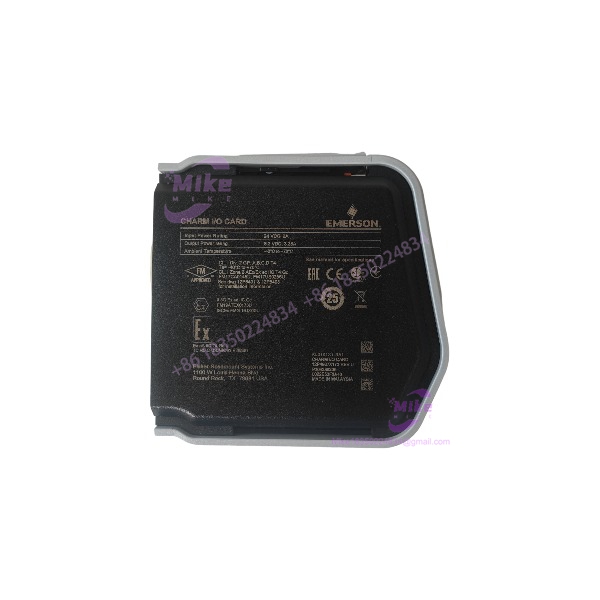
Emerson KL2101X1-BA1 | DeltaV CHARM I/O Card
Product Introduction
When a DeltaV Electronic Marshalling subsystem loses its controller-facing interface, replacing an individual CHARM will not address the fault. The Emerson KL2101X1-BA1 is identified as a CHARM I/O Card (CIOC), which provides the interface between the installed CHARM subsystem and the DeltaV control system.
This is not a conventional channel-level I/O card. Its replacement must be evaluated in the context of the CIOC carrier, installed CHARM population, control-network arrangement, and simplex or redundant architecture. A card that powers up is not necessarily a proven replacement for the original system configuration.
Supplier technical listings report a 24 VDC input at 2 A maximum and a 6.3 VDC output at 3.25 A. These figures are useful for preliminary procurement screening, but the exact-model OEM documentation and nameplate should govern acceptance and commissioning.
KL2101X1-BA1
Key Technical Specifications
- Model Number: KL2101X1-BA1
- Manufacturer: Emerson
- Product Family: DeltaV
- Module Classification: CHARM I/O Card (CIOC)
- Primary Role: Interface between the CHARM I/O subsystem and DeltaV control system
- Input Voltage: 24 VDC
- Maximum Input Current: 2 A
- Output Voltage: 6.3 VDC
- Output Current: 3.25 A
- System Architecture: Simplex or redundant CIOC configuration, as defined by the system design
- Carrier Requirement: Compatible CIOC carrier; verify the exact carrier model
- I/O Architecture: Electronic Marshalling using compatible CHARMs
- Operating Temperature: −40°C to +70°C, as reported in supplier technical data
- Relative Humidity: 5–95% non-condensing, as reported in supplier technical data
- Shock Rating: 10 g, half-sine, 11 ms, as reported in supplier technical data
- Vibration Rating: 1 mm peak-to-peak from 2–13.2 Hz; 0.7 g from 13.2–150 Hz, as reported in supplier technical data
- Airborne Contaminants: ISA-S71.04-1985 Class G3, as reported in supplier technical data
- Calibration Requirement: Supplier documentation states calibration is not required
- Serviceability: Supplier documentation states the unit contains no user-serviceable parts
Specification qualification: The electrical and environmental values above are published in supplier listings for KL2101X1-BA1. Confirm the exact revision and applicable Emerson documentation before using them as formal engineering acceptance limits.
Global Sourcing & Live-Test SOP
For a used or surplus KL2101X1-BA1, visual inspection and a basic power-up are not enough. The card must be evaluated against the intended CIOC carrier and Electronic Marshalling configuration.
1. Inbound Verification
- Photograph the complete model and serial-number labels.
- Confirm KL2101X1-BA1 exactly; do not rely on a seller’s shortened or handwritten description.
- Record the hardware revision, serial number, and any associated ordering number.
- Compare the card with the customer’s existing CIOC and carrier arrangement.
- Inspect the connector, PCB edges, retaining features, and housing for physical damage.
- Check for corrosion, contamination, bent contacts, heat discoloration, or signs of unauthorized repair.
- Request traceability and condition documentation where available.
- Keep seller claims such as “new,” “factory tested,” or “unused” separate from independently verified inspection findings.
2. Controlled Power and Physical Inspection
- Verify the applicable OEM installation instructions before applying power.
- Confirm the correct carrier and approved test setup.
- Use a controlled 24 VDC supply with current monitoring, following the documented wiring and polarity.
- Do not apply power through unidentified contacts or an improvised test fixture.
- Observe startup behavior and card diagnostics.
- Check for abnormal current draw, unexpected resets, or visible signs of overheating.
- Record test equipment, supply conditions, and observed results.
3. CIOC and CHARM Configuration Verification
A standalone power-up does not prove that the card is compatible with the customer’s live configuration.
- Confirm the CIOC carrier model and installed arrangement.
- Verify whether the application uses simplex or redundant CIOCs.
- Check the intended CHARM population and carrier layout.
- Confirm DeltaV release and applicable hardware compatibility requirements.
- Follow the approved site procedure for card replacement and system restart.
- Verify card recognition and expected subsystem communications.
- Check system diagnostics and relevant alarms before declaring the replacement service-ready.
4. Extended Run and Diagnostics
Where the approved test setup permits, run the card under monitored conditions using a compatible CIOC carrier and representative system configuration.
Record:
- Test date and technician
- Exact card model, revision, and serial number
- Carrier model and test arrangement
- Applied supply conditions
- Startup and diagnostic results
- Communication status
- Any abnormal behavior or fault history
Do not advertise a 24-hour burn-in, live-rack test, or channel-level functional test unless it was actually performed and documented. A CIOC is a subsystem interface; its test plan should reflect that role rather than treating it as an individual field-channel CHARM.
5. Final Preparation and Packaging
- Preserve all labels and traceability records.
- Photograph the card and connector before packing.
- Use ESD-safe packaging and suitable impact protection.
- Include the inspection report and available documentation.
- Identify the actual condition as new, used, refurbished, or untested.
- Do not promise a warranty, original packaging, or included accessories unless confirmed in the sales documentation.
Field Engineer’s Pitfall Guide
❗ Do not confuse the CIOC with an individual CHARM
The is the CHARM I/O Card that interfaces the Electronic Marshalling subsystem with DeltaV. It is not a discrete-input, analog-input, or other individual signal-type CHARM. Verify that the failed component is actually the CIOC before ordering.
❗ Redundancy depends on the installed system design
A single should not be represented as a complete redundant CIOC assembly. Confirm whether the application requires simplex or redundant cards, the appropriate carrier, and the corresponding system configuration before planning the replacement.
❗ Do not insert or remove the card without checking power and hazardous-area requirements
Supplier-published instructions state that removal or insertion is not permitted with system power energized unless the area is known to be non-hazardous. Follow the applicable Emerson and site procedures for the exact installation. Do not assume that the card is universally hot-swappable.
Intent-Driven FAQ
What is the Emerson ?
It is an Emerson DeltaV CHARM I/O Card (CIOC), used as the controller-facing interface for a CHARM-based Electronic Marshalling subsystem.
Is the an individual CHARM?
No. It is the CIOC, not an individual signal-type CHARM. The CIOC interfaces the populated CHARM subsystem with the DeltaV control system.
What are the power requirements for the ?
Supplier listings specify a 24 VDC input at 2 A maximum and a 6.3 VDC output at 3.25 A. Confirm these values against the exact-model OEM documentation before commissioning.
Does the support redundant operation?
The CIOC can be used in simplex or redundant arrangements, depending on the system design. Verify the required card count, carrier, and DeltaV configuration for the specific installation.
Can the be hot-swapped?
Do not assume so. Follow the exact installation and hazardous-area instructions. Supplier-published technical data restricts insertion or removal with system power energized unless the area is confirmed non-hazardous.
Does the require calibration or field repair?
Supplier technical data states that calibration is not required and that the card contains no user-serviceable parts. For suspected internal faults, use an approved repair or replacement route rather than attempting component-level field repair.
What should I verify before buying a replacement?
Confirm the full designation, serial number, revision, physical condition, compatible CIOC carrier, simplex/redundant architecture, and seller test documentation. If the card is intended for an operating plant, also verify compatibility with the installed DeltaV release and the customer’s CHARM configuration.
Bottom Line for Buyers
The is a DeltaV CHARM I/O Card (CIOC)—a subsystem interface, not an individual CHARM or standalone controller. Replacement suitability depends on the CIOC carrier, CHARM population, redundancy arrangement, and installed DeltaV configuration.
For procurement, request clear nameplate and connector photographs, the exact revision, and documented test results. Treat the supplier-listed 24 VDC input and 6.3 VDC output ratings as preliminary until verified against the applicable OEM documentation.
For manufacturer information and system documentation, start with the official Emerson website.





