


Description
Emerson Epro CON041 | Eddy Current Signal Converter
Dynamic Product Introduction
Tracking subtle shaft vibration and radial displacement inside heavy industrial turbines leaves no tolerance for signal distortion. When legacy transducer drivers degrade or suffer internal oscillator drift, integrating a genuine Emerson Epro CON041 converter reestablishes absolute linearity across the monitoring loop.
Unlike basic generic signal conditioners, this dedicated unit processes modulated inputs from proximity sensors (such as the PR6422 through PR6426 series) without introducing phase delay. Deploying a fresh CON041 module yields an immediate reliability upgrade—delivering precise, low-noise gap metrics straight to rack-based turbine supervisory instrumentation.
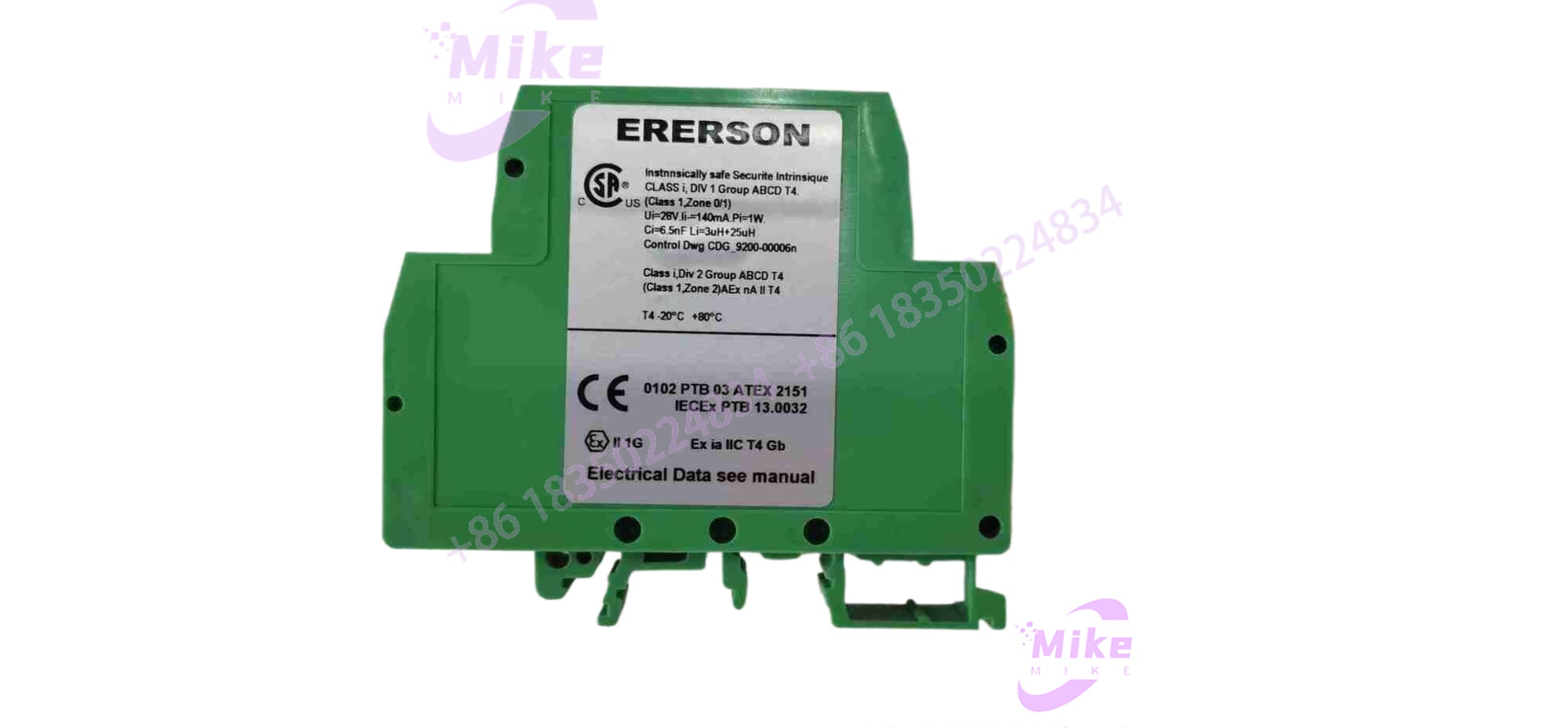
CON041
Key Technical Specifications
| Core Parameter | Technical Specification |
| Product Model | CON041 (Epro Eddy Current Converter) |
| Manufacturer | Emerson / Epro |
| Compatible Probes | PR6422, PR6423, PR6424, PR6425, PR6426 series |
| Dynamic Frequency Range | 0 to 20 kHz (-3 dB) |
| Step Response Rise Time | < 15 microseconds |
| Power Supply Input | -23V to -32V DC (Output Range: -4V to -20V variant) |
| Housing Material | PA 6.6 industrial thermoplastic (~60 grams) |
| Mounting Format | 35 mm DIN-rail mounting configuration |
| Operating Temperature | -30°C to +100°C industrial field threshold |
| Enclosure Protection | IP20 panel housing layout |
Global Sourcing & Live-Test SOP (Transparency Core)
Acquiring legacy vibration monitoring hardware through secondary channels requires an exhaustive verification workflow to guarantee zero calibration drift in safety-critical loops.
- Inbound Verification: Incoming CON041 batches undergo high-magnification optical checks of coaxial connector threads and holographic anti-counterfeit checks against official Epro manufacturing logs.
- Live Simulation: Technicians mount the converter onto a dedicated dynamic test rig paired with a calibrated target simulator and precision micrometer gap adjustment stand.
- Diagnostics: Engineers inject known physical displacement steps, verifying output millivolt-per-mil/millimeter linearity, oscillator frequency stability, and signal rise times across a 24-hour thermal soak.
- Final Prep: Units receive comprehensive calibration logging, protective coaxial terminal caps, and vacuum sealing inside heavy-gauge moisture-barrier ESD bags.
The Field Engineer’s Pitfall Guide
❗ Coaxial Cable Length Mismatch: Altering the integrated or extension coaxial cable length between the probe tip and the CON041 converter without recalibration will instantly skew your zero-gap voltage offset. I’ve seen plant startup windows delayed for hours because a technician swapped a probe extension cable without adjusting the system baseline scale factor.
❗ Improper Grounding Loops: Running signal common lines directly to high-voltage machine earth instead of isolated system grounds will inject severe electromagnetic noise into the dynamic vibration trace. Always verify that shield drains terminate cleanly at the designated safety barrier bus.
❗ Power Supply Voltage Sag: Supplying unstable DC voltage to the converter input will disrupt the internal high-frequency oscillator circuit, manifesting as phantom spikes on your machinery protection monitor. Always check rail stability before commissioning a replacement unit.
Intent-Driven FAQ
Will swapping this converter require a complete probe recalibration?
If you are replacing the electronic converter box while keeping the existing probe and extension cable intact, system calibration is typically preserved assuming the unit matches the exact part number and suffix specifications. However, always verify gap voltage on the rack display during zero speed.
Are these units original factory sealed or surplus stock?
Sourced inventory pools span both original factory-sealed boxes and fully tested, certified surplus hardware. Every single unit undergoes bench-level gap sweeps and frequency response testing prior to dispatch.
Can this converter be used with any manufacturer’s proximity probes?
The is explicitly engineered to match the electrical impedance and high-frequency modulation characteristics of Epro/Emerson proximity sensor lines (such as the PR64xx series). Mixing brands without matching electrical curves will result in severe measurement nonlinearity.
What tools are required to verify the converter output locally?
Field verification requires a high-impedance digital multimeter to check gap DC voltage at the monitor terminals, alongside a portable oscilloscope if inspecting dynamic AC vibration waveforms.
What kind of warranty accompanies a replacement signal converter?
All supplied units carry a comprehensive 1-year operational warranty covering internal oscillator health, linearity accuracy, and connector terminal integrity.
Are you installing this converter into a turbine-generator monitoring rack or replacing a field-mounted unit on a critical compressor skid?





