


Description
EMERSON A6312 | Machinery Health Protection Card, In Stock
Architect’s Product Breakdown
The Emerson A6312 functions as a critical speed, phase, and zero-speed monitoring card within the AMS 6500 machinery protection ecosystem. Deployed on high-value rotating assets such as steam turbines, gas turbines, large compressors, and hydro-turbines, it interfaces with eddy current displacement probes to track shaft RPM, phase reference points (keyphase), and reverse rotation. The module features options for redundant operation, allowing automatic switchover to a backup tachometer input channel without sacrificing phase continuity.
Deploying or servicing the A6312 module requires precise configuration of setpoints, pulse-counting logic, and sensor gap voltages via system software. Because this card operates within safety-critical machinery protection and trip loops, technicians must verify pin alignments, terminal backplane seating, and analog output loop scaling (0/4–20 mA) before clearing the asset for industrial service.
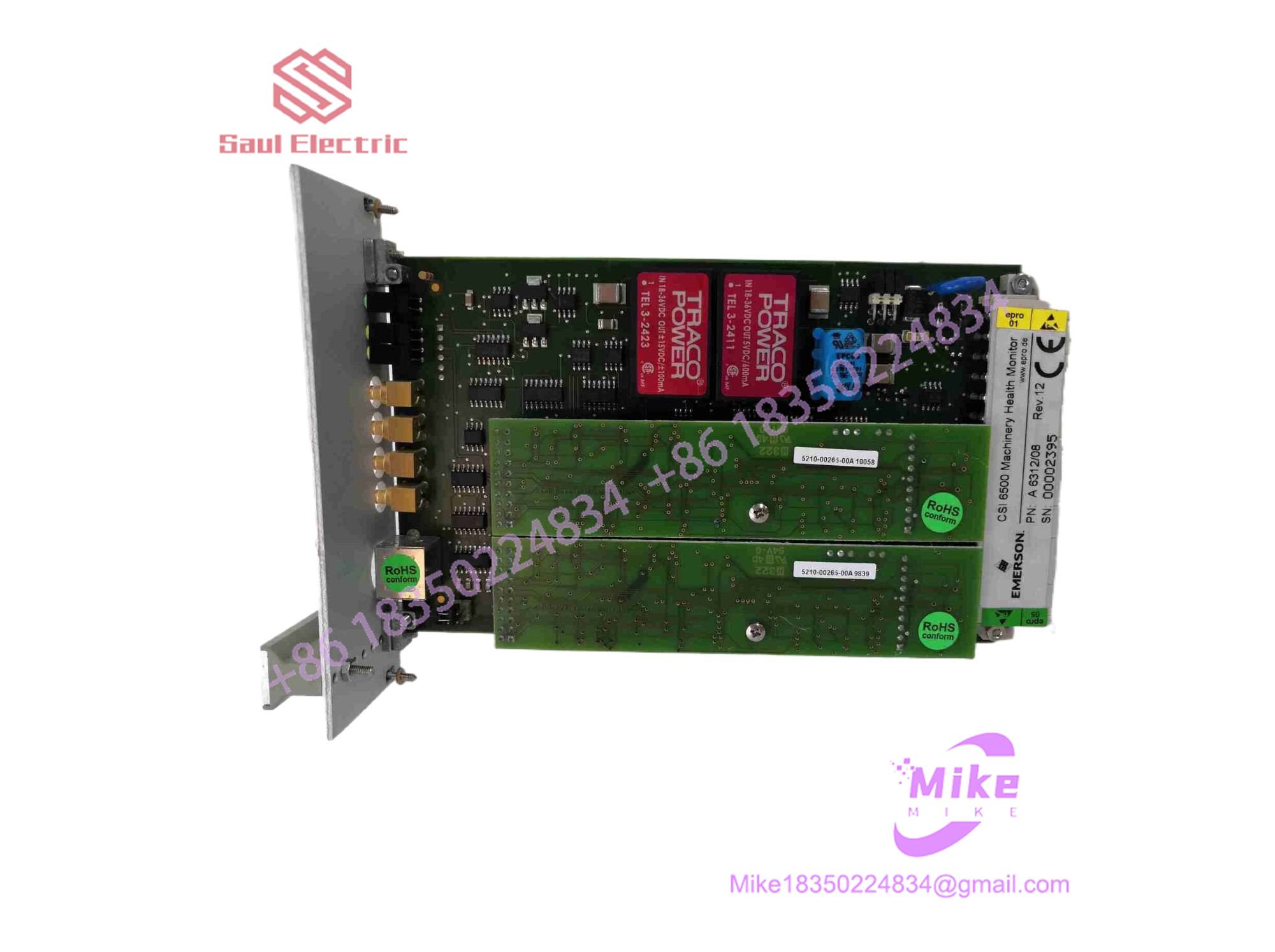
A6312
Key Technical Specifications
| Parameter | Specification |
| Manufacturer | Emerson |
| Part Number | A6312 (A6312/06 variant) |
| Compatible System | Emerson AMS 6500 Machinery Health Monitor Platform |
| Module Type | Speed and Keyphase Protection Card |
| Standard Compliance | API 670 Compliant |
| Form Factor | 3U Eurocard (Single-slot plug-in module) |
| Inputs | Compatible with eddy current displacement sensors & drivers (e.g., CON series) |
| Outputs | Proportional 0/4-20 mA, Front/Rear Buffered Waveform Outs |
| Operating Temperature | 0°C to +65°C (32°F to 149°F) |
Field Engineer’s Pitfall Guide
- Electrostatic Discharge (ESD) Hazards: Warning: The internal surface-mount microprocessors and logic gates on this module are exceptionally sensitive to static charges. Always use a grounded ESD wrist strap and handle the PCB strictly by its extraction handles or board edges.
- Hot-Insertion Misalignment Risks: Do not slide this module into an active rack backplane without checking alignment. Forcing a card at an angle can bend backplane pins or cause voltage transients that trigger false trips on neighboring protection slots.
- Redundant Plane Alignment Oversights: When running the A6312 in redundant tachometer mode, primary and backup sensors must be mounted in the exact same axial plane. Failing to align them physically results in phase discontinuity during an automatic switchover event.
QA & Testing SOP (Transparency)
- Visual & Structural Audit: Incoming cards are inspected under optical magnification for component stress, trace continuity, edge connector wear, and authentic Emerson OEM markings.
- Static Bench & Power Rail Check: Technicians verify internal power supply isolation, bus buffer integrity, and DC rail resistance to guarantee zero internal short circuits.
- Live Rack Simulation Testing: The module is inserted into a certified AMS 6500 test rig, connected to a pulse/signal simulator, and subjected to simulated frequency waveforms to validate dual-channel speed tracking and phase accuracy.
- Relay & Trip Logic Verification: Functional checks are performed to ensure analog outputs, front-panel waveform buffers, and alarm trip relays actuate precisely according to setpoint criteria prior to anti-static sealing.
Technical FAQ
What is the primary function of the Emerson module?
The is a specialized protection card designed to monitor rotational speed, direction of rotation, zero speed, and phase angle (keyphase reference) for critical industrial turbomachinery.
Can the monitor be configured for redundant speed sensing?
Yes. The module supports a redundant configuration where an automatic switchover from a primary to a standby tachometer input occurs smoothly based on gap voltage and pulse counting comparisons.
What causes an input fault or “Not OK” error indication on the front panel?
Common causes include open or shorted proximity probe field wiring, improper sensor gap voltage, loss of rack power rail stability, or an unseated card edge connector.
Is component-level repair recommended for a damaged card?
No. Because safety protection systems demand absolute reliability under strict API 670 guidelines, component-level micro-soldering is discouraged. Full factory-certified module exchange is standard industrial procedure.





