


Description
Emerson 5X00226G02 | Controller I/O Interface Card In Stock
Architect’s Product Breakdown
The Emerson Ovation 5X00226G02 serves as an I/O Interface Control (IOIC) module within the Ovation controller subsystem. Positioned directly in the controller base chassis alongside the main OCR CPU cards, the 5X00226G02 acts as the high-speed gateway between the controller’s central logic execution engine and the distributed local I/O base assemblies. It serializes and routes real-time process data across local I/O branches, managing deterministic scan intervals for connected analog, digital, and specialty cards.
In critical process architectures, backplane throughput and timing jitter determine system stability. The 5X00226G02 hardware variant incorporates dedicated bus arbitration and hardware error-checking logic. By offloading I/O driver handshakes and cyclic redundancy checks (CRC) from the main CPU, it ensures that high-density I/O drops (such as turbine control or boiler fuel management systems) maintain consistent sub-millisecond execution loops without CPU starvation.
During system expansions or emergency drop maintenance, matching the exact 5X00226G02 hardware revision is critical to maintaining backplane timing margin. Inserting an incompatible or older revision of the IOIC card can cause branch-level communication dropouts, resulting in unexpected “I/O Bus Fault” alarms or forced controller switchovers. Swapping in a verified 5X00226G02 module guarantees seamless bus synchronization across all active local I/O branches without requiring software rebuilds in Developer Studio.
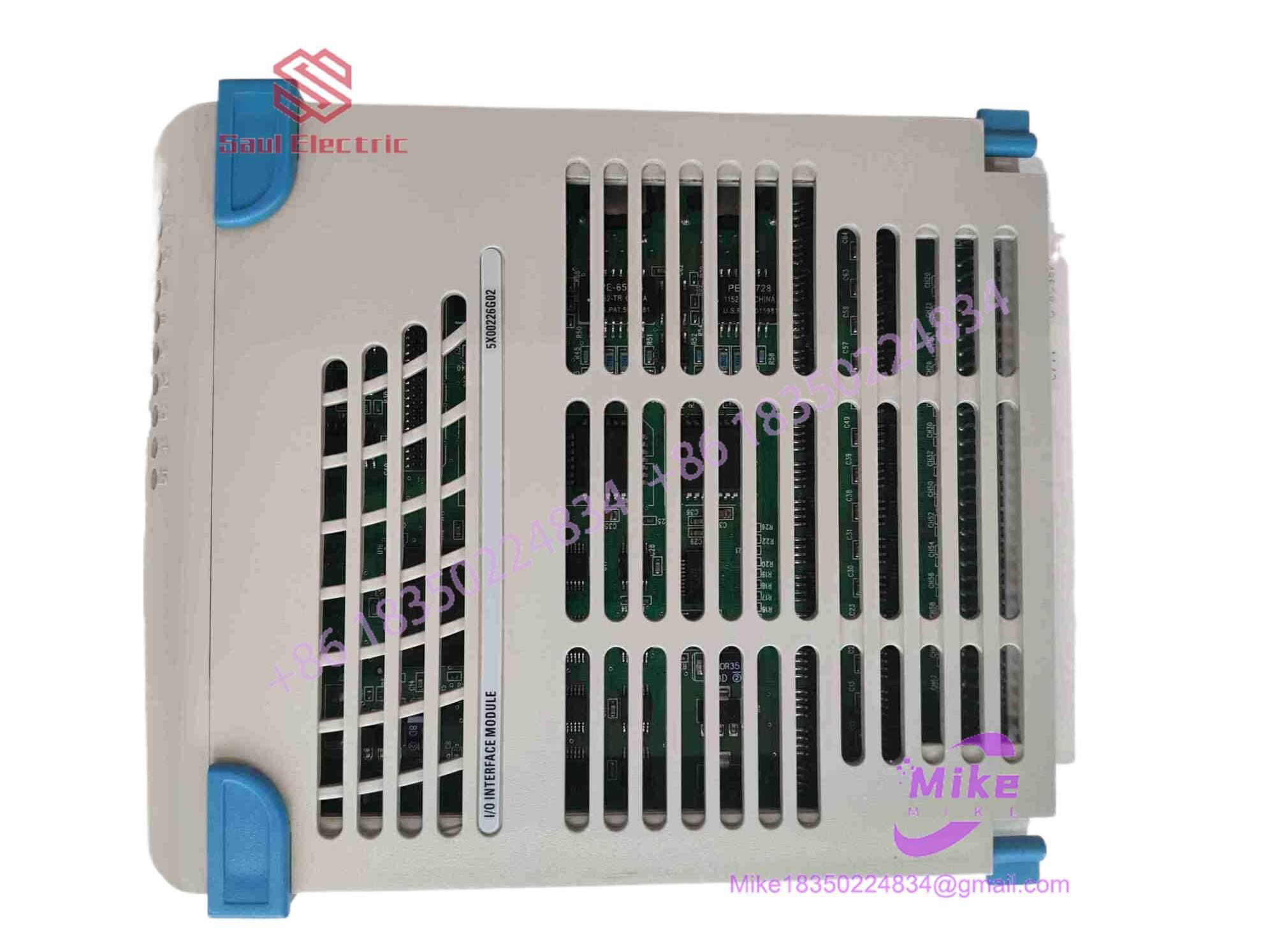
5X00226G02
Key Technical Specifications
| Parameter | Specification / Value |
| Component Type | Controller I/O Interface Module (IOIC) |
| System Architecture | Emerson Ovation OCR Series Controllers |
| Backplane Interface | CompactPCI Local Bus Interconnect |
| Supported Branches | Multi-branch local I/O expansion support |
| Error Handling | Onboard hardware parity & bus transaction timeout checks |
| Backplane Power Supply | 5 VDC / 24 VDC (routed through controller base chassis) |
| Power Dissipation | ~4.5 Watts maximum |
| Operating Temperature | 0°C to +60°C (32°F to 140°F) |
| Storage Temperature | -40°C to +85°C (-40°F to 185°F) |
| Humidity Range | 5% to 95% non-condensing |
Field Engineer’s Pitfall Guide
WARNING: Live Extraction Causes Drop Trip
Never pull the 5X00226G02 IOIC module while the local controller drop is actively controlling the process. Because this card drives the communication bus for entire branches of local I/O cards, removing it instantly severs the controller’s link to all downstream I/O on those branches, driving all field outputs to their fail-safe states and triggering a master controller drop fault.
WARNING: Branch Ribbon Cable Termination Integrity
I’ve seen I&C teams spend hours troubleshooting intermittent I/O bus errors after replacing a 5X00226G02 card, only to find the root cause was a loose or damaged branch cable connector. The high-speed parallel/serial signals traversing the local I/O branch cables are extremely sensitive to bad shield terminations or bent connector pins. When re-attaching branch cables to the IOIC interface, ensure the strain-relief latches are fully clicked into place and that cable shields are bonded properly to prevent EMI coupling from nearby VFDs.
WARNING: Redundant Controller IOIC Revision Sync
In redundant Ovation controller drops (Drop A and Drop B), both drops must run identical IOIC hardware revisions. Installing a 5X00226G02 in Drop A while leaving an older revision (such as a G01) in Drop B can lead to subtle memory transfer timing differences during high-speed tracking sync, causing bumpless failover sequences to fail when an active drop swap occurs.
QA & Testing SOP
Every 5X00226G02 IOIC module completes a 4-stage technical verification prior to release:
- Physical & Gold-Finger Inspection: High-magnification audit of CompactPCI bus connectors, surface-mount components, PCB ground planes, and original OEM serial tags.
- Backplane Bus Diagnostic: Installed into an active Ovation OCR controller chassis. Logic rail voltages, onboard clocks, and bus transceiver handshakes are validated during initial controller boot.
- Full Branch Communication Stress Test: The card is connected to a multi-branch test rack populated with active I/O modules. Deterministic cyclic reads/writes are performed under max-throughput traffic to verify zero dropped packets or parity errors.
- Thermal Stability & Static-Shield Packaging: Tested under continuous load in an elevated thermal environment, cleaned with anti-static ESD protocols, and sealed in static-shielding wrap with connector edge guards.
Technical FAQ
What is the primary difference between a CPU card and the 5X00226G02 IOIC card?
The CPU card executes the application control logic (graphics, function blocks, algorithms), while the 5X00226G02 IOIC card acts as the specialized hardware bridge that manages physical data transport between the CPU and the downstream I/O base modules across local branches.
Does the 5X00226G02 card require firmware flashing upon installation?
Generally, no separate firmware flashing is required for a like-for-like hardware replacement. The module’s base firmware resides onboard, and operational communication parameters are initialized dynamically by the Ovation Controller CPU upon drop boot up.
Why is the “I/O BUS FAULT” LED illuminated on the module front panel?
An illuminated I/O Bus Fault LED indicates a loss of communication or a high error rate on one of the connected I/O branches. First, check that all downstream local I/O base assemblies are powered on. Second, inspect branch interconnect cables for loose seating or damage. If all field cables are fine, the onboard bus driver transceiver may have sustained a surge and requires module replacement.
Can I mix different hardware revisions of the IOIC module on non-redundant drops?
On standalone, non-redundant drops, a 5X00226G02 can usually replace earlier hardware revisions without issue. However, you should always consult your specific Ovation system release notes to verify that your controller software version supports the G02 hardware revision’s timing parameters.





