Description
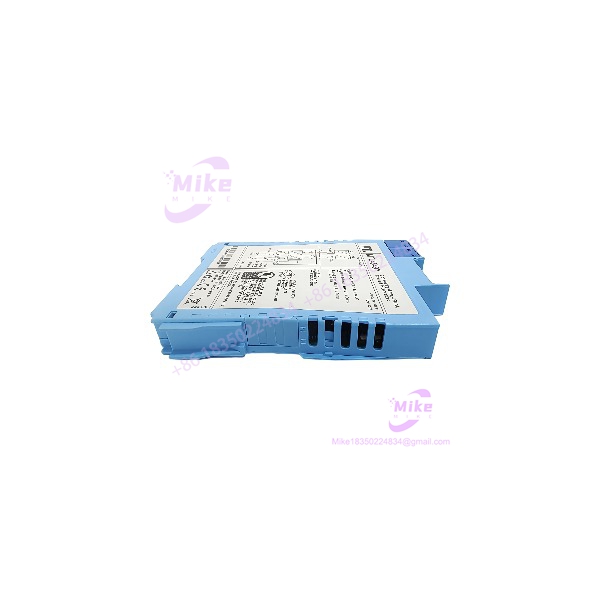
Eaton MTL4549Y | 2-Channel Isolating Driver, 4-20mA HART
Architect’s Product Breakdown
The Eaton MTL4549Y is a specialized two-channel isolating driver built to power and control 4-20mA smart instruments—such as valve positioners and current-to-pressure (I/P) converters—situated in hazardous zones. It guarantees galvanic isolation between the safe-area control system and the hazardous-area field device while fully transparently passing bidirectional digital HART communication overlays.
The “Y” suffix designation indicates a specific variant of the open-circuit line fault detection (LFD) architecture, driving the line fault current drop down to below 0.5mA during an open-circuit fault state. When specifying or replacing this module, always verify that your control system card’s fault configuration matches this exact threshold to prevent false alarms or missed loop diagnostics.
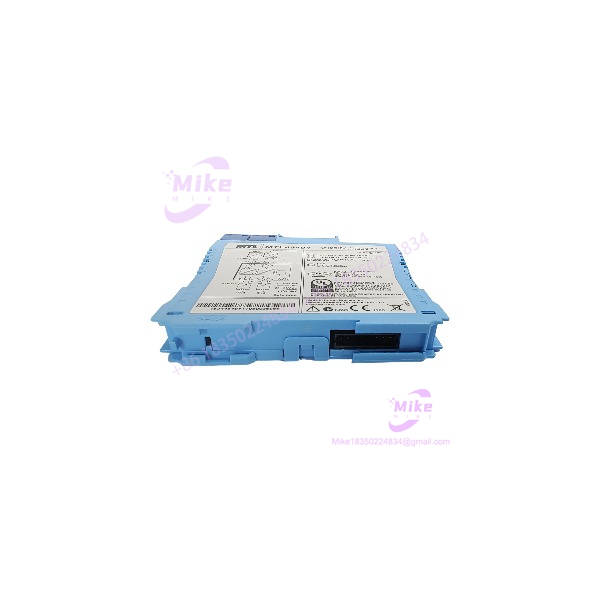
MTL4549Y
Key Technical Specifications
| Parameter | Specification |
| Number of Channels | Two channels |
| Input Signal | 4 to 20 mA floating or grounded from safe area |
| Hazardous Area Output | 4 to 20 mA for smart I/P converters (Zone 0, 1, or 2) |
| HART Communication | Bidirectional (500 Hz to 10 kHz) |
| Line Fault Detection (LFD) | Open-circuit detection only (< 0.5mA fault state) |
| Bus Power Supply | 20V to 35V DC |
| Ambient Temperature Range | -20°C to +60°C |
| SIL Capability | SIL 2 capable per IEC 61508 |
| Mounting | MTL4500 backplane mounting |
Field Engineer’s Pitfall Guide
- WARNING: LFD Threshold Configuration Mismatch. The “Y” suffix routes an open-circuit fault state down to < 0.5mA. If your DCS analog input card expects the standard < 0.9mA drop of a regular model, your system may misinterpret the fault limits or fail to annunciate an open field wire.
- WARNING: Backplane Pin Alignment. Never force the module onto the backplane bus if alignment guides are slightly askew. Forcing the connector will bend gold pins and ruin the slot.
- WARNING: Loop Resistance Boundaries. Ensure total loop resistance stays under the 800-ohm maximum drive capacity threshold. Exceeding this limit distorts HART communication packets and causes positioner signal attenuation.
QA & Testing SOP
- Visual & Origin Verification: Inspect the molded housing for structural flaws, verify OEM traceability laser markings, and ensure gold edge connector pins are unblemished.
- Backplane Bench Test: Seat the module onto an active test backplane powered by a regulated 24V DC supply to confirm clean power LED indicators.
- Current Loop Calibration: Inject a 4mA to 20mA signal into the safe-area terminals via a process calibrator and measure hazardous-side output current for strict linearity.
- HART and LFD Verification: Test bidirectional communication pass-through and induce an open-circuit condition to validate that the output current drops below the 0.5mA threshold.
- Packaging: Seal inside a static-shielding bag and pack with high-density anti-static foam cushioning.
Technical FAQ
Can I hot-swap this isolating driver while the process loop is live?
Yes. The MTL4500 backplane design allows safe hot-swapping without disconnecting field wiring or powering down the entire rack.
What is the precise difference between the MTL4549C and the MTL4549Y?
While both models provide open-circuit line fault detection only (omitting short-circuit detection), the MTL4549Y drives the open-circuit fault state down below 0.5mA compared to < 0.9mA on the C variant.
Does this barrier supply power to the field instrument?
Yes. It acts as an isolating driver that energizes the 4-20mA loop for smart positioners and I/P converters located in the hazardous area.
Is configuration software required to install this hardware?
No software is required; the module operates transparently as a galvanic isolator and signal repeater, though field devices connected downstream may require individual HART configuration.