


Description
B&R 8MSA4S.R0-31 | AC Servo Motor High Dynamic 3000 RPM
Dynamic Product Introduction
When designing tight-envelope automated cells, finding a motor with low rotor inertia and a compact overall body length is essential. B&R engineered the 8MSA4S.R0-31 specifically to deliver high dynamic acceleration where space is at a premium. By combining the wide mounting footprint of a Size 4 frame (~105mm flange) with a short rotor stack length (“S” variant), this motor maintains high torsional rigidity while keeping overall casing length down to ~150 mm.
The unit delivers roughly 1.80 Nm of continuous stall torque at a nominal speed of 3000 RPM. Its analog resolver (R0) feedback architecture makes it an ideal workhorse for high-vibration applications like flying shears, labeling heads, and diverter gates. Unlike delicate glass-disk encoders, the electromagnetic resolver handles mechanical shock and elevated ambient operating temperatures without signal degradation.
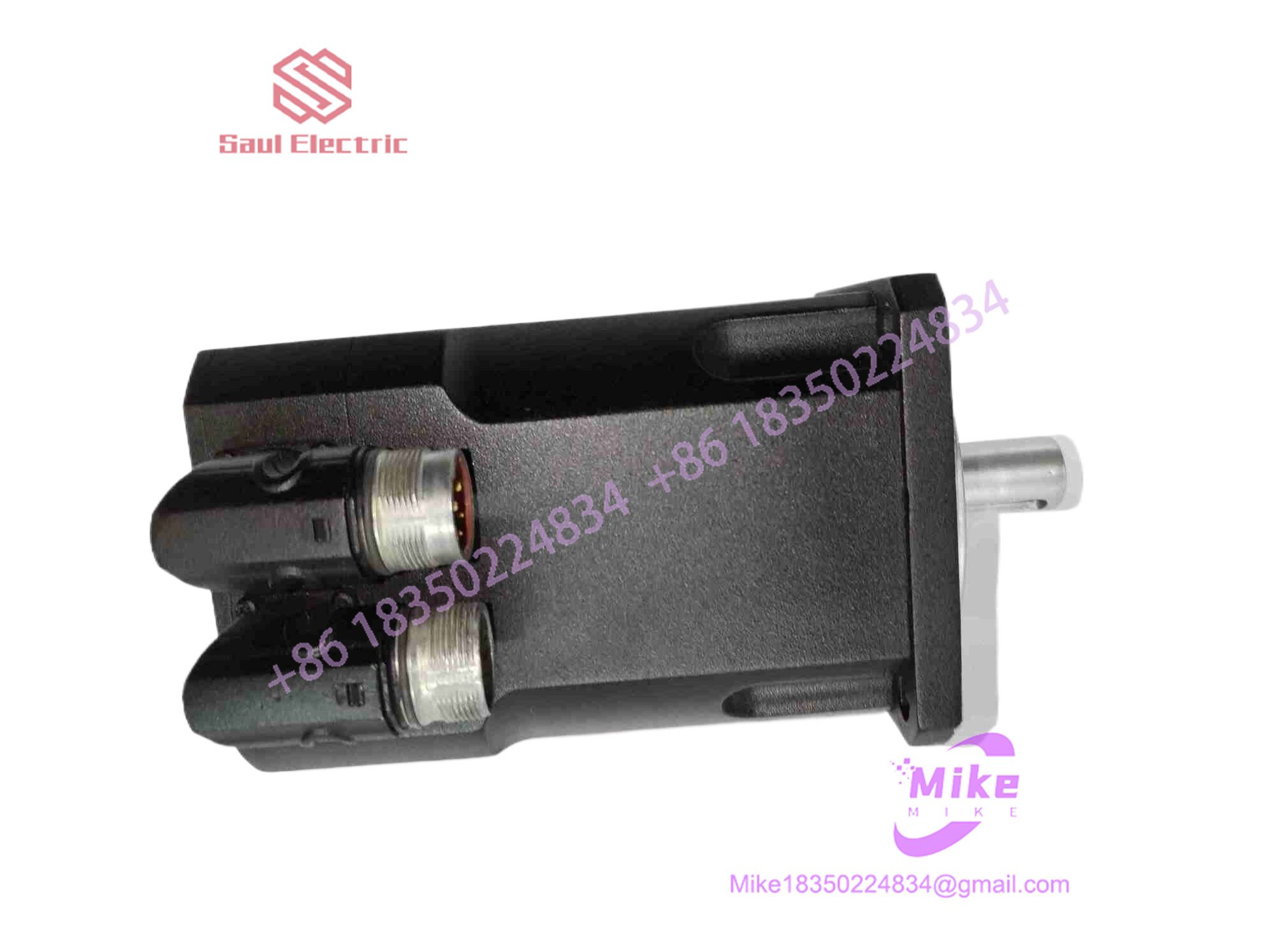
8MSA4S.R0-31
Key Technical Specifications
| Parameter | Specification | Field Note / Operational Limit |
| Rated Speed | 3000 RPM | Nominal operating velocity under 400/480 VAC bus supply |
| Stall Torque (M_0) | ~1.80 Nm | Continuous static torque rating (\Delta T = 100 K) |
| Peak Torque (M_{\max}) | ~7.20 Nm | Maximum short-duration acceleration burst |
| Feedback System | Analog Resolver (R0 Variant) | Heavy-duty electromagnetic feedback with high shock/vibration tolerance |
| Flange Dimensions | Size 4 (~105mm Flange) | Wide mounting pattern for rigid frame mounting |
| Overall Length (K_0) | ~150 mm | Compact short-stack enclosure footprint |
| Protection Rating | IP65 Standard | Dust-tight and resistant to splashing liquids (fitted shaft seal ring) |
| Connection Standard | Dual SpeedTEC / Intercontec | 90-degree rotatable circular quick-lock connectors |
| Cooling Method | Natural Convection | Minimum 30mm clearance required on all sides for air circulation |
| Thermal Protection | Integrated Thermal Sensor | Direct thermal monitoring via the resolver connection loop |
Global Sourcing & Live-Test SOP (Transparency Core)
Sourcing surplus or replacement servo motors requires rigorous quality checks—installing a unit with degraded resolver bobbins or bearing race pitting leads to positioning jitter under dynamic loads. Every unit undergoes our complete verification workflow before shipping:
- Inbound Mechanical Inspection:
We mount the motor on a precision test block and check radial and axial shaft runout using digital dial indicators (<0.015mm tolerance). Serial numbers are cross-referenced with original B&R factory build databases.
- ACOPOS Bench Simulation Setup:
The unit is interfaced with an authentic ACOPOS servo drive controlled by B&R Automation Studio.
- Diagnostic Test Routine:
- Resolver Phase Handshake: Oscilloscope captures verify zero signal distortion across carrier waves and confirm 360^\circ transformation accuracy.
- Full-Speed Dynamic Test: A continuous 3-hour velocity profiling cycle reaching 3000 RPM monitors thermal stabilization, acoustic bearing signatures, and current consumption.
- Dielectric Megger Test: A 1000V DC surge test across phase-to-phase and phase-to-ground guarantees complete stator insulation integrity.
- Final ESD Packaging:
The shaft extension is coated with anti-rust protection and capped. The entire assembly is sealed in anti-static wrap and cradled in custom high-density foam packaging.
The Field Engineer’s Pitfall Guide
- ❗ Resolver Null-Point Offset Errors from End-Cap Tampering:
Never loosen or adjust the rear end-cap assembly on an
R0motor variant. On B&R motors, the physical alignment of the resolver stator relative to the rotor’s magnetic poles is factory-pinned. Shifting the resolver body even by a fraction of a millimeter alters the commutation angle, causing the ACOPOS drive to draw massive current spikes or throwCommutation Angle Error 9005immediately upon enabling power. - ❗ Forcing Connector Rotation Under Cable Strain:
While the SpeedTEC right-angle circular connectors swivel for flexible cable routing, attempting to turn the connector housing while the mating cable plug is locked down will twist and shear internal stator lead wires. Always unlock and remove the mating cable plug completely before adjusting the connector orientation.
- ❗ Shaft Coupling Damage from Direct Mechanical Impact:
Hammering gear couplings or timing pulleys onto the precision-ground shaft extension will collapse internal ball bearing races and fracture the resolver winding bobbin positioned directly behind the rear bearing. Always draw couplings on smoothly using a threaded puller tool anchored in the shaft’s tapped center hole.
Intent-Driven FAQ
What is the main difference between 8MSA4S, 8MSA4M, and 8MSA4L motors?
All three belong to B&R’s Size 4 frame family (~105mm flange), but they differ in rotor stack length and continuous stall torque:
- 8MSA4S (Short Stack): ~1.80 Nm torque, shortest body length (~150 mm), lowest rotor inertia.
- 8MSA4M (Medium Stack): ~5.30 Nm torque, mid-length body (~185 mm).
- 8MSA4L (Long Stack): ~3.20–8.0 Nm torque (depending on winding), longest body length (~220 mm).
Will my ACOPOS drive automatically recognize this motor model?
Yes. If your Automation Studio project includes standard B&R motor database entries, selecting 8MSA4S.R0-31 automatically imports matching current limits, resolver excitation frequencies, and velocity loop parameters.
Can I replace an 8MSA4S.R0-31 with an optical encoder motor like an 8MSA4S.E0 series?
Not without modifying your drive configuration and cabling. Optical EnDat encoders (E0) require digital serial data communication lines and a different pinout configuration at the ACOPOS drive compared to analog resolver excitation channels. Your Automation Studio project hardware tree must match the exact feedback variant installed.
What should I check if Automation Studio throws a motor overtemperature error upon installation?
First, check the feedback cable connection. The motor’s internal thermal sensor signal routes through dedicated pins inside the resolver connector. An unseated connector or pushed-back pin creates an open circuit, which the drive interprets as an extreme thermal fault above 150^\circC.
How can I confirm if a replacement 8MSA4S motor is factory unused?
Inspect the mounting flange face, shaft keyway, and gold connector pins. Unused factory-sealed stock exhibits zero bolt compression rings or paint scraping around the flange holes, unmarred shaft surfaces, pristine gold connector pins without insertion tracking, and original protective caps intact over the shaft extension and electrical connectors.





