


Description
PFSK152 (material number 3BSE018877R2, with versions 3BSE018877R1 and 3BSC780006R361) is a signal concentrator board in ABB industrial automation systems. Its core function is to aggregate, condition, and convert analog and digital signals from multiple sensors, switches, and transmitters on site, and transmit them to the upper controller for unified processing. It is a signal junction node in the system I/O layer.
core positioning
The module itself does not execute control algorithms, nor does it output control instructions. It is a printed circuit board installed on DIN rails or rack panels inside the control cabinet, serving as an intermediate junction layer between the on-site signal source and ABB controllers (such as AC 800M, Advant OCS, System 800xA, etc.). Its core value lies in three things: firstly, concentrating multiple signals scattered throughout the site onto one board to reduce wiring complexity; Secondly, filter, amplify, and A/D convert analog signals, and perform optoelectronic isolation and shaping on digital signals; Thirdly, provide a unified communication interface to upload the processed data to the controller.
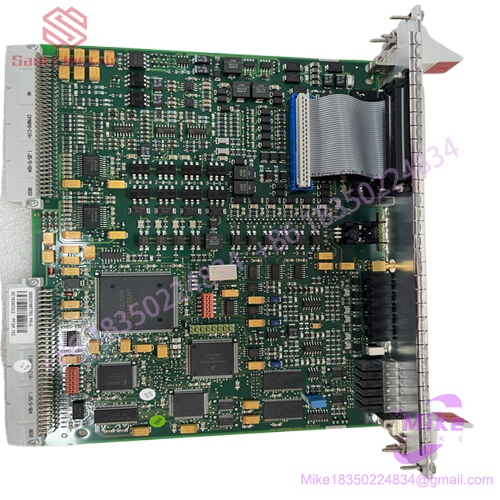
PFSK152 3BSE018877R2 ABB Signal concentrator board
I/O channel configuration
Digital output: Provides 16 digital output channels, with transistor output as the output type and mechanical insulation as the isolation method. The response time is less than 10ms, with a rated output voltage of DC 24V and a rated output current of 5A/point. It can directly drive on-site actuators such as solenoid valves, indicator lights, and alarms.
Digital input: Provides multiple digital input channels, supports 24V DC level dry or wet contact signal access, each input has photoelectric isolation, supports SOE (sequence of events recording) timestamp function, and meets the requirements of process industry for fault tracing. It can monitor the status changes of discrete signals such as switches, buttons, and relay contacts, and each channel can be programmed to configure functions and response conditions.
Analog input: Provides 4 channels of analog input, with a resolution of 12 bits, supporting 4-20mA or 0-10V signal types, and can be connected to field instruments such as temperature transmitters, pressure transmitters, and flow meters.
Signal processing capability
The module completes the filtering, amplification, isolation, and A/D conversion of various input signals internally, and outputs clean signals that have been conditioned for use by the controller. Supports mixed processing of analog and digital signals, enabling filtering, amplification, conversion, and other operations to meet the signal quality requirements of complex control systems. Simultaneously equipped with data collection, monitoring, and fault diagnosis functions, it can display the real-time working status of each channel through onboard LED indicator lights.
Communication and Electrical Characteristics
Communicating with the upper controller through the system bus, it supports the dedicated communication protocol of ABB automation system and is also compatible with standard industrial protocols such as Modbus TCP, Ethernet/IP, and can be integrated with third-party systems. The working power supply is 24V DC, and the module achieves electrical isolation of not less than 2.5kV between the field side and the system side, with overvoltage protection (OVP), undervoltage protection (UVP), overcurrent protection (OCP), and surge protection. Automatically detect the electrical ID of the module when powered on, and refuse to enter the running state when it does not match the system configuration.
Physical specifications
Weighing approximately 0.5kg, it adopts a modular printed circuit board design, with DIN rail installation or control cabinet panel installation. The working temperature range is -10 ° C to+50 ° C (some versions have a nominal range of -40 ° C to+85 ° C), with a protection level of IP20, meeting the installation requirements inside the control cabinet. Supports hot swapping and can be replaced without interrupting signal acquisition when the system is powered on.
Typical Applications
Mainly used for auxiliary system monitoring of thermal power, hydropower, and gas turbines in the power industry, valve and pump control in the petrochemical industry, pump station automation in water treatment, transmission control in the metallurgical industry, as well as production lines and building automation in the manufacturing industry. In the brownfield renovation project, PFSK152 can serve as a signal collection node, integrating scattered I/O signals from old sites into the new generation ABB control system without the need to replace on-site instruments one by one, significantly reducing renovation costs. Sharing a unified engineering configuration environment with modules of the same series such as PFSK151, PFSK142, PFSK160A, PFSK162, PFSK164, PFSK130, and PFSK165 allows for mixed deployment within the same cabinet.





