


Description
LDMUI-01 ABB 61320946C I / O module
Introduction to ABB LDMU-01 61320946C I/O Module
ABB LDMU-01 61320946C is a multifunctional I/O module in ABB’s industrial automation product line, belonging to the LDMUI series (with variants such as LDMU-01A in the same series). Its core function is to establish electrical isolation signal channels between DCS controllers and field sensors and actuators, while also undertaking analog output and power management functions. It is a standard I/O node for traditional control platforms such as ABB AC800M DCS, Bailey INFI 90, Advant OCS, and is widely used in a large number of old DCS projects still in service.
core positioning
The module itself does not execute control logic, nor does it collect primary side electrical quantities. Instead, it exists as an intelligent I/O node that integrates “signal conversion+electrical isolation+power distribution” – receiving digital instructions from the DCS controller, outputting standard analog signals after internal D/A conversion to drive on-site actuators (such as regulating valves and frequency converters); Simultaneously collect simulated signals from on-site sensors and transmit them back to DCS. The core difference from ordinary I/O modules is that it has built-in current source analog output capability, which can directly drive 4-20mA circuits without the need for external signal conditioners; Simultaneously providing multiple digital I/O and communication interfaces, one card can complete the tasks of signal acquisition, output, and communication. In some application scenarios, it also assumes the function of power distribution, providing stable 24V DC power to adjacent I/O modules.
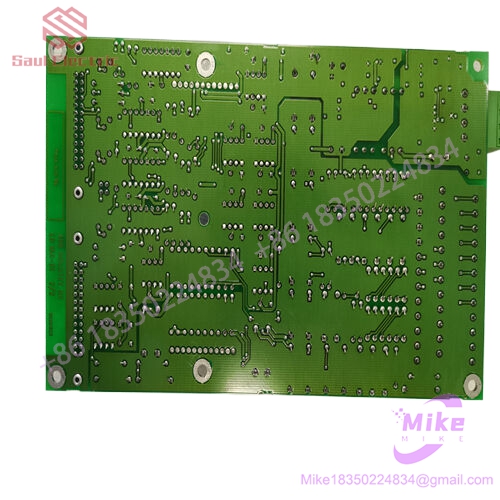
LDMUI-01 ABB 61320946C I / O module
Basic Parameters
Material number: LDMUI-01/LDMUI-01A/61320946C (three model suffixes correspond to different configuration versions of the same hardware platform)
Model: LDMUI-01 (61320946C)
Type: Multi functional I/O module/current source analog output module
System: ABB AC800M DCS, Bailey INFI 90, Advance OCS, Symphony Plus
Digital I/O: Multiple digital inputs (DI)+digital outputs (DO), the specific number of channels depends on the configuration
Analog I/O: Current source analog output (4-20mA), analog input (0-10V/4-20mA optional)
Communication interfaces: Modbus RTU/TCP, Profibus DP, RS-232, RS-485, multi protocol onboard
Working voltage: 24V DC (supports wide range input from 21.6V to 31.2V)
Signal range: Analog output 4-20mA; Analog input 0-10V/4-20mA; Digital signal 24V DC
Electrical isolation: ≥ 1500V rms isolation between I/O channel and system side
Protection level: IP20 (installed inside the control cabinet), some configurations can reach IP65
Working temperature: -20 ° C to+60 ° C (some data indicate -20 ° C to+70 ° C)
Storage temperature: -40 ° C to+85 ° C
Installation method: DIN rail installation, compatible with ABB standard I/O subrack
Cooling method: Natural cooling (passive heat dissipation, fanless)
Size: Approximately 100mm x 100mm x 50mm (standard module size, slightly different depending on version)
Weight: Approximately 0.3kg to 0.5kg
Main functional features
Current source analog output: Equipped with a high-precision D/A converter, it can directly output 4-20mA current signals to drive on-site actuators (such as regulating valves and variable frequency drives), with high output accuracy and small long-term drift, without the need for external signal conditioners or isolation amplifiers, reducing the number of on-site wiring and spare parts. This is the core difference from ordinary voltage output modules (0-10V) – current signals are not affected by line resistance during long-distance transmission, making them suitable for scenarios where field instruments are far away from control cabinets.
Multi protocol native communication: onboard Modbus RTU/TCP, Profibus DP, RS-232/RS-485 multiple communication interfaces, can communicate with field devices of different protocols such as DCS controllers, smart meters, and frequency converters simultaneously. Compared to the basic version, the LDMUI-01A version has added an Ethernet port that can directly connect to Modbus TCP networks without the need for an additional protocol conversion gateway.
High level electrical isolation: The I/O channel is isolated from the system side by ≥ 1500V rms, and the on-site side is completely isolated from the system side. It can effectively block the impact of on-site grounding circuits and high-frequency transients on DCS controllers, and is suitable for power plants and heavy industry sites with strong interference.
Digital I/O integration: Provides multiple digital inputs (collecting switch values, relay status) and digital outputs (driving solenoid valves, alarm lights). All digital channels are electrically isolated and can directly switch AC/DC loads without the need for additional intermediate relays.
Power management and distribution: Under some configurations, 24V DC power distribution can be provided for adjacent I/O modules, with built-in overvoltage protection, overcurrent protection, and undervoltage protection functions to ensure system power stability. The rated output current can reach 40A (power configuration version), meeting the requirements of multi module cascade power supply.
Parameterized configuration: Supports online configuration of I/O channels, filtering time, communication parameters, and output range through ABB dedicated industrial control software (such as Advant OCS Configurator, Symphony I/O Configurator), with real-time configuration taking effect and reducing downtime for debugging.
Status indication: Equipped with LED status indicator lights, it displays TX/RX communication activity, I/O channel status, and power status, providing intuitive on-site diagnostic feedback, making it easy to quickly determine whether it is a module side problem or a line side problem.
Start self check: Automatically check the electrical ID of the module when powered on, and do not enter the running state when it does not match the DCS configuration, to prevent signal errors or control failures caused by mismatches.
Hot swappable support: Supports replacement when the DCS I/O subrack is powered on, and maintenance can be completed without cutting off the system power supply, reducing the risk of downtime.
Comparison with products in the same series
LDMUI-01A (61320946C): The current mainstream version adds Ethernet ports and more digital I/O channels, supports Modbus TCP, and is suitable for scenarios that require access to upper level SCADA systems.
LDMU-001 (early version 61320946C): Basic version, only supports RS-232/RS-485, without Ethernet, with fewer digital channels, suitable for old projects that do not require network communication for renovation, and has extremely high compatibility with spare parts.
LDMUI-02 (high-end version of the same series): Doubling the number of channels, supporting more analog output channels, suitable for process control scenarios that require a large amount of analog output (such as multi loop PID regulation), with a wider structure and greater installation space requirements.
ACQ810 (3AUA0000127586): ABB frequency converter, a completely different product line from LDMUI-01. LDMUI-01 can be used as a given signal source for ACQ810, and the two are used in combination.
TC520 (3BSE001449R1): ABB universal I/O module with similar functionality to LDMUI-01, but TC520 is designed for a wider range of DCS platforms (including 800xA), while LDMUI-01 is specifically designed for AC800M/INFI 90/Symphony, with higher native integration in these older platforms.
CI858-1 (3BSE018137R1): Advant Controller series Ethernet communication module, only provides communication function, does not have the analog output and digital I/O capabilities of LDMUI-01, and needs to be used in conjunction with CPU. LDMUI-01 integrates “I/O+communication” and can run independently.
Typical application scenarios
Power industry: The analog output node of the generator set DCS, the reference signal for the drive governor and excitation regulator, and the electrical isolation function protect the DCS from the transient effects of high-power equipment switches.
Chemical industry: Analog signal acquisition and output of reaction kettle temperature, pressure, and flow rate, 4-20mA current output directly drives the regulating valve, and long-distance transmission is not affected by line resistance.
Metallurgical industry: I/O expansion of auxiliary equipment for rolling mills and continuous casting machines, digital input collection of limit switches and sensor status, digital output driving solenoid valves and alarm lights.
Water treatment: The DCS I/O node of the variable frequency water supply system in the pump station simulates input to collect water level and flow signals, and simulates output with a given variable frequency drive speed. It is equipped with an IP65 configuration to adapt to humid environments.
Oil and gas: Serial data exchange between SCADA system and on-site RTUs, intelligent instruments, multi protocol support for simultaneous access to instruments from different manufacturers, wide voltage power supply suitable for diverse power supply environments on site.





