


Description
Introduction to ABB DSTD150A 5716001-UH Communication Interface Module (TCM Card)
ABB DSTD150A 5716001-UH is a Terminal Communication Module (TCM card) in the ABB Advance Master/Symphony Plus distributed control system. It serves as a communication bridge between the main controller, remote I/O stations, and field devices in the DCS architecture, and is the core communication component for data exchange between the system and external devices.
core positioning
The module itself does not collect on-site switch or analog signals, nor does it directly drive the actuator. Instead, it exists as a “communication processor” – converting the control data sent by the main controller (such as DSPC170 CPU) into a communication format recognizable by remote devices, and transmitting the on-site data collected by the remote I/O station back to the main controller. It is a key interface layer component in the Symphony Plus system that enables reliable communication between the main station and remote I/O stations.
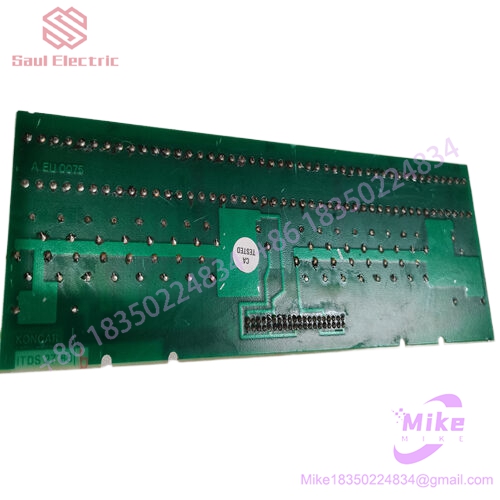
DSTD150A 57160001-UH ABB CONNECTION UNIT
Basic Parameters
Material Number: 57160001-UH (/1 is a specific revised version)
Model: DSTD150A
Series: DSTD Series Digital Connection Unit/TCM Communication Card
System: ABB Advance Master/Symphony Plus DCS
Communication interface: Supports asynchronous/synchronous serial communication, compatible with protocols such as Modbus RTU/Modbus TCP, etc
Working voltage: 24V DC
Communication speed: configurable, supporting up to 115200 bps
Electrical isolation: ≥ 1500V isolation between the controller side and the communication port side
Size: Approximately 178mm × 95mm × 96mm (DSTD series standard size)
Weight: Approximately 0.1kg
Working temperature: -20 ° C to+60 ° C
Storage temperature: -40 ° C to+85 ° C
Relative humidity: 5% to 95% (non condensing)
Protection level: IP20, suitable for installation inside control cabinets
Installation method: DIN rail installation/rack mounted installation, using 5.0mm spacing pluggable terminals for easy wiring
Main functional features
Multi protocol communication support: Supports Modbus RTU and Modbus TCP dual protocols, and can set working modes through engineering tools, making it easy to integrate with remote devices and upper systems from different manufacturers and adapt to various industrial communication scenarios.
Communication Control and Scheduling: Responsible for packaging, unpacking, and scheduling management of communication data, using a polling mechanism (where the master station sends requests to the slave stations and receives responses) to ensure timely and accurate signal transmission between the controller and remote I/O stations, meeting the real-time communication requirements of process control.
Electrical isolation: A ≥ 1500V electrical isolation is achieved between the controller side and the communication port side, effectively suppressing the impact of on-site electromagnetic interference on the control system and improving system safety and communication stability.
Status indicator: Equipped with operation indicator light, communication status indicator light, and fault indicator light, it can quickly determine the working status of the module and whether the communication link is normal on site, without the need for additional diagnostic tools.
Signal protection: Built in overvoltage protection, overcurrent protection, and interference suppression circuits can maintain stable communication in industrial environments with strong voltage fluctuations or electromagnetic interference, reducing the risk of communication interruption caused by external abnormalities.
Loop monitoring: supports the detection of communication interruptions, power outages, frame errors, and other anomalies. Fault information can be reported to the main controller through the system bus, making it easy to quickly locate communication faults.
Parameterized configuration: supports parameter configuration through system tools, including communication rate, working mode, etc. The configuration takes effect in real time, reducing downtime for debugging.
Hot plug support: Supports online hot plug replacement, maintenance can be completed without cutting off the system power, reducing the risk of downtime.
Start self check: Automatically check the electrical ID of the module when powered on, and do not enter the running state when it does not match the configuration, to prevent communication abnormalities caused by mismatches.
Comparison with products in the same series
DSTD108 (57160001-ABD/1) is a 16 DI+16 DO digital connection unit that focuses on the acquisition and driving of on-site switch values. It does not have independent communication control capabilities and must be attached to the basic unit. The core positioning of DSTD150A is the “communication interface module”, which does not process on-site I/O signals, but focuses on establishing communication links, protocol conversion, and data scheduling. It is the communication hub between DSTD108 and other I/O modules and the main controller. DSTC190 is an asynchronous communication connection unit, DSTC456 is a communication control card, and the communication focus of the three is different. DSTD150A is irreplaceable in scenarios that require high reliability data exchange with remote I/O stations through fieldbus and flexible protocol adaptation.
Typical application scenarios
Power industry: Communication connection between auxiliary systems of generator sets and remote I/O stations to achieve reliable data exchange between controllers, field transmitters, and actuators.
Chemical industry: Communication bridge between DCS system and remote I/O station, reducing wiring length from site to control room, and integrating third-party devices compatible with Modbus protocol.
Metallurgical industry: Distributed communication deployment of remote I/O stations for equipment such as continuous casting machines and rolling mills.
Water treatment: remote monitoring communication link for pump station and dosing system.
Manufacturing: Remote I/O station control and data acquisition for production line equipment.





