


Description
NDCU-21C (Drive Control Unit) is the core control unit of ABB ACS 600/ACS 6×7 series frequency converters, belonging to the “brain” of MultiDrive modular drive system. It does not directly drive the motor, but serves as a signal processing and command execution hub between the frequency converter power module and the upper control system, responsible for receiving operation instructions, collecting on-site feedback, calculating control algorithms, and issuing PWM drive signals to the power module.
internal structure
The NDCU-21C consists of two circuit boards integrated within a metal shielded enclosure: the NAMC-21 board (Application and Motor Controller) and the NIOC-01 board (Standard Input/Output Board). NAMC-21 is responsible for motor control algorithm calculations (supporting DTC direct torque control and scalar V/F control), while NIOC-01 is responsible for collecting and outputting all on-site I/O signals. The two boards are interconnected through an internal bus and work as an inseparable control unit as a whole.
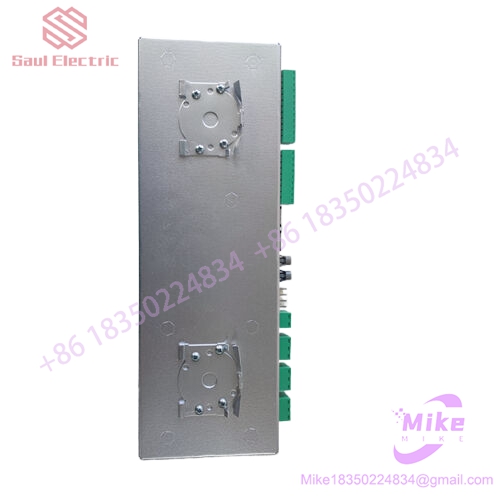
ABB NDCU-21C DRIVE CONTROL UNIT
Analog input channel
There are a total of 3 analog inputs, divided into two groups: 2 programmable differential current inputs, ranging from 0mA/4mA to 20mA, with an input resistance of 100 Ω; 1 programmable differential voltage input, ranging from -10V/0V/2V to+10V, with an input resistance of 200k Ω. All analog input channels are electrically isolated in groups, with an isolation withstand voltage of 500VAC for 1 minute. The maximum common mode voltage between channels is ± 15VDC, and the common mode rejection ratio is greater than 60dB (50Hz). Voltage input resolution is 12 bits (0.025% full scale), current input resolution is 11 bits (0.5% full scale), accuracy is ± 0.5% full scale (25 ° C), and maximum temperature drift is ± 100ppm/° C.
Analog output channel
2-channel analog voltage output, range+10VDC, 0V, -10VDC, accuracy ± 0.5% full scale (25 ° C), maximum temperature drift ± 100ppm/° C, maximum load capacity 10mA, supports external 1k Ω~10k Ω potentiometer adjustment. Can be used to output continuous control variables such as frequency and torque settings.
Digital input channel
6-way digital input (DI1~DI6), 24VDC level, used to receive discrete control signals such as start, stop, forward and reverse, fault reset, and operation mode selection. Each channel can be configured to be effective at high or low levels.
Digital output channel
3 relay outputs, each rated load 200mA, 24VDC, used to drive external contactors, indicator lights, alarm devices, etc.
communication interface
Equipped with RS-485 interface, running DDCS (Drive Data Communication System) protocol to achieve real-time data exchange with the upper controller and parallel frequency converter. Simultaneously supporting fiber optic communication interfaces (V57/V68, PPCS link, speed 10MBd) for high-speed parallel synchronous control between multiple frequency converters.
Electrical characteristics and protection
The working power supply is 24VDC. An electrical isolation of no less than 500VAC is achieved between the analog input group and the system side, effectively blocking the on-site grounding circuit and transient interference. Automatically detect the electrical ID when the module is powered on, and refuse to enter the running state when it does not match the system configuration. Supports hot swapping and can be replaced while the rack is powered on without interrupting system operation. The onboard LED indicator lights display real-time power, communication, I/O status, and fault information.
Physical specifications
Metal casing, installed in the ACS 600 standard I/O rack (compatible with R6i~R12i frames, etc.), fixed by upper and lower fixing points (M6/M8 bolts), equipped with terminal blocks and status indicator lights in the front. The module has low power consumption and a working temperature range of -20 ° C to+70 ° C, meeting the long-term continuous operation requirements of industrial sites.
Typical Applications
NDCU-21C is specifically designed for ACS 600/ACS 6×7 series frequency converters (power range from several hundred watts to several megawatts) to drive various AC motors. Used in the power industry for fans, pumps, and conveyor belts; Used in petrochemical industry for compressors and mixers; Used in the metallurgical industry for rolling mills and lifting mechanisms; Used in water treatment for dosing pumps and aeration fans. DTC control can achieve a torque response time of less than 5ms, meeting the requirements of high dynamic performance.





