

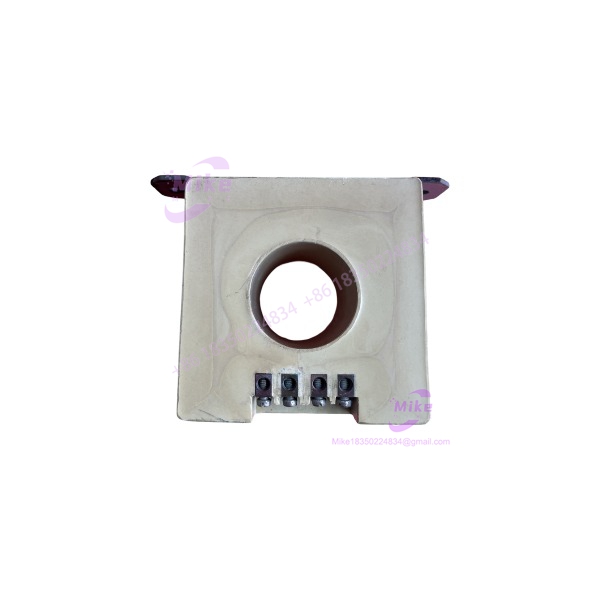
Description
ABB HIER464920P0001 | UNITROL Current Relay
Dynamic Product Introduction
The ABB HIER464920P0001 is a specialized current-detection relay used within ABB excitation and AVR/DVR equipment. Procurement records identify the component as a UNITROL 6000 current relay at position T02, with another record identifying the corresponding current relay as T02.1 and referencing I>40 A. That application context matters: this is not simply an interchangeable industrial relay that can be selected by coil voltage and contact count alone.
ABB’s own product page confirms HIER464920P0001 as an ABB product, while secondary records consistently associate the part with the catalog description “Current Detection” and the long description “CURRENT RELAY, UNS 0017A-P.”
For maintenance teams supporting generator excitation equipment, the practical value is straightforward: retaining the exact ABB identification avoids introducing a relay with different sensing characteristics, switching behavior, mechanical geometry, or terminal arrangement into a protection/control circuit. (That distinction becomes particularly important during a forced outage when an apparently similar relay is being considered as a substitute.)

HIER464920P0001
Key Technical Specifications
- Manufacturer: ABB
- Part Number: HIER464920P0001
- Catalog Description: Current Detection
- Long Description: CURRENT RELAY, UNS 0017A-P
- Component Function: Current detection / current relay
- ABB System Association: UNITROL excitation and AVR/DVR equipment
- UNITROL 6000 Position: Procurement records identify the component as current relay T02; another record specifies T02.1.
- Current Reference: I>40 A is associated with HIER464920P0001 in multiple industrial procurement records. Treat this as an application/reference threshold rather than assuming it is the complete electrical specification of the relay.
- Associated Relay Type: UNS 0017A-P designation appears in ABB-related component records.
- Application Class: Generator excitation, AVR/DVR and power-electronics control
- System Environment: ABB UNITROL equipment
- Exact Coil/Contact Rating: Not sufficiently verified from the available ABB documentation
- Exact Pickup/Dropout Characteristics: Not sufficiently verified
- Exact Terminal/PIN Assignment: Not sufficiently verified
- Exact Mounting Dimensions: Not sufficiently verified from an ABB primary source
- Firmware: Not applicable as a conventional programmable module
- Communication Protocol: None established; this should not be represented as a networked I/O module
ABB’s UNITROL documentation shows that excitation systems contain dedicated measuring interfaces, I/O interfaces, firing units, protection components and other power-electronics hardware, reinforcing the need to identify the complete host system before selecting a substitute.
Global Sourcing & Live-Test SOP
For an ABB HIER464920P0001 intended for critical excitation equipment, receiving inspection should focus on identity and electrical condition before installation.
1. Inbound Verification
- Photograph the complete relay before removing packaging.
- Confirm the identification against the purchase order.
- Record the ABB label, serial information, date code and visible revision markings where present.
- Check the housing for cracks, heat discoloration, corrosion, damaged terminals or evidence of rework.
- Trace OEM paperwork where available, particularly when the part is being sourced through surplus inventory.
- Do not accept an undocumented “equivalent” simply because the seller describes it as a current relay.
2. Electrical Inspection
- Verify terminal condition and mechanical retention.
- Check continuity and contact behavior with an appropriate calibrated meter where the relay’s contact configuration is documented.
- Do not apply an arbitrary test voltage to an unidentified coil or sensing circuit.
- Compare the measured configuration with the original UNITROL cabinet documentation before energization.
3. System Simulation
Where the maintenance procedure permits bench testing, reproduce the relevant current-detection circuit using the original engineering documentation.
- Confirm relay pickup behavior against the documented threshold.
- Check contact-state transitions.
- Verify alarm/protection logic downstream of the relay.
- Confirm that the relay does not chatter near the operating threshold.
4. Heat-Run and Final Preparation
For a refurbished or previously installed unit:
- Perform an extended energized test appropriate to the documented relay circuit.
- Monitor contact stability and temperature.
- Record test results with the serial number.
- Photograph the final tested configuration.
- Seal in ESD-safe packaging where appropriate and protect terminals against mechanical impact.
- Preserve the original configuration documentation with the shipment.
Field Engineer’s Pitfall Guide
❗ Do Not Treat “I>40A” as the Complete Relay Specification
Industrial records associate with an I>40 A current-relay designation, but that does not establish every electrical characteristic of the device. Do not infer coil voltage, contact rating, hysteresis, pickup tolerance or terminal assignment from that one number.
❗ T02/T02.1 Is an Application Reference, Not a Generic Relay Specification
The part is documented as the current relay T02 in UNITROL 6000 procurement information, while other records use T02.1. If the cabinet drawing identifies T02.1, preserve that reference during replacement. Mixing a relay from another protection position can create a wiring or functional mismatch even if the physical device appears similar.
❗ Do Not Substitute by Physical Appearance
A generic current relay may fit the cabinet and still have the wrong sensing threshold, contact arrangement or operating characteristics. For excitation equipment, verify the original ABB BOM, electrical schematic and terminal assignment before approving a replacement. This is especially important during a migration strategy where legacy UNITROL hardware is being retained while surrounding controls are upgraded.
Intent-Driven FAQ
What is ABB ?
ABB is identified as a current-detection/current relay, with the long description “CURRENT RELAY, UNS 0017A-P.” It is associated with ABB excitation equipment rather than being a general-purpose PLC output relay.
Is used in UNITROL 6000?
Yes. An industrial procurement record explicitly identifies as the current relay for an ABB UNITROL 6000 AVR/DVR system, at relay position T02.
What does I>40A mean for this part?
Records associated with the exact part number identify it as I>40A. This should be treated as the documented application/reference threshold, not as permission to assume that 40 A is the relay’s complete continuous-current, contact or sensing specification.
Is this a PLC I/O module?
No. The available evidence identifies as a current relay/current-detection component for ABB excitation equipment. It should not be listed or installed as a conventional PLC digital I/O module.
Can I replace it with another ABB relay?
Not automatically. The replacement should match the original electrical function, sensing characteristics, contact arrangement, mounting and UNITROL application. Verify the cabinet schematic and ABB BOM before approving an alternate part.
Is the part still supported by ABB?
The exact ABB product page exists, but the available public page does not provide enough information to establish current manufacturing status or a current replacement part. For procurement, treat as an exact legacy/service part unless ABB confirms an active successor.
What should I verify before buying a used ?
At minimum, verify the exact marking, physical condition, relay configuration, terminal condition, application position, and available test documentation. For a UNITROL 6000 installation, compare the part against the original cabinet drawing and BOM rather than relying solely on an online seller’s title.
Procurement Description
ABB Current Relay, UNS 0017A-P, associated with ABB UNITROL excitation/AVR-DVR systems. UNITROL 6000 procurement records identify this part as the current relay at T02/T02.1, with I>40 A application notation. Exact electrical ratings and terminal configuration should be verified against the original ABB system documentation before installation.





