


Description
ABB Entrelec 1SNA6842522R0200 ILPH RS232-485 Ethernet Signal Conditioner/Communication Interface Module
[Product Positioning]
1SNA6842522R0200 is a signal conditioner product in the Mini MCR-SL series under ABB Entrelec (formerly ABB Low Voltage Electrical and Automation Division). ILPH is the communication interface configuration version of this model, integrating RS232, RS485, and Ethernet triple communication capabilities. Model interpretation: 1SNA is the prefix for ABB Entrelec products, 684252 is the Mini MCR-SL series code, R0200 is the specific configuration version, and ILPH indicates that this version is equipped with an intelligent communication interface (RS232/RS485/Ethernet). This device integrates analog signal conditioning and multi protocol communication into a single compact rail installation module, which is a digital integrated alternative to traditional independent signal isolators, independent communication gateways, and independent signal conditioners. It is designed for process automation scenarios that require precise signal conditioning and also require on-site equipment networking.
【 Important Notice 】
According to ABB’s official channel information, the current status of this model (1SNA6842522R0200) is “unavailable/no longer in stock” and it is a discontinued product. If there is a need for replacement, it is recommended to contact an authorized ABB distributor to confirm the latest replacement model.
[Core Function]
This module simultaneously undertakes tasks such as analog signal conditioning, signal isolation, multi protocol communication conversion, and data transmission. Built in dual processor architecture: one processor is dedicated to real-time signal conditioning algorithms (sampling and conversion), while the other processor manages RS232/RS485/Ethernet three-way communication, with no resource contention between the two. All channels are provided with electrical isolation, which can effectively suppress common mode spike interference of the frequency converter. The module communicates with the upper system through an internal bus without the need for additional programming, and parameters can be directly set in the ABB system configuration tool.
Signal conditioning function
Analog input: Supports voltage (0-10V, -10 to+10V) and current (0-20mA, 4-20mA) signal input, and can select the signal type and range of each channel through software.
Analog output: Supports voltage (0-10V) or current (0-20mA, 4-20mA) signal output.
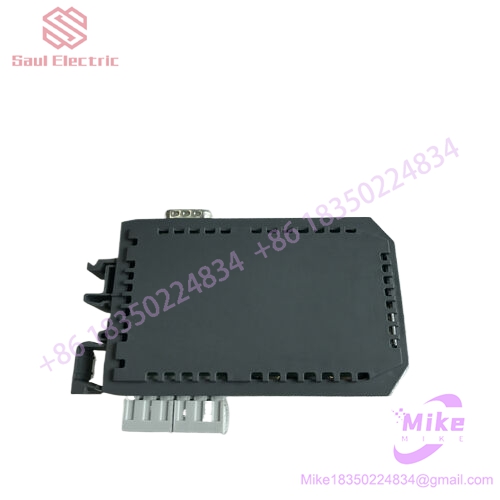
ABB Entrelec 1SNA684252R0200 ILPH RS232-485 Ethernet
Resolution: 12 bits+sign bit.
Conversion cycle: Typically ≤ 1ms.
Input impedance: voltage input>100k Ω, current input about 330 Ω.
Filter time constant: software programmable.
Wire breakage detection: supported, automatically triggers a fault alarm when the signal is lost.
Overvoltage protection: The voltage input can withstand a continuous overvoltage of ± 30V without damage.
All channels support reverse connection protection and short circuit protection.
Electrical isolation between channels, with a typical isolation voltage of 500V DC.
Communication Interface (ILPH Configuration Core)
RS232 interface: standard DB9 serial port, supports point-to-point communication, adaptive baud rate of 300-115200bps, 7/8-bit data bits optional, parity check optional. The maximum transmission distance is about 15m.
RS485 interface: Half duplex, supports multi-point communication (up to 32 nodes), adaptive baud rate of 300-115200bps. Adopting balanced drive differential reception, it has strong resistance to common mode interference and a maximum transmission distance of about 1200m (at 100kbps). Supports 2-wire half duplex bus topology.
Ethernet interface: RJ45, 10/100BASE-TX adaptive, supports TCP/IP protocol stack. It can achieve transparent data conversion between RS232/RS485 serial port devices and Ethernet networks, enabling seamless integration of on-site serial port instruments into SCADA/DCS systems.
Communication protocol: Supports Modbus RTU (RS232/RS485), Modbus TCP (Ethernet), and can be configured to support other custom protocols.
Three communication channels can work simultaneously without conflicting with each other.
I/O Configuration (Mini MCR-SL-F-UI-SP-NC)
Analog input: 4-channel, voltage/current, 12 bits+sign bit, module level electrical isolation.
Analog output: 4-channel, voltage/current, 12 bits+sign bit, module level electrical isolation.
Digital input: No independent DI channel.
Digital output: No independent DO channel.
All I/O channels provide electrical isolation, with a typical isolation voltage of 500V DC.
[Physical Specifications]
Size: approximately 90mm x 25mm x 115mm (width x depth x height, including terminals), net weight of approximately 0.2-0.3kg.
Installation method: 35mm DIN rail, snap in installation, supports horizontal or vertical installation.
Front panel protection level: IP20 (compatible with cabinet up to IP54).
Working temperature range: 0 ° C to+60 ° C, storage temperature -40 ° C to+70 ° C.
Auxiliary power supply: 24V DC (± 20% adaptive), powered externally or through a communication interface (depending on configuration).
Typical power consumption: Approximately 2-5W during normal operation.
Fanless design, no electrolytic capacitors, no moving parts, normal coating coated board, maintenance free long-term operation.
Programming and Configuration
Use ABB system configuration tools (such as ABB Ability System Platform or Mini MCR dedicated configuration software) for channel configuration, range setting, filtering parameters, communication parameters, and alarm threshold setting. The signal type, range, filtering, and alarm of all channels can be directly set in the software without the need for on-site jumpers or potentiometers. Support remote parameter modification and online diagnosis. The module status (channel fault, communication status, disconnection detection) can be directly viewed on the HMI of the upper system.
Self diagnosis and alarm
The device continuously self monitors internal faults, channel anomalies, and configuration drift, and reports its health status directly to the main controller. Each analog input supports upper and lower limit alarms, and the alarm values can be independently set. When an alarm is triggered, the module sends an alarm signal to the main controller through the communication interface, which can be configured to trip, slow down and stop, or only record. The LED indicator light displays the real-time signal status of each channel. Continuously self check the internal electronic components and software operation of the module, and automatically lock all channels and report to the main controller in case of internal faults.
[Typical Application]
Process signal conditioning and networking: Collect sensor signals such as temperature, pressure, flow rate, liquid level, etc., and upload the data to the SCADA/DCS system through RS485 bus or Ethernet for production monitoring and data recording.
Serial port device networking: By using RS232/RS485 to Ethernet conversion function, old-fashioned serial port instruments (such as transmitters and analyzers) on site can be connected to modern Ethernet monitoring systems without the need to replace on-site devices.
Multi protocol gateway: acts as a protocol conversion bridge between RS232 point-to-point devices, RS485 bus devices, and Ethernet devices.
Distribution and Industrial Automation: Suitable for medium/low voltage distribution systems and process control systems that require signal isolation and conditioning while also requiring equipment networking.
Certification and Standards
Compliant with IEC 61000 series electromagnetic compatibility standards and IEC 61131 programmable controller standards. Certified by CE, cULus, and UL 508. HS code 853701190. Origin Switzerland.
Comparison with the same series
1SNA6842522R0200 (ILPH version): 4AI+4AO+RS232/RS485/Ethernet, triple communication, this product (discontinued).
1SNA6842522R0100 (Basic Edition): 4AI+4AO, no communication interface or only RS485, suitable for pure signal conditioning scenarios.
1SNA684252R0300 (Ethernet version): 4AI+4AO+Ethernet, without RS232/RS485, suitable for pure Ethernet access scenarios.
Mini MCR-SL Full Series: Provides 1-4 channel AI/AO combinations, optional communication interfaces, consistent electrical core, software compatibility, and can be selected as needed.
[Replacement suggestion]
Due to the discontinuation of this model, similar products currently in production by ABB can be considered:
ABB Ability Mini MCR series: a new generation of signal conditioners with stronger functions and richer communication interfaces.
ABB AX521/AX522: AC500 series analog I/O module with communication function, suitable for DCS integration.
ABB ILPH independent communication module: If RS232/RS485 to Ethernet conversion function is still required, it can be used in conjunction with any signal conditioning module.
Suggest contacting ABB authorized distributors to obtain the latest alternative solutions.





