


Description
Rexroth CLC-V02.3C-FW | Motorola 68020 VMEbus Multi-Axis Card Quantified Spec
Dynamic Product Introduction
Complex high-speed automation lines utilizing legacy Indramat drives often encounter severe tracking errors when host PLCs attempt to manage interpolation tasks over slow backplanes. The CLC-V02.3C-FW eliminates this limitation by operating as a dedicated motion processor card that offloads kinematic calculations and electronic gearing from the main system controller. By processing multi-axis profiles locally and communicating directly via a fiber-optic SERCOS ring, the CLC-V02.3C-FW ensures tight velocity synchronization across demanding packaging and metal-forming machinery.
Maintaining aging production lines without undergoing complete automation overhauls requires reliable drop-in components like the CLC-V02.3C-FW to keep legacy VME racks operational. Sourcing a verified replacement unit ensures compatibility with existing parameters, avoiding costly machine downtime and extensive reprogramming.
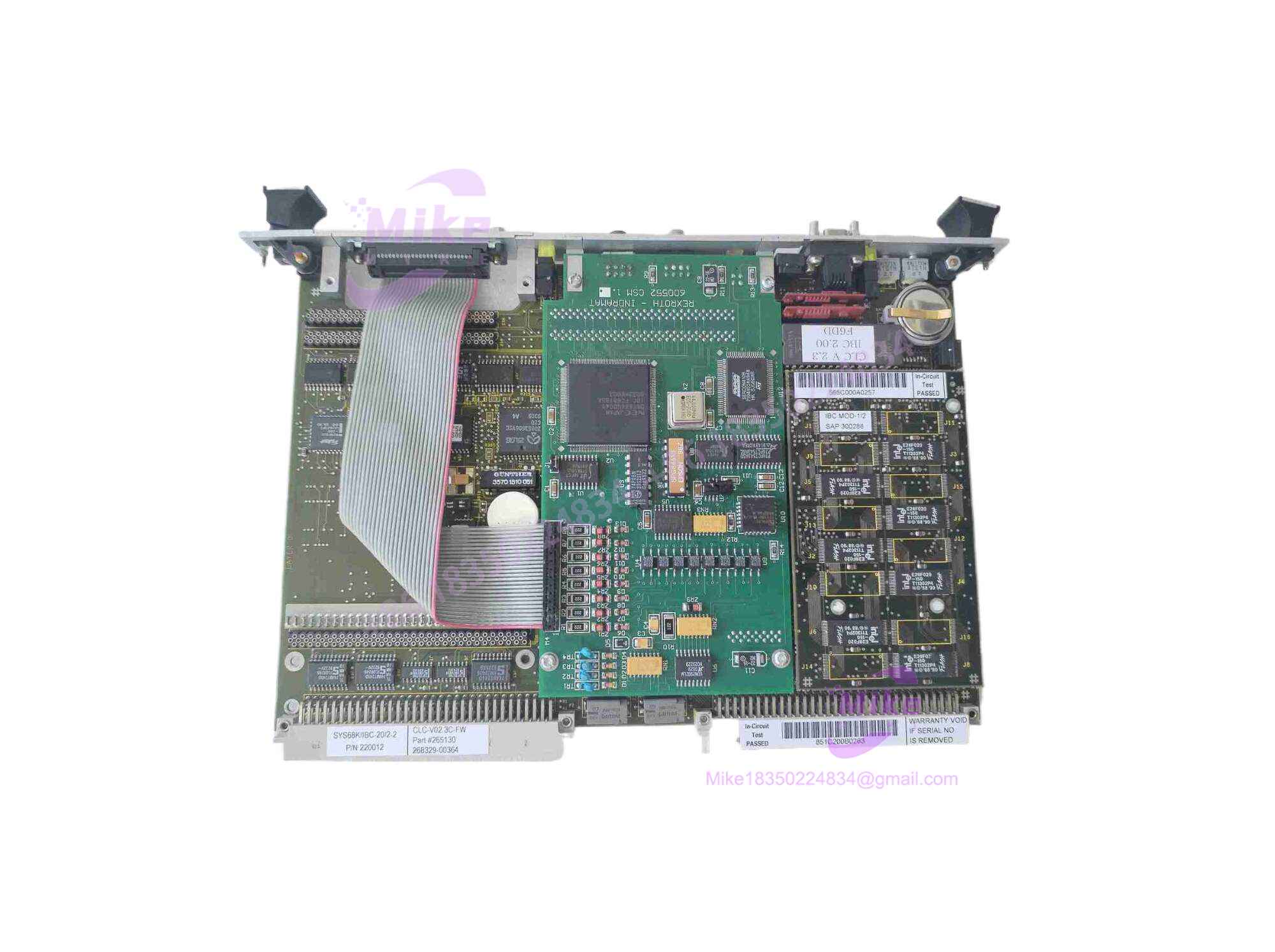
CLC-V02.3C-FW
Key Technical Specifications
| Core Parameter | Technical Specification |
| Processor Architecture | Motorola 68020 (25.0 MHz clock frequency) |
| Math Coprocessor | Motorola 68882 floating-point unit |
| Memory Configuration | 1 Mbyte Flash EPROM, 32 Kbytes battery-backed SRAM, 2 Mbytes shared SRAM |
| VME Interface | A32/A24/A16 addressing, D8/D16/D32 data modes |
| SERCOS Communication | 1 fiber-optic input, 1 fiber-optic output ring port |
| Onboard I/O | 12 digital inputs, 4 sourcing transistor outputs (300 mA max each) |
| Serial Ports | 2 RS-232C channels (parameter download and diagnostics) |
| Operating Temperature | 0 °C to 55 °C |
| Enclosure Format | VMEbus single-height plug-in module |
| Part Number | CLC-V02.3C-FW |
Global Sourcing & Live-Test SOP (Transparency Core)
Acquiring obsolete, high-performance motion hardware demands strict quality control to guarantee absolute reliability upon installation. Every secondary-market CLC-V02.3C-FW unit is processed through an exhaustive technical evaluation workflow:
- Inbound Verification: Technicians perform visual inspections of the VME edge connector fingers, check battery voltage levels on the SRAM backup circuit, and authenticate manufacturing date codes against original Indramat production ledgers.
- Live Simulation: The card is slotted into an active VME test rack equipped with a compatible power supply and linked to a live SERCOS drive loop test bench.
- Diagnostics: Engineers validate fiber-optic signal amplitude, execute full memory read/write cycles across the dual-port and shared SRAM spaces, and test digital I/O response using calibrated multi-meters and diagnostic software. Units undergo a 24-hour thermal soak under operational loop loads.
- Final Prep: RAM is cleared of legacy user data, firmware parameter sets are reset to baseline defaults, and the module is sealed inside a multi-layer anti-static moisture barrier bag.
The Field Engineer’s Pitfall Guide
- ❗ Lithium Backup Battery Depletion: Installing a surplus that has sat on a shelf for years without checking the onboard memory-backup battery voltage will result in lost machine parameters upon power-down. (—though replacing the coin cell or lithium pack prior to commissioning prevents unexpected data corruption.) I’ve seen maintenance teams lose entire axis calibration profiles because an unverified storage unit dropped its SRAM contents during a routine line shutdown.
- ❗ SERCOS Ring Polarity Errors: Reversing the fiber optic transmit (Tx) and receive (Rx) cables during installation breaks the closed-loop ring topology, causing the to throw immediate communication fault codes on its 7-segment display.
- ❗ VME Backplane Bus Conflict: Failing to configure base address jumpers or software switches correctly when adding a to an existing VME chassis can cause address overlapping and immediate system bus lockups.
Intent-Driven FAQ
Will swapping a faulty .3C-FW card erase my motion programs and axis parameters?
Yes, if the internal battery backup has failed or if the module is unpowered for an extended period without a valid backup. Parameter sets and motion logic should ideally be backed up via the Visual Motion software environment before swapping hardware.
Can I use this card with modern Rexroth drives, or is it strictly limited to legacy hardware?
The is optimized for legacy Indramat digital drives (such as DDS, DKS, and DKC series) utilizing the SERCOS-I communication protocol. Direct integration with newer modern drive generations may require protocol translation or updated controller platforms.
How do I establish a communication link to upload parameters to the controller?
Parameters and diagnostic strings can be accessed by connecting a configuration PC to one of the front-panel RS-232C serial ports using the correct null-modem cable configuration and legacy Indramat software tools.
Is it safe to hot-swap a .3C-FW card in a running VME rack?
No. VMEbus architectures do not support live electrical insertion. Main power to the chassis must be completely shut off before inserting or extracting the to avoid destroying the backplane bus drivers.
What kind of warranty covers surplus or pre-owned motion controller cards?
Reputable industrial automation suppliers back verified surplus units with a comprehensive 1-year operational warranty covering both processor execution stability and communication transceivers.
Are you interfacing this .3C-FW controller with legacy DDS or DKC series servo drives in your current VME rack layout?





