


Description
Yokogawa 720254 | 4-Channel Isolation Module, New In Stock
Architect’s Product Breakdown
The Yokogawa 720254 plug-in module serves as a high-precision, four-channel data acquisition interface engineered for the ScopeCorder platform family. Designed for engineers capturing fast electromechanical transients, power inverter switching waveforms, or multi-channel sensor outputs, this module provides complete channel-to-ground and channel-to-channel electrical isolation. This isolation prevents ground loops and protects main instrument hardware when measuring floating potentials or high common-mode voltages in industrial power testing environments.
Integration into a mainframe like the DL850 or DL750 requires clean insertion along the chassis slot rails to ensure the rear multi-pin connector engages the mother-bus without bending alignment pins. Input channels utilize standard BNC or safety terminal connections depending on the exact terminal adapter variant attached. Operators must verify input attenuation settings and voltage range limits in the software menu prior to connecting live test lines to prevent over-voltage stressing of the front-end analog-to-digital converters.
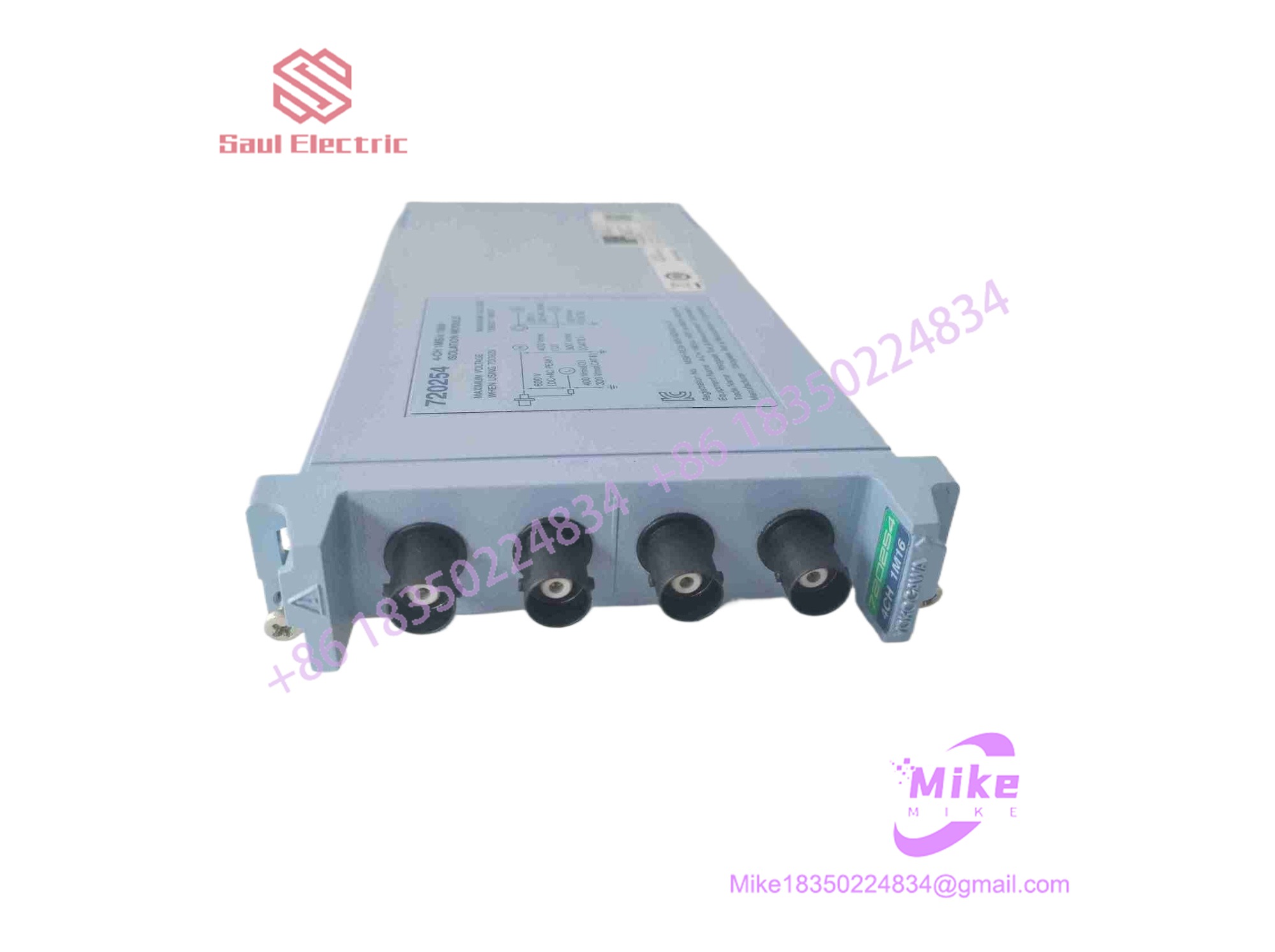
720254
Key Technical Specifications
| Parameter | Specification Data |
| Module Type | 4-Channel Isolated Input Module |
| Compatible Mainframes | Yokogawa ScopeCorder series (DL750, DL850, SL1000) |
| Number of Channels | 4 independent channels |
| Maximum Sampling Rate | 1 MS/s (1 megasample per second per channel) |
| A/D Resolution | 16 bits |
| Maximum Input Voltage | \pm 100 VDC / Peak AC |
| Isolation Rating | Ground-to-channel and channel-to-channel isolation |
| Operating Temperature | 0^\circC to +40^\circC |
| Storage Temperature | -20^\circC to +60^\circC |
| Relative Humidity | 20% to 80% non-condensing |
Field Engineer’s Pitfall Guide
- Common-Mode Voltage Exceedance: Exceeding the rated 100V isolation limit between channels or earth ground will breach internal barriers, destroying input circuitry. Always verify floating potential ranges with a DMM before connecting leads.
- Backplane Insertion Force Errors: Forcing the module into the mainframe slot at an angle can bend the delicate rear interface pins, causing immediate slot recognition failures on the instrument display.
- Probe Attenuation Mismatch: I have seen testing technicians record wildly inaccurate amplitude scaling because the software probe attenuation factor didn’t match the physical 10:1 passive probe connected to the BNC terminal. Always check scale factors before running automated tests.
QA & Testing SOP (Transparency)
- Visual & Origin Inspection: Verification of OEM model labels, connector pin alignment, structural housing integrity, and absence of physical wear.
- Bench Test Environment: Installation into a calibrated ScopeCorder test mainframe running validation diagnostics.
- Signal Calibration & Handshake: Injection of known precision DC voltages and high-frequency sine waves across all four channels to verify 16-bit A/D conversion accuracy and frequency response.
- Packaging: Antistatic ESD shielding bag encased in high-density anti-shock foam containers to protect sensitive analog components during transit.
Technical FAQ
- Can I hot-swap this input module while the ScopeCorder mainframe is powered on? No, standard operating guidelines require powering down the instrument completely before sliding plug-in modules in or out of slots to prevent electrical latch-up.
- Which ScopeCorder mainframes are compatible with the 720254 module? It is designed for multi-slot Yokogawa acquisition mainframes such as the DL750, DL850 series, and related transient recording systems.
- Does the module store its own calibration data? Calibration coefficients and zero-offset data are stored in onboard non-volatile memory on the module itself, ensuring measurement accuracy across different mainframe slots.
- Are the four input channels isolated from each other? Yes, the module provides complete electrical isolation between individual channels as well as from the chassis earth ground reference.





