


Description
Hartmann & Braun Contrans T TEU471 | Temperature Transmitter Unit
Dynamic Process Introduction
Accurate thermal monitoring across heavy industrial reaction vessels requires transmitters that maintain strict calibration stability under severe ambient temperature shifts. When legacy instrumentation loops drift or fail due to electronic component aging, deploying a verified Hartmann & Braun Contrans T TEU471 transmitter restores precise measurement linearity to the control network.
Unlike basic analog converters, this intelligent unit features programmable configuration parameters and robust galvanic isolation to suppress common-mode ground noise. Dropping a fresh TEU471 unit into service yields an immediate reliability leap—slashing measurement error margins while protecting downstream DCS input cards from field-side voltage spikes.
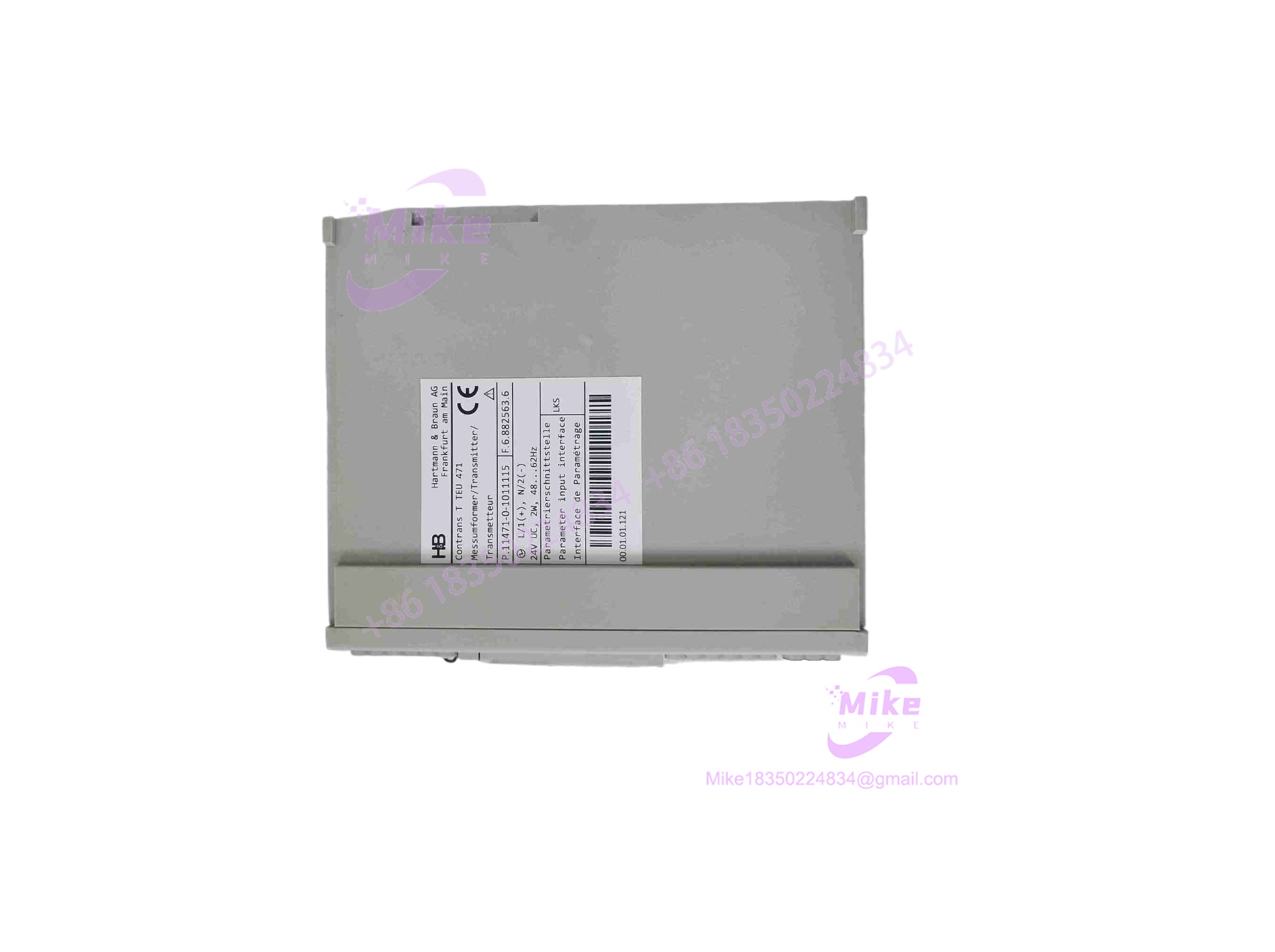
TEU471
Key Technical Specifications
| Core Parameter | Technical Specification |
| Product Model | Contrans T TEU471 (TEU471-EX variants available) |
| Manufacturer | Hartmann & Braun (ABB Heritage Line) |
| Input Types | Thermocouples (Types J, K, T, S, B, etc.), RTDs (Pt100), Ohms, mV |
| Output Signal | 2-wire 4 to 20 mA analog current loop (proportional to input) |
| Communication Interface | Local Communication Interface (LCI) / HART protocol support |
| Galvanic Isolation | Complete input-to-output optical and transformer isolation |
| Power Supply | 11 to 30V DC loop-powered configuration |
| Operating Temperature | -20°C to +70°C industrial field threshold |
| Mounting Format | Head-mount or DIN-rail / rack-mounted module housing |
Global Sourcing & Live-Test SOP (Transparency Core)
Acquiring legacy process instrumentation from secondary surplus markets demands a rigorous validation pipeline to guarantee long-term calibration accuracy.
- Inbound Verification: Every incoming TEU471 batch undergoes high-magnification optical terminal checks, pin corrosion inspection, and holographic database tracing against vintage Hartmann & Braun production ledgers.
- Live Simulation: Technicians mount the transmitter onto a calibrated test bench loop powered by regulated DC rails, connecting precision resistance and millivolt source simulators to the input terminals.
- Diagnostics: Engineers execute multi-point temperature simulation sweeps across the full operating span, verifying 4–20 mA output linearity, cold-junction compensation accuracy, and LCI communication handshakes under a 24-hour thermal soak.
- Final Prep: Units receive comprehensive calibration profile documentation, protective terminal caps, and vacuum sealing inside heavy-gauge moisture-barrier ESD shielding bags.
The Field Engineer’s Pitfall Guide
❗ Cold-Junction Compensation Errors: Swapping a thermocouple transmitter without verifying that the terminal block’s built-in temperature sensor is properly seated will throw off ambient thermal offsets. I’ve seen plant technicians chase phantom temperature errors on furnace loops simply because a replacement unit lacked proper cold-junction tracking.
❗ LCI Programming Port Mismatch: Attempting to configure an older hardware revision with modern software tools without the proper adapter cable can corrupt internal register mapping. Always utilize the designated Local Communication Interface (LCI) box during parameter adjustments.
❗ Loop Power Voltage Drop: Adding series barriers or auxiliary indicators without calculating total loop resistance can starve the 2-wire transmitter of its minimum 11V DC operating threshold. Always verify power supply headroom before commissioning a replacement loop.
Intent-Driven FAQ
Will I lose my custom span and range configuration if I swap this unit?
Yes, transmitter calibration parameters (such as zero, span, and input sensor type) are stored in the device’s internal memory. When replacing a failed unit, you must re-configure the new module using the LCI software tool to match your exact process scale.
Are these units original factory sealed or surplus stock?
Sourced inventory pools span both original factory-sealed packaging and fully tested, certified surplus hardware. Every single unit undergoes bench calibration and input-to-output signal verification before dispatch.
Can this transmitter handle hazardous area installations?
Specific variants (such as -EX models) are engineered with intrinsic safety certifications for deployment in explosive industrial atmospheres, provided they are wired through approved zener barriers or galvanic isolators.
What tools are required to configure the unit locally?
Local parameterization requires a dedicated LCI communication adapter cable linked to a PC running the appropriate configuration software suite.
What kind of warranty accompanies a replacement transmitter?
All supplied units carry a comprehensive 1-year operational warranty covering component health, internal power stage stability, and signal conversion accuracy.
Are you configuring this transmitter for a thermocouple measurement loop or an RTD temperature sensor application?





