


Description
SKF CMPT CTU | Copperhead Vibration & Temperature Transmitter
Dynamic Product Introduction
Detecting mechanical degradation early on pumps, fans, and compressors prevents catastrophic unplanned plant outages. When basic local monitoring fails to catch high-frequency bearing impacts, integrating an SKF CMPT CTU transmitter module into your control cabinet reestablishes deep diagnostic insight.
Unlike standard loop-powered transmitters that only output raw analog values, this intelligent unit processes raw signals directly from industrial accelerometers. Deploying a fresh Copperhead transmitter unit yields an immediate leap in surveillance reliability—enabling precise tracking of acceleration enveloping, overall velocity, and operational temperature without taxing the primary distributed control system.
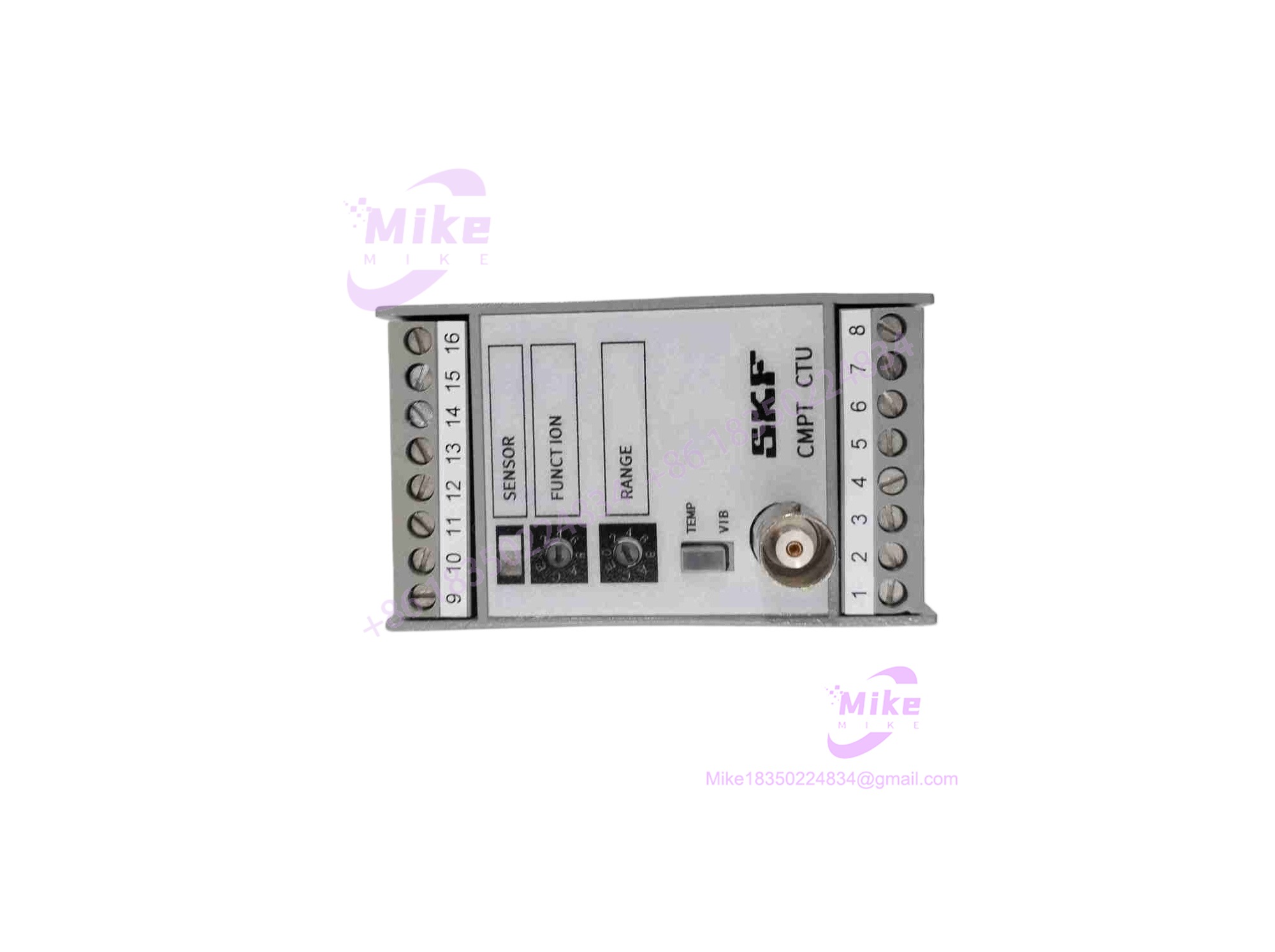
CMPT CTU
Key Technical Specifications
| Core Parameter | Technical Specification |
| Product Model | CMPT CTU (Copperhead Transmitter Unit) |
| Manufacturer | SKF |
| Compatible Sensors | Constant current accelerometers (10 to 230 mV/g) |
| Vibration Analysis Modes | Acceleration Enveloping (g_E), Acceleration (g), Velocity (mm/s or inch/s) |
| Analog Outputs | 4 to 20 mA or 0 to 10 V DC (proportional to vibration/temperature) |
| Communication Interface | Proprietary CAN-bus protocol for multi-unit networking |
| Power Requirements | +24 V DC (22 to 28 V DC, max 250 mA / 6 W) |
| Enclosure & Mounting | IP20 ABS plastic housing, 35 mm DIN-rail mount (EN50022) |
| Operating Temperature | 0°C to +70°C industrial threshold |
| Physical Dimensions | 75 mm × 45 mm × 118 mm (~0.225 kg) |
Global Sourcing & Live-Test SOP (Transparency Core)
Acquiring legacy condition-monitoring hardware through secondary inventory channels requires an absolute verification workflow to ensure signal integrity and operational longevity.
- Inbound Verification: Every incoming CMPT CTU unit undergoes microscopic terminal block inspection and laser traceability checks against factory distribution records to block counterfeit circulation.
- Live Simulation: Technicians mount the module onto an active DIN-rail test rack powered by regulated 24V DC rails to verify backplane CAN bus communication and internal logic loops.
- Diagnostics: Engineers inject multi-frequency vibration waveforms and thermal inputs using calibrated signal generators, validating 4-20 mA conversion accuracy and running a 24-hour thermal soak.
- Final Prep: Units receive comprehensive firmware revision logging, anti-static shielding, and vacuum sealing inside heavy-gauge moisture-barrier bags with fresh desiccant packs.
The Field Engineer’s Pitfall Guide
❗ Sensor Sensitivity Mismatch: Failing to match the CMPT CTU front-panel configuration switches to the specific mV/g sensitivity of your attached accelerometer will throw off your entire scaling loop. I’ve seen plant technicians troubleshoot phantom vibration spikes for hours only to find a 100 mV/g setting paired mistakenly with a 500 mV/g specialty probe.
❗ CAN-Bus Termination Faults: Neglecting proper line termination resistance on multi-unit Copperhead daisy-chains will introduce packet framing errors across the network. Always verify that your terminal blocks include correct impedance matching when tying multiple nodes to a central display.
❗ Shield Grounding Loops: Running unshielded long-run cabling from the field accelerometer directly to the transmitter module invites heavy electromagnetic interference (EMI) from nearby variable frequency drives. Always ground signal drain shields strictly at the cabinet end.
Intent-Driven FAQ
Will I lose my configuration parameters if I replace this CMPT CTU module?
Configuration profiles—such as filter bands, range settings, and analysis modes—are established via physical front-panel switches on the unit. When swapping hardware, you must mirror the exact switch settings from the legacy unit onto the replacement card.
Are these units original factory sealed or surplus inventory?
Available stock includes both factory-sealed original boxes and fully tested, certified surplus hardware. Every unit undergoes bench-level signal verification and calibration sweeps before dispatch.
Can this transmitter tie into third-party PLC and DCS architectures?
Yes, the unit provides standard 4-20 mA and 0-10 V analog outputs that interface effortlessly with any standard automation input card, alongside its native CAN-bus networking capability.
What tools are required to verify the module’s live signal locally?
Field verification can be performed using a high-resolution handheld multimeter to check analog loop currents, alongside the front-panel BNC connector for raw or processed vibration signal checks using a portable analyzer.
What warranty coverage accompanies a replacement transmitter module?
All supplied units carry a comprehensive 1-year operational warranty covering internal component health, signal processing accuracy, and communication port stability.
Are you integrating this CMPT CTU module into a standalone PLC loop or connecting it to a multi-node monitoring network with a centralized display unit?





