

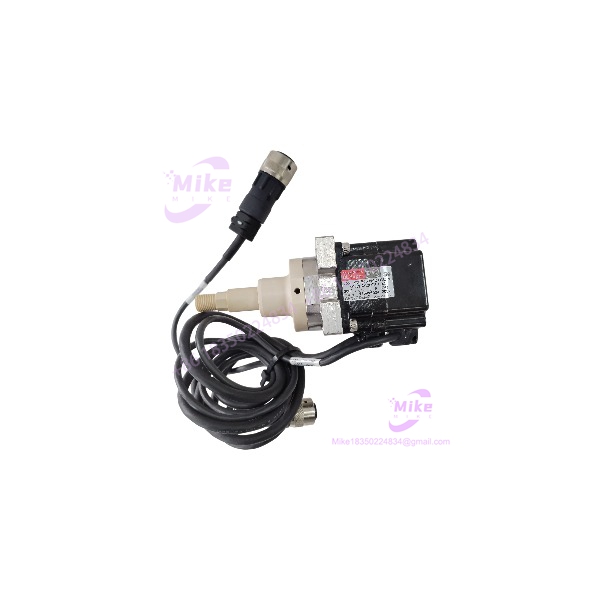
Description
SANYO DENKI P30B06010DXS8SM 100W AC Servo Motor
Product Introduction
The P30B06010DXS8SM is designed for compact servo-driven mechanisms that require controlled speed and repeatable positioning. Its brushless permanent-magnet construction and incremental encoder support closed-loop control when paired with a compatible servo amplifier. Sanyo Denki’s P3 family documentation identifies applications such as small robots, wafer-transfer equipment, and semiconductor manufacturing machinery.
The model’s 60 mm flange makes mechanical fit an important replacement check. Confirm the shaft dimensions, mounting-hole pattern, connector orientation, and overall motor length against the installed unit before ordering.
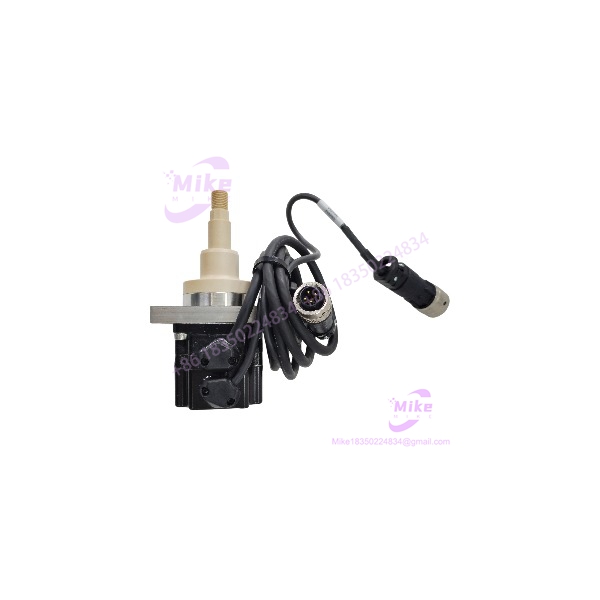
P30B06010DXS8SM
Key Technical Specifications
| Parameter | Specification |
|---|---|
| Manufacturer | SANYO DENKI |
| Model | P30B06010DXS8SM |
| Product family | P3 Super BL |
| Motor type | Brushless AC servo motor |
| Excitation | Permanent magnet |
| Rated output | 100 W |
| Supply class | 200 VAC |
| Rated speed | 3,000 RPM, reported in supplier data |
| Maximum speed | 4,500 RPM |
| Encoder | Wiring-saving incremental encoder |
| Encoder resolution | 2,000 pulses/revolution |
| Mounting flange | 60 mm |
| Protection rating | IP40 |
| Cooling | Self-cooling |
| Holding brake | Not equipped, according to the listed configuration |
| Duty rating | Continuous, according to supplier data |
| Insulation resistance | 10 MΩ minimum at 500 VDC, as listed |
| Dielectric strength | 1,500 VAC for 1 minute, as listed |
| Compatible amplifier | Verify exact model and feedback support |
Sources:
Procurement caution: The specifications above are based on a combination of supplier listings and P3-series documentation. Confirm current manufacturer documentation for exact-model electrical ratings, dimensions, and environmental limits before final engineering approval.
Application Scenarios & Pain Points
- Semiconductor equipment: Compact positioning and wafer-transfer mechanisms requiring controlled servo motion.
- Automated assembly: Indexing and positioning axes where encoder feedback supports repeatable movement.
- Small robotic mechanisms: Servo-driven axes with moderate power requirements and frequent motion cycles.
- Inspection equipment: Controlled movement of stages or fixtures in automated inspection systems.
- Legacy machine maintenance: Replacement of a matching P3-series motor without redesigning the entire motion-control system.
Typical problems include encoder alarms, inconsistent positioning, motor overheating, excessive vibration, and servo-drive faults. Before replacing the motor, inspect the feedback cable, amplifier, coupling, load inertia, and mechanical alignment; these can produce symptoms similar to motor failure.
QA & Live Testing SOP
- Confirm identification. Record the full
P30B06010DXS8SMmodel and serial number from the nameplate. - Inspect mechanical condition. Check the 60 mm flange, shaft, connectors, housing, and mounting surface for damage.
- Verify the drive. Confirm that the amplifier supports the 200 VAC-class motor and the specified encoder interface.
- Check feedback wiring. Inspect the wiring-saving encoder connector and verify the pinout against the applicable documentation.
- Perform electrical checks. Qualified personnel should test winding integrity and insulation using manufacturer-approved procedures. Avoid inappropriate high-voltage testing of encoder electronics.
- Run a low-speed test. With a compatible amplifier, verify direction, feedback counts, smooth rotation, and abnormal noise.
- Inspect operating behavior. Check vibration and temperature rise under suitable test conditions.
- Confirm brake requirements. This model is listed without a holding brake. If the machine requires stationary load retention, assess the need for an external holding mechanism or a correctly specified brake-equipped motor.
- Record acceptance results. Document the amplifier used, test conditions, feedback performance, and any limitations.
For used or refurbished units, request test evidence tied to the exact motor being supplied.
Field Engineer’s Pitfall Guide
- Wrong frame size: The
060designation is associated with the 60 mm flange class. Do not substitute a 40 mm frame motor without checking mounting and shaft compatibility. - Encoder mismatch: Confirm the wiring-saving incremental encoder interface and 2,000 P/R specification before connecting the motor to an existing amplifier.
- Voltage assumptions: Verify the 200 VAC-class configuration against the drive nameplate and documentation.
- Assuming IP40 means washdown-ready: IP40 does not provide protection against water jets. Check the installation environment and enclosure requirements.
- Overlooking the missing brake: A non-brake motor may not safely hold a vertical or gravity-loaded axis when power is removed.
- Confusing motor speed with application speed: The motor’s maximum speed is not necessarily the permitted speed for the coupled mechanism.
- Ignoring mechanical alignment: Shaft misalignment and excessive radial or axial loads can damage bearings and cause vibration.
Intent-Driven FAQ
Q1: What is the SANYO DENKI P30B06010DXS8SM?
It is a P3 Super BL brushless AC servo motor listed with 100 W rated output and a 60 mm flange.
Q2: What is the maximum speed?
Supplier data lists a maximum speed of 4,500 RPM. Confirm the permitted speed for the exact drive and mechanical application.
Q3: Which encoder does it use?
The listed configuration uses a wiring-saving incremental encoder with 2,000 pulses per revolution. Verify the interface and resolution against the motor label and drive documentation.
Q4: Does it include a holding brake?
The listed P30B06010DXS8SM configuration is not equipped with a holding brake. Confirm the actual unit before using it on a load that must remain stationary without motor torque.
Q5: Is the motor suitable for wet or washdown environments?
The supplier listing specifies IP40. Do not treat that rating as suitable for direct water exposure or washdown.
Q6: Can it replace another 100 W servo motor?
Not automatically. Check voltage, encoder compatibility, mounting dimensions, shaft configuration, brake requirements, and drive support.
Q7: What should buyers verify when purchasing used stock?
Request a clear nameplate photo, serial number, condition report, encoder test results, functional test details, and written warranty or return terms.





