


Description
R. Stahl 8070/1-1-HR311 | Ex de Roller Lever Limit Switch Quantified Spec
Dynamic Product Introduction
Operating limit sensing and safety interlocking within explosive atmospheres requires certified hardware designed to prevent electrical arcing from igniting surrounding volatile gases. The R. Stahl 8070/1-1-HR311 operates as a robust electromechanical position switch featuring a stainless steel roller lever actuator, engineered specifically for hazardous-duty industrial applications. Unlike standard commercial limit switches that lack proper containment ratings, this unit combines an increased safety (Ex e) enclosure with a flameproof (Ex d) interchangeable contact element.
Moving beyond older legacy switch designs, this Series 8070 model brings reliable snap-action switching and positive-opening contacts to critical safety loops. Field maintenance records confirm that dropping in a verified replacement switch ensures strict compliance with safety standards while eliminating intermittent contact bounce in harsh chemical or oil-and-gas environments.
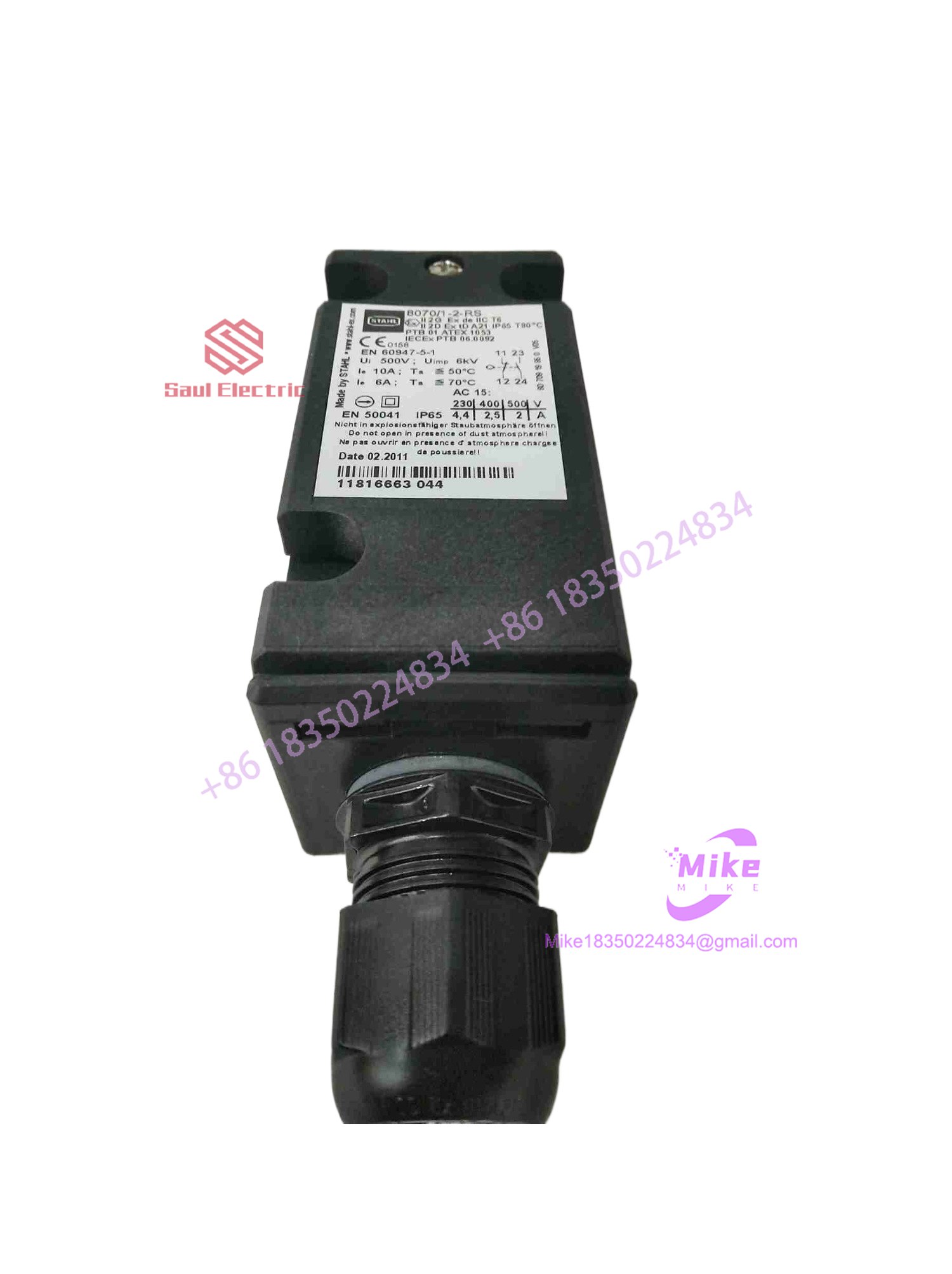
Key Technical Specifications
- Switch Type: Electromechanical Position Switch (Limit Switch) with Roller Lever
- Contact Configuration: 1 Normally Closed (NC) + 1 Normally Open (NO) with positive opening
- Rated Operational Voltage: Up to 500 VAC (same potential) / 250 VAC (unequal potential)
- Rated Operational Current: 10 A (at +50^\circC Ta) / 6 A (at +70^\circC Ta)
- Explosion Protection: ATEX (Gas: II 2 G Ex d e IIC T6; Dust: II 2 D Ex tD A21 T80°C), IECEx certified
- Enclosure Material: Glass fibre-reinforced polyamide (Black)
- Degree of Protection: IP65
- Operating Temperature Range: -20^\circC to +70^\circC
- Mechanical Service Life: \ge 1 \times 10^6 operating cycles
- Weight: ~0.3 kg (0.66 lbs)
Global Sourcing & Live-Test SOP (Transparency Core)
Deploying replacement safety switches in hazardous areas requires an uncompromising verification protocol to guarantee enclosure integrity and contact reliability.
- Inbound Verification: Incoming switches are audited against official ATEX/IECEx manufacturing specifications. Polymer housings, actuator arms, and cable entry glands are inspected under optical magnification for micro-cracks, thread wear, or seal degradation.
- Live Simulation: The switch is mounted onto an electrical test rig and wired to an isolated continuity and insulation resistance tester.
- Diagnostics: Technicians execute multi-cycle actuation sweeps using the roller lever, verifying snap-action timing, contact resistance stability, and positive-opening mechanical travel limits across a thermal soak cycle.
- Final Prep: Once electrical logs clear baseline safety standards, terminal compartments are sealed, and the unit is packaged in an ESD-safe protective barrier.
The Field Engineer’s Pitfall Guide
❗ Exceeding Cable Clamping Ranges: Using undersized or oversized field cables through the cable gland compromises the IP65 seal, allowing moisture and corrosive vapors to enter the enclosure. (I’ve seen switches fail hazardous-area inspections simply because an incorrect cable diameter ruined the compression seal.) Always match cable outer diameters to the specified gland rating.
❗ Improper Grounding of Increased Safety Enclosures: Failing to tie internal and external protective earth bonding points securely can lead to static charge buildup in explosive zones. Always verify low-resistance ground continuity with a digital multimeter during installation.
❗ Forcing Mechanical Actuation Beyond Limits: Adjusting the roller lever past its maximum permissible operating angle or exceeding operating speeds can warp internal trip mechanisms, destroying the positive-opening safety feature. Always align cams to respect designated pre-travel and over-travel limits.
Intent-Driven FAQ
Will swapping this 8070/1-1-HR311 switch require re-certification of the control panel?
No. Direct replacement of a damaged field device with an identical ATEX/IECEx-certified component of the same rating and classification maintains existing panel compliance without requiring re-certification.
Can this position switch be serviced or opened while the hazardous area is energized?
No. Never open an increased safety or flameproof enclosure while circuits are live in an explosive atmosphere. Always de-energize external feeds via an approved lockout/tagout procedure prior to opening the cover.
What causes the switch contacts to fail prematurely or stick?
Contact sticking or premature wear typically points to excessive electrical load currents exceeding the 10A limit, severe inductive kickback without arc suppression, or moisture ingress inside the housing. Inspecting arc suppression elements and seals resolves the issue.
Is the roller lever actuator position adjustable?
Yes. The actuator head can generally be repositioned in 90-degree increments around the switch body to suit various mechanical approach directions and cam orientations.
What kind of warranty accompanies surplus or refurbished units?
Reputable industrial suppliers typically back tested surplus or refurbished explosion-protected safety components with a standard 1-to-2 year replacement warranty, backed by an independent bench test report confirming contact continuity and insulation health.





