


Description
OKUMA ER-JG-7200D | 16,384-Pulse CNC Encoder
Product Introduction
Position feedback is where an older CNC machine can become deceptively difficult to troubleshoot. The motor may still run, the amplifier may pass its basic checks, and yet the OSP control can refuse axis operation because the feedback device is no longer delivering a valid position signal. OKUMA ER-JG-7200D is designed for precisely this feedback chain — an absolute encoder that supplies axis position and speed information to the CNC control.
The technical records available for the ER-JG-7200D describe a multi-pole resolver architecture with a 5 kHz feedback frequency and a control reference of 81.92 MHz, producing 16,384 clock pulses per revolution. The encoder is associated with Okuma OSP control systems and applications including BL motors and certain hydraulic automatic tool-changer mechanisms.
This is precision feedback hardware, not a generic rotary encoder. Mechanical interface, encoder revision, motor compatibility, and OSP system configuration should all be checked before substitution.
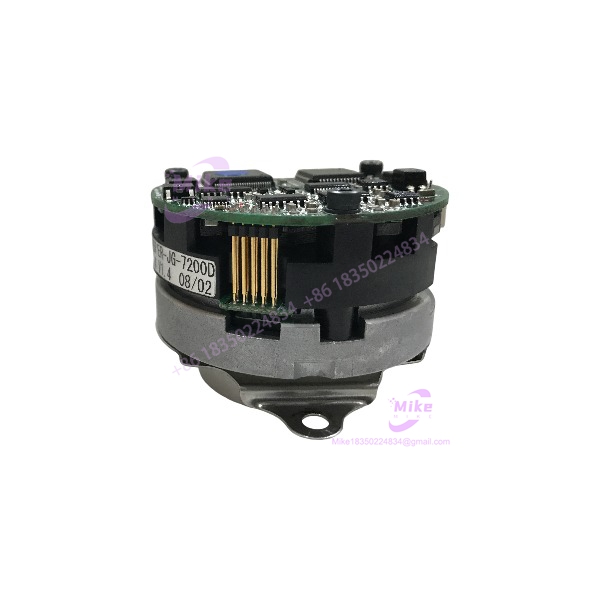
ER-JG-7200D
Key Technical Specifications
- Manufacturer: OKUMA
- Model: ER-JG-7200D
- Alternate Model Format: ERJG7200D
- Product Type: Absolute position encoder
- Encoder Category: Internal encoder
- Primary Function: Axis speed and position feedback
- Feedback Technology: Multi-pole resolver
- Feedback Frequency: 5 kHz
- Clock Reference: 81.92 MHz
- Pulse Count: 16,384 clock pulses per revolution
- Feedback Destination: Okuma OSP control
- Application: Okuma BL motors and selected hydraulic ATC systems
- Mechanical Configuration: Shaft-type encoder
- Known Related Number: 1005-801D-01-010 appears in current Okuma parts catalogs alongside ER-JG-7200D
- Other Cross-Reference: 1005-8014-01-010 is also associated with ER-JG-7200D in current market records
- Resolution Class: Approximately 14-bit equivalent pulse-count representation per revolution
- Status: Legacy / service-part application
The 5 kHz, 81.92 MHz, and 16,384-pulse figures are published by secondary industrial technical references. They are useful for engineering identification, but the machine’s original Okuma documentation should remain the final authority for installation and configuration.
Application Scenarios & Pain Points
OSP CNC axis feedback replacement
When an Okuma machine generates encoder-related alarms or loses reliable axis position, the feedback device becomes an immediate suspect. Replacing the encoder can restore the original feedback architecture without replacing a functioning servo motor or CNC control.
BL motor maintenance
The ER-JG-7200D is documented for use with Okuma BL motor applications. That makes motor-to-encoder matching particularly important — a similar-looking encoder is not necessarily electrically or mechanically equivalent.
Hydraulic ATC feedback
Technical documentation also associates this encoder with hydraulic automatic tool-changer applications. This expands its relevance beyond conventional linear-axis servo feedback.
Legacy OSP machine maintenance
Older Okuma machines can remain productive long after their original feedback components become difficult to source. Maintaining a verified ER-JG-7200D as a spare can reduce diagnostic time during an unexpected encoder failure.
Intermittent position faults
Encoder degradation can manifest as unstable position feedback, axis initialization problems, positioning errors, or control alarms. The failure may initially appear intermittent — particularly when connectors, cables, or internal encoder electronics are aging.
QA & Live Testing SOP
We treat the ER-JG-7200D as precision feedback equipment and test it accordingly.
Step 1 — Identity verification
We record the complete ER-JG-7200D marking, secondary part number, revision information, serial information, and any associated motor or machine reference.
Step 2 — Mechanical inspection
The shaft, mounting interface, housing, connector, and cable termination are checked for impact damage, deformation, contamination, or signs of forced installation.
Step 3 — Electrical screening
Before connecting the encoder to an OSP control, we inspect the connector and check for abnormal electrical conditions using the applicable Okuma service documentation. We do not substitute arbitrary power or signal levels based solely on a third-party listing.
Step 4 — Resolver/feedback test
Where a compatible Okuma test setup is available, the encoder is coupled to the appropriate test equipment and checked for stable feedback response through its operating range.
Step 5 — OSP system verification
The final test should confirm valid encoder initialization and consistent position feedback at the CNC control. Axis movement should produce repeatable feedback without encoder or position-related alarms.
Step 6 — Final QC
The encoder is protected against ESD, mechanical shock, and contamination before packaging. Serial and revision information remain attached to the test record for traceability.
Field Engineer’s Pitfall Guide
❗ Do not treat ER-JG-7200D as a generic 16-bit encoder. The published 16,384-pulse figure describes the feedback architecture, but mechanical interface and OSP compatibility are equally important.
❗ Verify the secondary part number before purchasing. Current records associate ER-JG-7200D with numbers including 1005-801D-01-010 and 1005-8014-01-010. These references are useful for identification, but do not assume that every related number is automatically interchangeable.
❗ Check the encoder against the original motor or machine assembly. Okuma uses several closely related internal encoder models, including ER-FC, ER-HC, ER-J, ER-JC, ER-JD, and ER-JG families. Physical similarity does not establish electrical compatibility.
Intent-Driven FAQ
Q: What is OKUMA ER-JG-7200D?
A: It is an Okuma absolute position encoder used for axis speed and position feedback in compatible CNC and motion-control equipment.
Q: Is ER-JG-7200D an absolute encoder?
A: Yes. Current technical references consistently identify the ER-JG-7200D as an absolute position/internal encoder.
Q: What is the resolution of ER-JG-7200D?
A: Technical documentation specifies 16,384 clock pulses per revolution, corresponding to a 14-bit pulse-count representation per revolution.
Q: What is the feedback frequency?
A: The published technical specification is 5 kHz. The same source identifies an 81.92 MHz clock reference used in the feedback calculation.
Q: Which Okuma systems use ER-JG-7200D?
A: It is associated with Okuma OSP controls, BL motor feedback, and certain hydraulic ATC applications. Exact compatibility must be confirmed against the machine configuration.
Q: Is ER-JG-7200D the same as 1005-8014-01-010?
A: Current market records associate those identifiers, but procurement should still be based on the complete encoder marking, revision, and machine application rather than cross-reference alone.
Q: Can ER-JG-7200D replace another Okuma encoder with the same pulse count?
A: Not automatically. Resolver characteristics, mechanical mounting, shaft configuration, signal interface, firmware/control expectations, and machine-specific calibration can all matter.





