

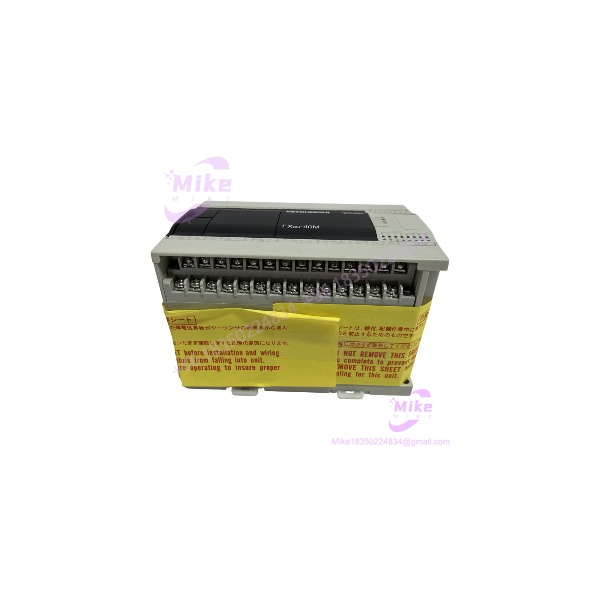
Description
Mitsubishi FX3G-40MT/ESS | 40-Point Transistor PLC
Dynamic Product Introduction
The Mitsubishi FX3G-40MT/ESS sits in the middle ground between a basic machine PLC and a more expandable control platform. With 24 DC inputs and 16 source-type transistor outputs, it is suited to machinery that needs more than simple relay sequencing but does not justify a larger modular PLC architecture.
The /ESS suffix matters. This is the 100–240 VAC-powered, transistor-output source type, not the similar FX3G-40MT/DS or FX3G-40MT/DSS versions that use 24 VDC power. Mitsubishi’s specifications also identify 32K-step EEPROM program memory, 128 local I/O capacity, 256 points when supported remote I/O configurations are included, USB and RS-422 interfaces, and a 210 ns basic LD instruction processing time.
For machine builders maintaining an existing FX3G installation, that combination is useful because the controller supports more than basic discrete I/O. High-speed pulse measurement, pulse-catch functions, communication expansion, analog expansion, and other function boards can be incorporated into the control architecture.
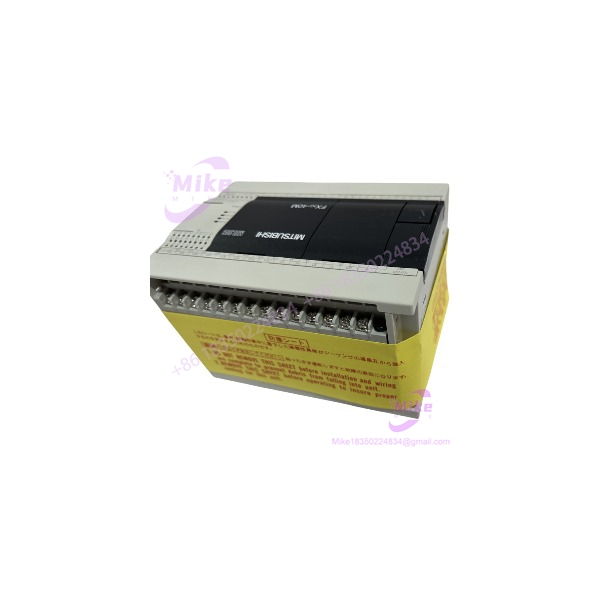
FX3G-40MTESS
Key Technical Specifications
- Model: FX3G-40MT/ESS
- Manufacturer: Mitsubishi Electric
- PLC Family: MELSEC-F
- Unit Type: Main PLC
- Integrated I/O: 40 points
- Inputs: 24 points
- Input Voltage: 24 VDC
- Input Logic: Sink/source compatible
- Outputs: 16 points
- Output Type: Transistor
- Output Logic: Source
- Power Supply: 100–240 VAC
- Program Memory: 32K steps, EEPROM
- Local I/O Capacity: Up to 128 points
- Local + Remote I/O: Up to 256 points with applicable remote-I/O architecture
- Basic LD Processing: Approximately 210 ns
- MOV Processing: Approximately 500 ns
- Communication Ports: USB and RS-422
- Power Consumption: Approximately 37 W
- Dimensions: 130 × 90 × 86 mm
- Weight: Approximately 0.7 kg
- Operating Temperature: 0–55°C
- Protection Rating: IP10
- Expansion: Supported
- Lifecycle: Mitsubishi currently lists the material as discontinued, with production scheduled to end December 31, 2026.
The terminal arrangement is also different from the relay-output variants. Mitsubishi’s hardware manual shows dedicated +V0 through +V5 terminals associated with the source-type transistor output groups on the FX3G-40MT/ESS. That wiring detail should be checked before replacing it with an MR or another MT variant.
Global Sourcing & Live-Test SOP
For a used or surplus , a power-on test is not enough. The transistor output section and the installed expansion architecture both need verification.
1. Nameplate verification
Confirm the complete designation . Record the serial number, hardware revision, production information, and any installed function-expansion boards.
2. Power verification
Confirm that the unit is the AC-powered version before applying power. The ESS configuration uses 100–240 VAC, whither variants use 24 VDC. This is an important procurement distinction.
3. CPU startup
Apply the correct supply under controlled conditions. Confirm normal RUN/STOP/ERROR behavior and check that no immediate CPU or memory fault is reported.
4. Input testing
Exercise all 24 DC inputs with a controlled 24 VDC test source. Verify that each input changes state consistently and that there are no intermittent channels.
5. Transistor-output testing
Test all 16 source outputs using a suitable load fixture. Verify switching behavior, response time, output-group supply wiring, and repeated operation.
6. High-speed function test
If the target machine relies on pulse capture or high-speed pulse measurement, test those functions independently. Mitsubishi specifies a 10 μs high-accuracy pulse-width and pulse-cycle measurement function for this platform.
7. Communication test
Verify USB and RS-422 communication where those interfaces are used by the machine or maintenance workstation.
8. Expansion verification
If the installation uses analog modules, communication adapters, function-expansion boards, or additional I/O, test the complete configuration rather than evaluating the CPU alone.
9. Extended run
Run the PLC continuously with representative I/O activity. Monitor CPU status, output switching, supply behavior, and enclosure temperature.
10. Final preparation
Document the tested I/O channels, program-memory condition, hardware revision, and expansion configuration. Package the PLC in ESD-safe material with adequate protection around the terminal areas.
Field Engineer’s Pitfall Guide
1. Do not confuse /ESS with /ES, /DS, or /DSS.
The has 100–240 VAC input power and 16 source-type transistor outputs. The /DS and /DSS versions use 24 VDC power, while the /ES version has a different output arrangement. Mitsubishi’s terminal diagrams show the distinction clearly.
2. Do not wire the source outputs like relay contacts.
The transistor output section uses +V group terminals rather than the relay-style COM arrangement. If a replacement is being installed into an existing cabinet, verify the output wiring group by group before energizing the machine.
3. Do not assume a newer FX5 controller is a drop-in replacement.
Mitsubishi currently identifies FX5S-40MT/ESS and FX5UJ-40MT/ESS as replacement candidates, but migration still requires checking the program, expansion modules, communications, special functions, I/O addressing, and machine wiring.
Intent-Driven FAQ
What is the Miishi /ESS?
The is a MELSEC-F programmable-controller main unit with 24 24-VDC inputs and 16 source-type transistor outputs, powered from 100–240 VAC.
How many I/O poidoes /ESS have?
It has 40 integrated I/O points: 24 inputs and 16 outputs.
Are the outputs relay or transistor?
They are transistor outputs, specifically source-type outputs. This is one of the most important distinctions when compa the /ESS with the similarly numbered relay-output models.
What power supdoes /ESS use?
The /ESS version uses a 100–240 VAC power supply. The 24 VDC versions use different model suffixes, so the complete part number should be checked before installation.
What is the program capacity?
Mitsubishi lists 32K steps of EEPROM program memory the /ESS.
Does /ESS support expansion?
Yes. The platform supports expansion for additional I/O as well as analog, communication, positioning, and other functions. Mitsubishi describes up to 128 local I/O points and up to 256 points when applicable remote-I/O configurations are used.
Does it have USB and RS-422?
Yes. Mitsubishi’s product data lists one USB interface and one RS-422 interface.
Is /ESS discontinued?
Mitsubishi’s current product information lists the material as discontinued, with a scheduled production end date of December 31, 2026. Mitsubishi identifies FX5S-40MT/ESS and FX5UJ-40MT/ESS as replacement candidates.
What should I verify when buying aplus /ESS?
Verify the exact /ESS suffix, 100–240 VAC input, 24-input/16-source-transistor configuration, hardware revision, terminal condition, CPU startup, all 40 I/O points, and any attached expansion hardware. For a production spare, request evidence that the transistor outputs have actually been tested rather than accepting a simple “powers on” statement.





