


Description
Koyo D4-RSDC | Serial Remote I/O Slave Module
Dynamic Product Introduction
Spreading automation architecture across large machine footprints usually introduces severe cabling costs when every remote sensor must home back to the main control enclosure. Honestly, the Koyo D4-RSDC eliminates this heavy wiring overhead by serving as a remote slave link, routing up to seven remote bases back to a central master slot over a twisted-pair cable. This module coordinates distant peripheral data reliably without choking main controller scans (—though keeping network traffic within asynchronous timing limits is vital). Compared to centralized wiring schemes, deploying the Koyo D4-RSDC reduces installation labor and streamlines multi-drop panel topologies.
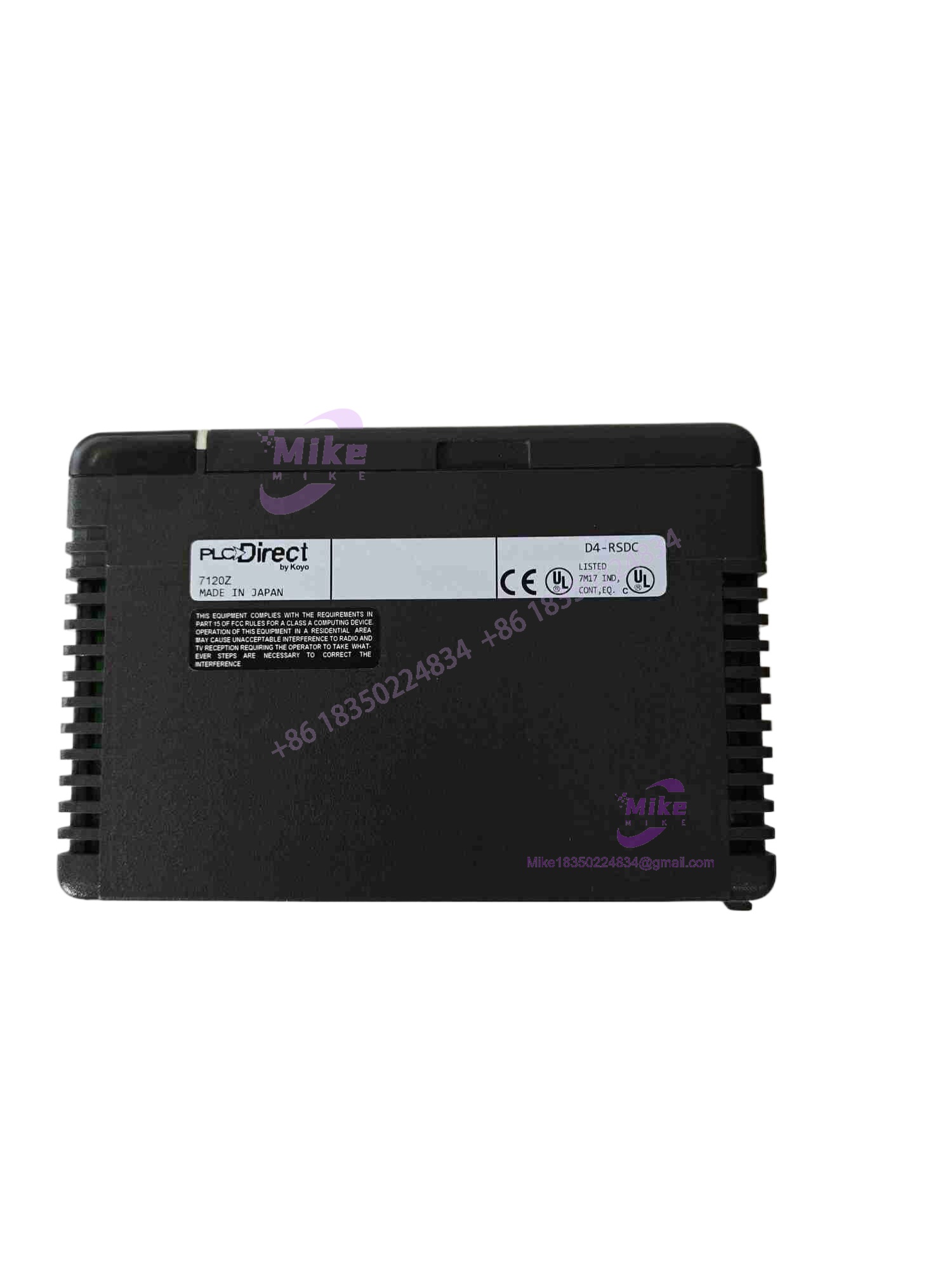
D4-RSDC
Key Technical Specifications
| Specification | Parameter Value |
| Product Series | DirectLOGIC DL405 |
| Module Type | Serial Remote I/O Slave |
| Communication Protocol | RS-485 via twisted-pair cable |
| Max Transmission Distance | Up to 1.2 km (depending on baud rate) |
| Baud Rate | Up to 38.4K baud |
| Input Power Supply | 24 VDC nominal |
| Daisy-Chain Capacity | Up to 7 slaves per remote master (D4-RM) |
| Operating Temperature | 0°C to 60°C industrial standard |
| Enclosure Rating | IP20 open-type rack module |
| Backplane Interface | Standard DL405 base slot connection |
Global Sourcing & Live-Test SOP (Transparency Core)
Acquiring obsolete secondary-market communication slaves requires strict loop testing to ensure RS-485 transceiver chips and internal power regulators are fully operational. For every inbound Koyo D4-RSDC unit, our audit team logs serial numbers against global traceability ledgers and inspects terminal pins for environmental corrosion or bending.
Once cleared, the module is mounted onto a live DL405 test rig paired with a remote master simulator. Technicians inject a regulated 24VDC supply, verify error-free packet transmission across twisted-pair lines at maximum baud rates, and execute a 24-hour thermal soak run. The unit is then cleaned, fitted with fresh desiccant, and sealed inside an anti-static moisture-barrier bag.
The Field Engineer’s Pitfall Guide
❗ Improper Network Termination: Forgetting to install physical terminating resistors at both physical ends of the RS-485 daisy-chain line will cause signal reflections and intermittent remote dropouts. Always verify network bias and termination before commissioning.
❗ Exceeding Distance and Baud Rate Limits: Pushing cable runs past 1.2 kilometers or setting mismatched baud rates against the master module will result in persistent communication fault codes. Always match your network configuration parameters to actual physical run lengths.
❗ Power Supply Voltage Sag: Powering the remote base with an unstable 24VDC supply causes internal rail drops during heavy input switching, forcing the D4-RSDC to reset and sever the master link.
Intent-Driven FAQ
- Will I lose configuration logic if I swap out the Koyo D4-RSDC?
No, slave modules do not store the primary user program; logic resides on the central CPU, though remote I/O mapping definitions must match your software project.
- How many remote slaves can be linked to a single master?
A single remote master (D4-RM) can support up to 7 remote slave units daisy-chained over a twisted-pair serial connection.
- What type of warranty covers surplus D4-RSDC units?
Verified secondary-market inventory includes a comprehensive 1-year operational warranty backed by our pre-shipment communication test logs.
- Can this module be used with any DL405 base size?
Yes, the D4-RSDC can be installed into any standard DL405 remote base rack configuration.
- How do I verify if a replacement unit has been bench-tested?
Look for serialized QA verification stickers, clean screw terminals free of wire scoring, and accompanying test reports included in the packaging.





