


Description
INFICON BCG450-SD | TripleGauge DeviceNet Full-Range Sensor
Product Introduction
When a semiconductor transfer chamber loses base pressure tracking mid-run, wafer contamination ruins entire batches. The INFICON BCG450-SD is not a standard single-technology sensor; it functions as an advanced TripleGauge architecture integrating a Bayard-Alpert hot ion section, a convection-enhanced Pirani, and a gas-type-independent capacitance diaphragm.
—though your mileage may vary depending on local network termination and bus topology—expect continuous, high-resolution data logging across wide pressure swings. It collapses what used to require three separate port cutouts and discrete controllers into a single compact flange.
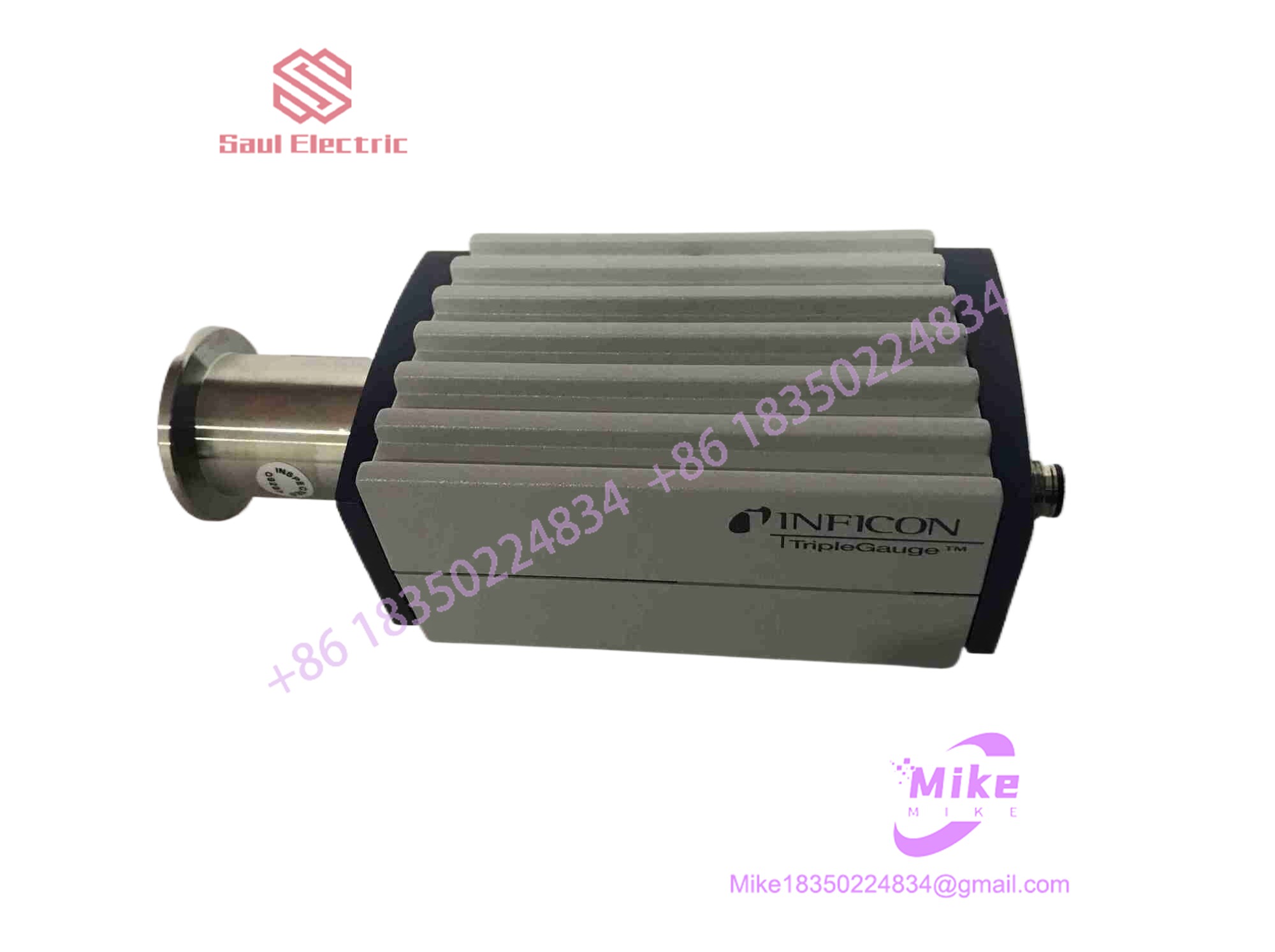
BCG450-SD
Key Technical Specifications
| Parameter | Specification |
| Measurement Range | 5 \times 10^{-10} to 1500 mbar (3.75 \times 10^{-10} to 1125 Torr) |
| Communication Interface | DeviceNet™ (Group 2 slave) + 15-pin D-Sub analog/relay connector |
| Supply Voltage | 20 to 28 VDC (nominal 24 VDC) |
| Accuracy Profile | \pm15\% (10^{-8} to 50 mbar), \pm2.5\% (950 to 1050 mbar) |
| Flange Options | DN 25 ISO-KF or DN 40 CF-R |
| Filament Type | Yttrium oxide-coated iridium (dual hot-cathode layout) |
| Ambient Operating Temp | 0°C to +50°C (32°F to 122°F) |
| Internal Volume | 24 cm^3 (ISO-KF) / 34 cm^3 (CF-R) |
Application Scenarios & Pain Points
- Semiconductor Loadlock Cycling: A high-volume etch tool kept throwing false transfer errors because legacy Pirani sensors misread nitrogen versus vent gas mixtures. Swapping to the BCG450-SD provided gas-independent diaphragm accuracy above 10 Torr, smoothing out fast cycle transitions.
- Thin-Film PVD Coating Lines: Industrial coaters running continuous multi-layer cycles need reliable base pressure verification before opening gate valves; this unit eliminates crossover deadbands between high-vac and roughing ranges.
- R&D Multi-Chamber Systems: Consolidating rack space on tight frame layouts allowed engineers to eliminate standalone switch boxes by routing setpoint relays and DeviceNet data straight back to the main PLC.
QA & Live Testing SOP (Trust Signal)
We validate precision vacuum electronics under strict environmental baselines before issuing deployment clearance:
- Cleanroom Visual & Vacuum Integrity Check: Inspected for microscopic envelope fractures, pin alignment on the 15-pin and Microstyle network connectors, and correct O-ring/gasket seating surfaces.
- DeviceNet Handshake & Node Verification: Attached to a live network loop to confirm baud rate recognition (125, 250, 500 kBaud), MAC ID rotary switch response, and polling behavior.
- Emission & Filament Burn-In: Powered on a calibration vacuum manifold to test hot ion filament lighting thresholds, automatic Pirani high-vacuum zero adjustment, and output linearity across the full analog curve (0 to 10 VDC).
- ESD Shielding: Encased in antistatic static-dissipative packaging to protect onboard microprocessors and isolated transceiver chips from transit damage.
Field Engineer’s Pitfall Guide
- ❗ Simultaneous Interface Conflict: Do not attempt to run active configuration commands via the front 15-pin RS-232 line while the DeviceNet fieldbus connection is actively polling. Simultaneous control loops will throw communication faults.
- ❗ Filament Exposure at Atmosphere: Never ignite the hot ion filament above its safety threshold (>2 \times 10^{-2} mbar) unless the automatic protection interlock is verified; exposing an active filament to high pressure causes instant thermal burnout.
- ❗ MAC ID and Baud Switch Errors: Ensure the physical rotary address wheels match your master PLC network configuration table before applying loop power, or the node will remain silent on the DeviceNet trunk line.
Intent-Driven FAQ
Can I connect this DeviceNet gauge directly to standard PLCs?
Yes. The -SD designation features an integrated DeviceNet interface compatible with standard industrial automation networks using standard Group 2 slave messaging protocols.
What happens to the sensor if the chamber suddenly vents to atmosphere?
The integrated Pirani and capacitance diaphragm logic automatically protects the system, and the internal interlock shuts down the hot ion filament safely before pressure reaches damaging levels.
Is the sensor head field-replaceable when it reaches end-of-life?
Yes. The sensing element can be swapped out easily; replacement units feature on-board calibration data stored directly on the chip to maintain factory measurement reproducibility.
What is the purpose of the secondary 15-pin D-Sub connector?
The 15-pin D-Sub connector handles auxiliary analog outputs (0 to 10 VDC pressure scaling), internal setpoint relay connections, and alternative power inputs independent of the network drop.
Does this gauge require an external control box?
No. It functions as an active standalone unit containing its own signal processing electronics, requiring only a 24VDC power source and your network or analog acquisition line.





