


Description
FMS EMGZ306A | Tension Measuring Amplifier
Product Introduction
A web-processing machine can have perfectly healthy rollers, bearings, and sensors yet still produce unstable tension feedback because the millivolt-level strain-gauge signal is being handled poorly. FMS EMGZ306A sits between the FMS force sensors and the machine controller, taking the low-level sensor signal and converting it into a usable analog feedback signal for a PLC, display, or tension-control system. It is a single-channel analog tension measuring amplifier housed in a compact DIN-rail enclosure.
The architecture is straightforward by design. EMGZ306A supplies the force sensors with a precision 5 VDC / 30 mA excitation, amplifies their millivolt output, and simultaneously provides a ±10 V voltage output plus a selectable 0–20 mA or 4–20 mA current output. Two 350 Ω force sensors can be connected in parallel, with the amplifier producing the corresponding average-value signal.
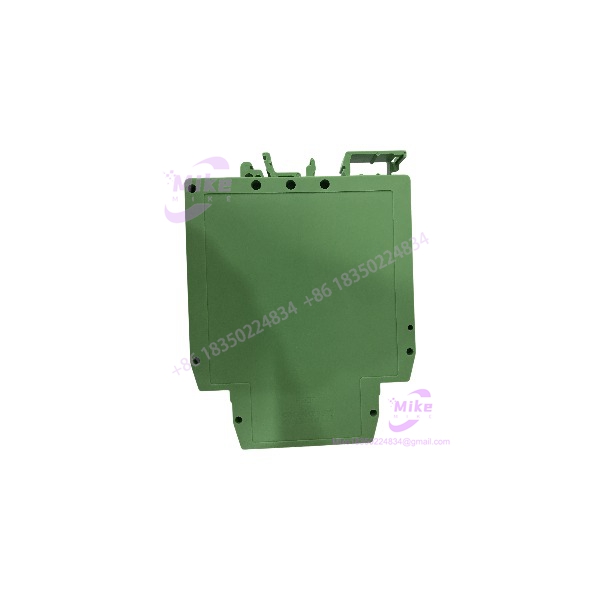
EMGZ306A
Key Technical Specifications
- Manufacturer: FMS Force Measuring Systems AG
- Part Number: EMGZ306A
- Function: Analog web-tension measurement amplification
- Channels: 1
- Force Sensor Input: 1 or 2 sensors
- Sensor Resistance: 350 Ω
- Sensor Excitation: 5 VDC / 30 mA precision supply
- Optional Sensor Supply: 10 VDC version available
- Voltage Output: ±10 V, minimum 1 kΩ load
- Current Output: 0–20 mA or 4–20 mA, maximum 500 Ω
- Power Supply: 24 VDC
- Mounting: DIN rail
- Protection Rating: IP20
- Gain Adjustment: 20-turn trimmer
- Offset Adjustment: 20-turn trimmer
- Offset Range: Approximately ±9 mV
- Signal Filtering: Configurable low-pass filter
- Electrical Isolation: Measuring circuit and power supply are galvanically isolated.
The standard factory configuration for the current output is 4–20 mA. Changing to 0–20 mA requires moving the internal jumpers; the housing must therefore be opened before making that configuration change.
Application Scenarios & Pain Points
Paper, Film, and Foil Web Lines
High-Speed Web Processing: A tension sensor may only produce a small millivolt-level signal, while the PLC expects a conventional analog process signal. EMGZ306A performs that amplification and presents the controller with ±10 V or current-loop feedback.
That makes it useful in machines processing paper, film, foil, cable, wire, and similar continuous materials. FMS distributors specifically list steel/metal, paper, and wire/cable applications for the EMGZ306A family.
With Two Force Sensors
Single sensor: One 350 Ω force sensor can be connected.
Dual sensor: Two 350 Ω sensors can be connected in parallel. The resulting measurement represents the average value of the two sensors.
That configuration is useful where the tension-measuring roller uses two sensing points and the control system needs one consolidated feedback signal.
Vibration-Induced Signal Noise
Machine vibration: Unbalanced rollers and mechanical vibration can introduce unwanted variations into the tension signal. The includes a configurable low-pass filter to suppress these fluctuations.
The trade-off is simple: lower filter cutoff means cleaner output but slower signal response. Do not over-filter a high-speed tension loop simply because the waveform looks noisy on a scope.
Legacy PLC Retrofit
If an older PLC cabinet already expects 4–20 mA or ±10 V, replacing the tension amplifier rather than redesigning the complete control architecture can significantly reduce commissioning work.
The catch? Sensor excitation, sensor resistance, gain, offset, polarity, and PLC scaling all need to be checked.
QA & Live Testing SOP
For , we would treat the amplifier as an analog measurement instrument rather than merely a DIN-rail electronic accessory.
- Verify the nameplate and physical configuration.
- Inspect the enclosure, terminals, adjustment trimmers, and PCB area for contamination or heat damage.
- Verify the 24 VDC supply requirement before energizing.
- Check the sensor excitation output against the specified 5 VDC / 30 mA configuration.
- Use a calibrated meter to verify the voltage and current output stages.
- Simulate a controlled sensor input where suitable test equipment is available.
- Verify the ±10 V output behavior.
- Verify the selected 4–20 mA or 0–20 mA output range.
- Check gain and offset adjustment.
- Confirm the low-pass-filter configuration where the application requires filtering.
- Perform final ESD-safe packaging after testing.
The two LEDs on the unit are used for supply-voltage monitoring, while gain and offset are adjusted through the dedicated trimmers.
Field Engineer’s Pitfall Guide
❗ Do not confuse with .CAL.
They belong to the same family, but the CAL version adds a calibration push-button for calculated calibration without physical calibration weights. The standard does not provide that same CAL function.
❗ Check the current-output jumper position before commissioning.
The factory standard is 4–20 mA, but the hardware can be configured for 0–20 mA. If the PLC scaling expects 4 mA at zero tension and the card is configured for 0 mA, your process values will be wrong even though the amplifier appears electrically healthy.
❗ Do not assume every FMS force sensor is interchangeable.
The documented input arrangement supports 350 Ω force sensors. Sensor excitation and bridge characteristics must match the amplifier before you start recalibrating gain and offset.
Intent-Driven FAQ
Q: What is FMS used for?
A: is a single-channel analog tension measuring amplifier. It receives low-level signals from FMS strain-gauge force sensors and converts them into analog feedback suitable for a PLC, analog instrument, or equivalent control device.
Q: How many tension sensors can handle?
A: It can connect one or two 350 Ω force sensors. When two sensors are used, they are wired in parallel and the amplifier output corresponds to their average measured value.
Q: Does FMS output 4–20 mA?
A: Yes. The current output can be configured for 4–20 mA or 0–20 mA. The standard factory configuration is 4–20 mA. The unit also provides a simultaneous ±10 V output.
Q: What power supply does require?
A: The specified power supply is 24 VDC. The amplifier also provides a precision sensor supply, normally 5 VDC / 30 mA, for the connected force sensors.
Q: Can I connect directly to a PLC?
A: Yes. That is one of its intended functions. The amplifier provides standardized analog outputs, including ±10 V and 0/4–20 mA, which can be connected to compatible PLC analog inputs or other measurement equipment.
Q: Does have a low-pass filter?
A: Yes. A configurable low-pass filter can reduce unwanted signal fluctuations caused by roller imbalance, machine vibration, or similar mechanical disturbances. The filtering affects both the tension and current outputs.
Q: Is the same as .CAL?
A: No. The version adds a calibration function that allows calculated calibration without using physical calibration weights. If your existing machine specifically calls for the CAL variant, do not substitute the standard without checking the commissioning procedure.
Procurement note: is a specialized web-tension measurement amplifier, not a general-purpose analog signal conditioner. For a replacement order, verify the force-sensor resistance, sensor count, supply voltage, output configuration, and required calibration method before purchasing.





