


Description
Eaton MTL 8937-HN | Fiber Optic Extender Module
Architect’s Product Breakdown
The Eaton MTL 8937-HN functions as a high-reliability fiber optic extender designed to bridge communication loops across hazardous or high-electromagnetic-interference (EMI) industrial environments. Operating as part of the MTL remote I/O and networking infrastructure, it converts standard electrical communication signals into optical pulses. This enables lossless data transmission over long cable runs between control rooms and remote process skids while completely eliminating ground-loop potentials and electrical transient risks.
Installation requires secure backplane or carrier seating alongside compatible I/O terminal assemblies (IOTA), adhering strictly to fiber optic handling specifications to prevent insertion loss or faceplate contamination. Its ruggedized layout is built to withstand harsh industrial process conditions, ensuring uninterrupted telemetry flow for supervisory control and data acquisition networks.
Deploying an authentic 8937-HN module guarantees protocol transparency, drop-in mechanical replacement compatibility, and robust signal extension performance across legacy and modern MTL network architectures.
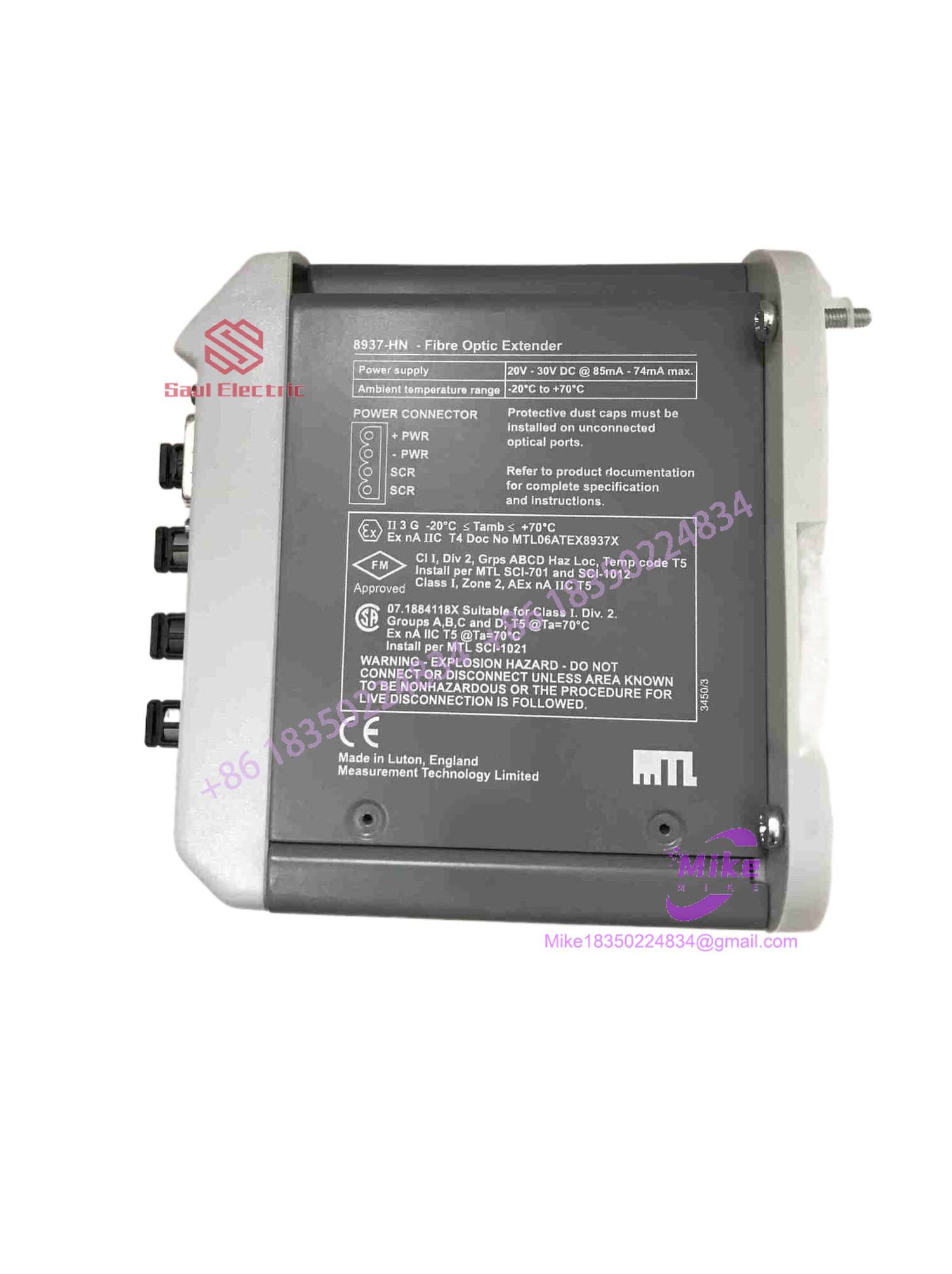
EATON 8937-HN
Key Technical Specifications
| Parameter | Technical Specification |
| Module Type | Fiber Optic Extender (FOE) / IOTA Interface |
| System Compatibility | Eaton / MTL Remote I/O & Communication Platforms |
| Operating Voltage (U_{aux}) | 20V to 30V DC nominal supply range |
| Firmware / Hardware Version | Version HN01, Revision F baseline |
| Communication Medium | Fiber optic cabling (supports high-noise / long-distance runs) |
| Operating Temperature | -20°C to +70°C (-4°F to +158°F) standard industrial range |
| Physical Enclosure | Industrial compact module with protected terminal pins |
| Physical Weight | ~0.13 kg (0.28 lbs) |
Field Engineer’s Pitfall Guide
- WARNING: Fiber Optic Bend Radius Violations. Exceeding the minimum bend radius of connected fiber optic patch cables introduces micro-bends that degrade optical signal amplitude, leading to intermittent packet drops or complete link failure.
- WARNING: Connector Contamination. Dust, oils, or microscopic debris on the optical transceiver tips will cause severe insertion loss. Inspect and clean fiber ferrules with optical-grade wipes before mating connectors.
- WARNING: Auxiliary Power Rail Tolerances. Allowing the 20V–30V DC input supply to dip outside specified operating thresholds can cause internal transceiver brownouts and sever active network polling loops.
QA & Testing SOP (Transparency)
- Visual & Origin Verification: Inspection of OEM branding, manufacturing labels, part numbering (8937-HN), and optical port dust cap integrity.
- Bench Power & Transceiver Check: Modules are mounted to an isolated test rig, powered via a regulated 24 VDC source, and verified for correct internal processor boot behavior and status LED handshakes.
- Optical Loopback Testing: Technicians utilize calibrated optical test sets to verify transmitter output power levels, receiver sensitivity, and bit-error-rate (BER) thresholds across the communication channels.
- Final Packaging: Non-volatile states are cleared, optical ports are sealed with protective caps, and the unit is packaged in anti-static moisture-barrier material inside high-density foam containers.
Technical FAQ
Can I hot-swap this fiber optic extender module while the system is energized?
Exercise caution. While modular systems often support maintenance swaps, pulling communication-linked extenders live can disrupt active token-passing networks or trigger communication fault trips on the master PLC. Consult local system guidelines before replacement.
What causes a sudden loss of communication link status on the module?
A dropped link is typically caused by a damaged or broken fiber optic strand, dirty optical connector faces, transceiver misalignment, or a total loss of the 20V–30V DC auxiliary power feed.
Are there software configuration settings required for the 8937-HN?
No. The module acts primarily as a hardware-layer physical media converter and extender, operating transparently without requiring direct software configuration or firmware addressing updates.





