


Description
Delta Tau Turbo PMAC ACC-24E2-2CH | Digital Control Board
Dynamic Product Introduction
When a machine application demands high-performance multi-axis control without the overhead of paying for unpopulated hardware channels, scaled expansion cards provide a precise structural fit. The Delta Tau ACC-24E2 configured in a 2-channel execution delivers the exact same rigorous loop update speeds and signal fidelity as its larger 4-axis counterpart, but tailored specifically for compact dual-axis motion nodes.
Whether driving precision dual-lead screw gantries or managing auxiliary axes in an existing UMAC rack, this board slots cleanly into the high-speed UBUS backplane. Maintaining legacy Delta Tau hardware relies on matching your exact channel requirements and option suffixes—swapping a multi-axis card without checking your axis definition tables will immediately throw configuration flags on boot.
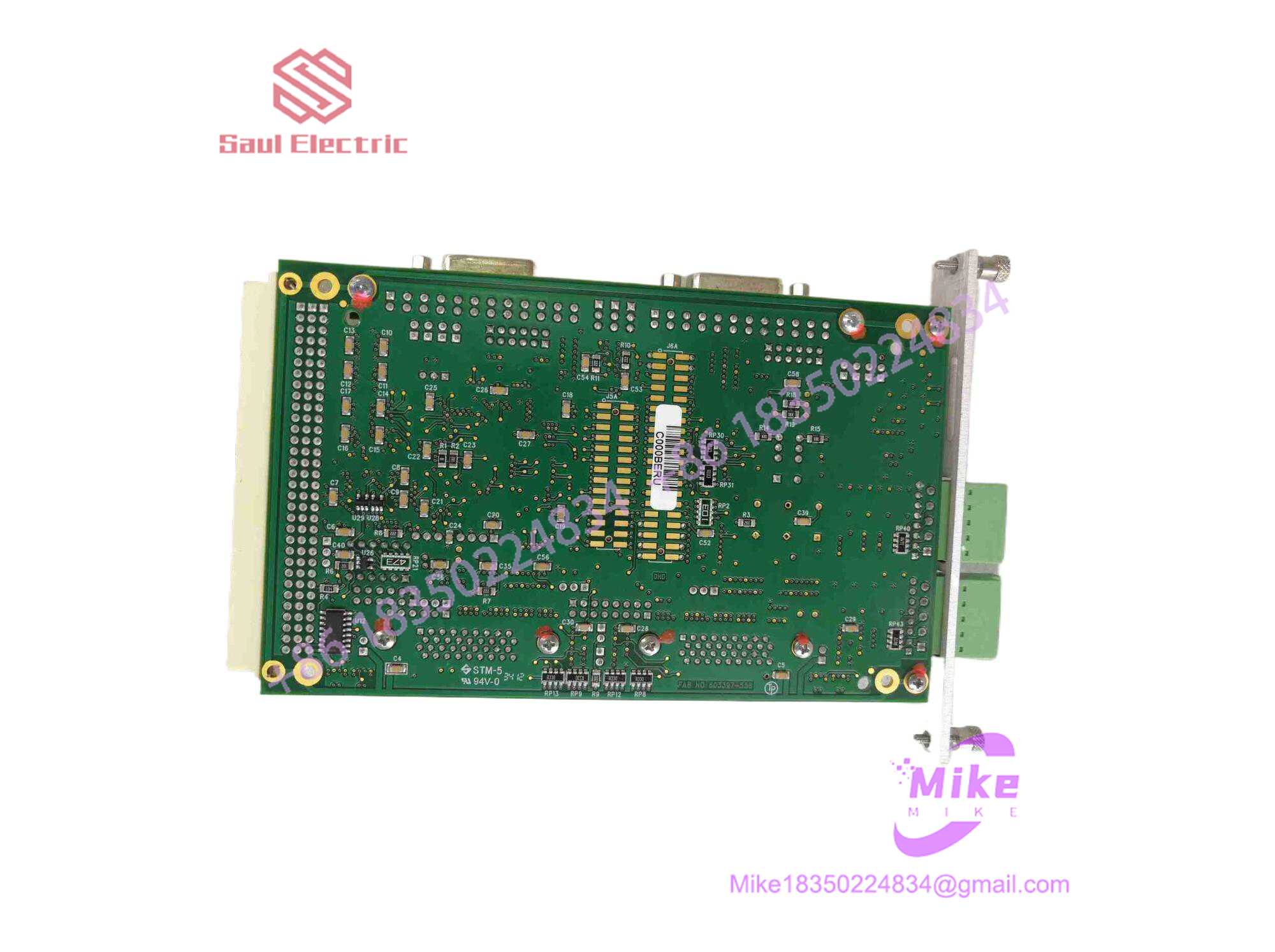
ACC-24E2-2CH
Key Technical Specifications
| Parameter | Specification Detail |
| Primary Architecture | PMAC2-style DSPGATE1 core (Populated for 2 Axes) |
| System Compatibility | UMAC Turbo, Turbo PMAC2, and compatible MACRO Stations |
| Control Outputs | 2 channels of direct digital PWM phase voltage or Pulse-and-Direction (PFM) |
| Feedback Inputs | 2 channels of digital quadrature encoders (differential line receiver) |
| Encoder Sampling Clock | Default 9.83 MHz (software adjustable) |
| Auxiliary I/O | Over-travel limits, amplifier faults, drive enables, and position compare triggers per axis |
| Form Factor & Mounting | 3U industrial rack-mount module (occupies 1 backplane slot) |
| Power Consumption | Powered via internal UBUS rails (+5VDC bus power) |
Global Sourcing & Live-Test SOP
Sourcing surplus multi-axis controller boards requires meticulous component-level validation to ensure internal custom gate arrays and line transceivers are fully operational:
- Inbound Verification: Board part numbers, layout revisions, and component population stamps are audited against authentic Delta Tau build records to confirm the 2-channel circuit layout.
- Live Rack Simulation: The card is mounted onto a dedicated UMAC Turbo test backplane. We verify that the central CPU registers the module ID correctly across the UBUS without communication dropouts.
- Diagnostics: Using a multi-axis simulator, we inject quadrature signals into both active encoder channels while exercising the PWM/step outputs. We confirm zero following-error latency, check position latching, and verify state transitions on all limit and fault flag inputs.
- Final Prep: Approved units are cleaned, fitted with protective connector caps, and sealed in heavy-duty anti-static moisture-barrier bags.
The Field Engineer’s Pitfall Guide
❗ Channel Address Confusion in Software: Replacing a 4-axis card with a 2-channel variant (or vice-versa) requires updating your PMAC configuration files. If your axis definition tables (Ixx00 parameters) still look for channels 3 and 4 on a 2-channel card, the system will generate hardware configuration faults.
❗ Improper Shield Grounding: Differential line receivers require solid earth shielding to filter out electrical noise. Leaving encoder cable shields floating at the panel clamp will invite common-mode interference, resulting in sporadic position jumps or sudden following-error trips.
❗ Hot-Plug Disasters: Never insert or remove an ACC-24E2 module into a live, powered UMAC rack. Doing so risks sending voltage spikes down the backplane bus, which can instantly fry the internal ASICs or corrupt the rack’s power distribution board.
Intent-Driven FAQ
Can a 2-channel ACC-24E2 card be field-upgraded to 4 channels?
No. The channel capacity is determined by factory component population (including underlying silicon/resistor networks on the DSPGATE1 architecture). You must use a fully populated 4-channel card if your application requires expansion beyond two axes.
Does this board support absolute encoders?
Standard ACC-24E2 variants are engineered primarily for incremental digital quadrature encoders (differential line receivers). Specialized absolute serial formats typically require dedicated interface cards or protocol-specific options.
Do I need to re-compile my motion program when swapping this board?
If you are replacing an identical failed 2-channel module with the same hardware configuration, your active PMAC firmware settings will run immediately upon boot without recompiling programs.
What causes an axis to trip immediately on “Following Error”?
This typically indicates that the encoder feedback signal is not reaching the board (due to broken wiring, incorrect phase connections, or a blown encoder power supply fuse), causing the controller to lose track of motor movement despite issuing command outputs.
What warranty is included with surplus units?
Every unit shipped from our stock is backed by a comprehensive 12-month operational warranty covering internal gate array health, signal transceivers, and power regulation circuits.





