


Description
Delta Tau ACC-24E2A | UMAC 2-Axis Analog Servo Interface
Dynamic Product Introduction
When high-precision motion applications require traditional analog amplifiers rather than direct digital PWM stages, matching the control hardware to the drive interface is critical. The Delta Tau ACC-24E2A provides the dedicated analog conversion layer for UMAC racks, outputting clean \pm10V command signals to velocity or torque loops while handling robust encoder tracking.
Configured natively as a 2-axis module or expandable to 4 axes via an Option 1 piggyback board, this card slides directly into the high-speed UBUS backplane. Keeping legacy multi-axis machine tools or test stands running smoothly depends on verifying whether your application uses standard digital PWM or these specialized analog command outputs before dropping in a replacement.
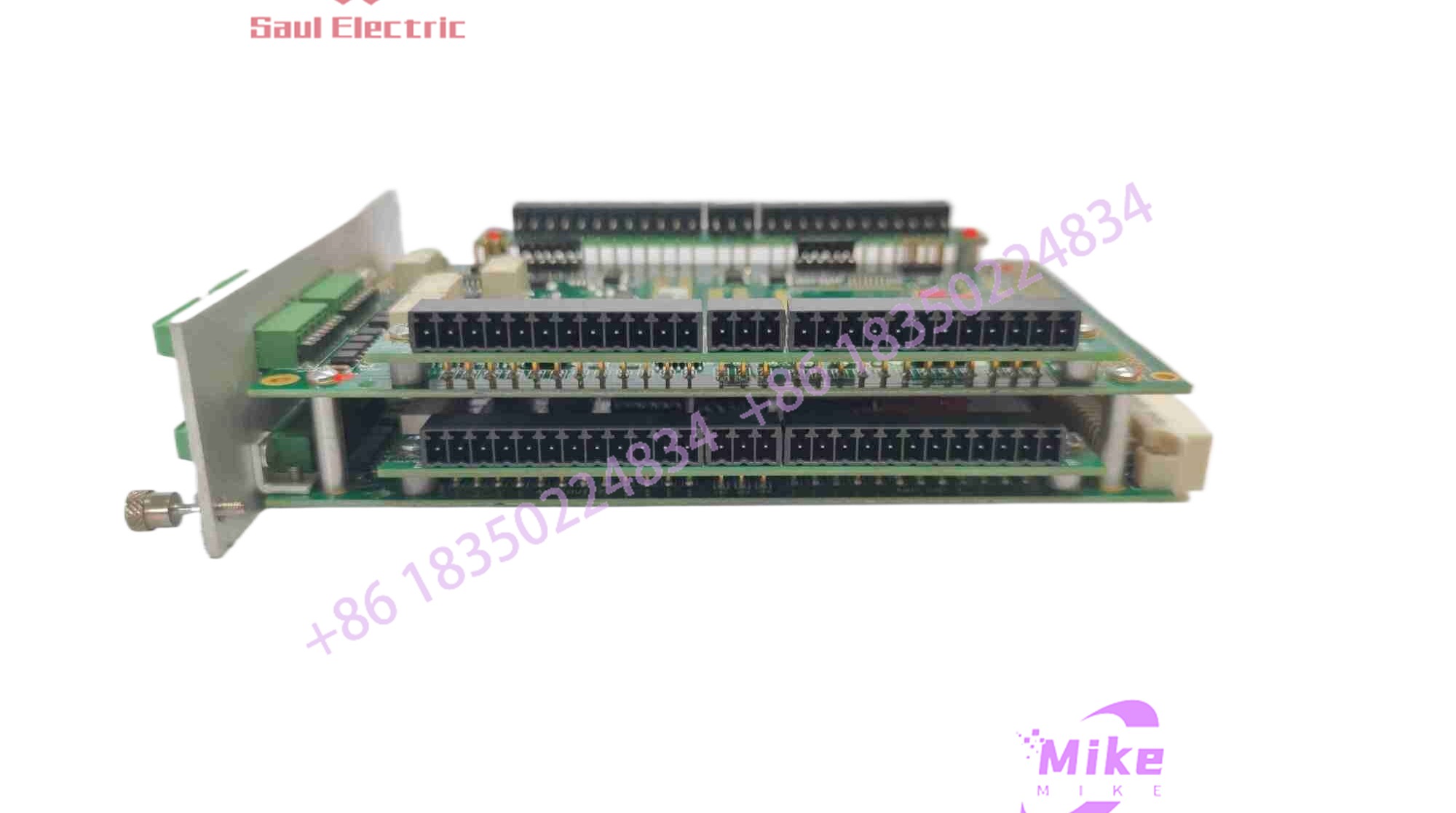
ACC-24E2A
Key Technical Specifications
| Parameter | Specification Detail |
| Primary Architecture | PMAC2-style DSPGATE1 core with onboard DAC circuitry |
| System Compatibility | UMAC Turbo, Turbo PMAC2, and compatible MACRO Stations |
| Command Outputs | \pm10VDC Analog (Velocity, Torque, or Sinusoidal Phase Current commands) |
| Feedback Inputs | Digital quadrature encoders (differential line receivers) or analog sinusoidal encoders |
| Axis Capacity | 2 axes standard on base board; expandable up to 4 axes via Option 1 mezzanine layer |
| Auxiliary I/O | Over-travel limits, amplifier faults, drive enables, and hardware position compare triggers |
| Form Factor & Mounting | 3U industrial rack-mount module (occupies 1 slot base, or 2 slots with Option 1 stacked) |
Global Sourcing & Live-Test SOP
Sourcing surplus analog interface cards requires strict electronic validation to ensure that sensitive digital-to-analog converters (DACs) and line receivers maintain calibration accuracy:
- Inbound Verification: Board part numbers, revision stamps, and option tags (such as Option 1A analog sub-assemblies) are audited against original manufacturing records.
- Live Rack Simulation: The card is mounted onto a verified UMAC Turbo test backplane, confirming proper communication registration across the UBUS.
- Diagnostics: Using precision multimeters and oscilloscope loops, we test the \pm10V DAC outputs across zero-offset and full-scale range commands. Simultaneously, we inject simulated quadrature feedback to verify error-free position latching and discrete flag transitions.
- Final Prep: Approved units are cleaned, fitted with protective connector covers, and sealed in heavy-duty anti-static moisture-barrier packaging.
The Field Engineer’s Pitfall Guide
❗ Analog Ground Loops: Because the ACC-24E2A deals with sensitive \pm10V analog reference signals, failing to properly isolate and single-point ground your amplifier signal shields will inject severe electrical noise, causing motor jitter or velocity drift.
❗ Auxiliary Power Rail Requirements: Unlike basic digital logic cards, analog interface modules rely heavily on clean \pm12V power rails from the rack supply to drive the onboard DACs. A sagging or noisy \pm12V rail will distort command outputs.
❗ Piggyback Option Stack Confusion: When configuring a 4-axis setup using the base card plus an Option 1 analog expansion layer, ensure terminal block wiring matches the software channel assignment tables precisely to avoid cross-wiring axis commands.
Intent-Driven FAQ
Can the ACC-24E2A handle sinusoidal encoder feedback?
Yes. Unlike standard digital-only encoder cards, the hardware architecture of the ACC-24E2A supports processing for analog sinusoidal encoders through dedicated conversion scaling loops.
How do I expand a 2-axis ACC-24E2A card to 4 axes?
You can mount the factory-matched Option 1 mezzanine board directly onto the base unit’s expansion connectors, scaling the single onboard 4-channel DSPGATE chip out to full physical terminal access across two stacked slot layers.
Do I need to re-tune my control loops when replacing this board?
If you are replacing an identical failed hardware module with matching firmware and parameter configurations, your existing PID and servo tuning files will run immediately without modification.
What causes an analog output to saturate at +10V or -10V uncontrollably?
This typically points to an open feedback loop (such as a disconnected encoder) or an inverted feedback phase causing a “runaway” condition where the controller ramps the analog command to maximum output trying to reach position.
What warranty is included with surplus units?
Every unit shipped from our stock is backed by a comprehensive 12-month operational warranty covering DAC linearity, transceiver health, and power regulation stability.





