


Description
Bristol Babcock 396563-06-6 Card | 24VDC Discrete Input Spec Sheet
Architect’s Product Breakdown
The Emerson / Bristol Babcock 396563-06-6 acts as a primary discrete signal acquisition card within the ControlWave architecture, widely deployed in remote telemetry units across natural gas pipelines and water treatment networks. This module senses field dry contacts, limit switches, and solid-state status outputs, isolating the high-voltage or noisy field environment from the sensitive internal backplane bus processor.
Integration demands rigorous attention to common return wiring and loop voltage stability. Because discrete inputs frequently travel long distances across industrial facilities, induced AC transients or ground potential differences can trigger erratic bit states if shielding and grounding protocols are ignored. Configuration requires mapping input points accurately within ControlWave Designer to ensure proper logic scans and fast event timestamping for alarm generation.
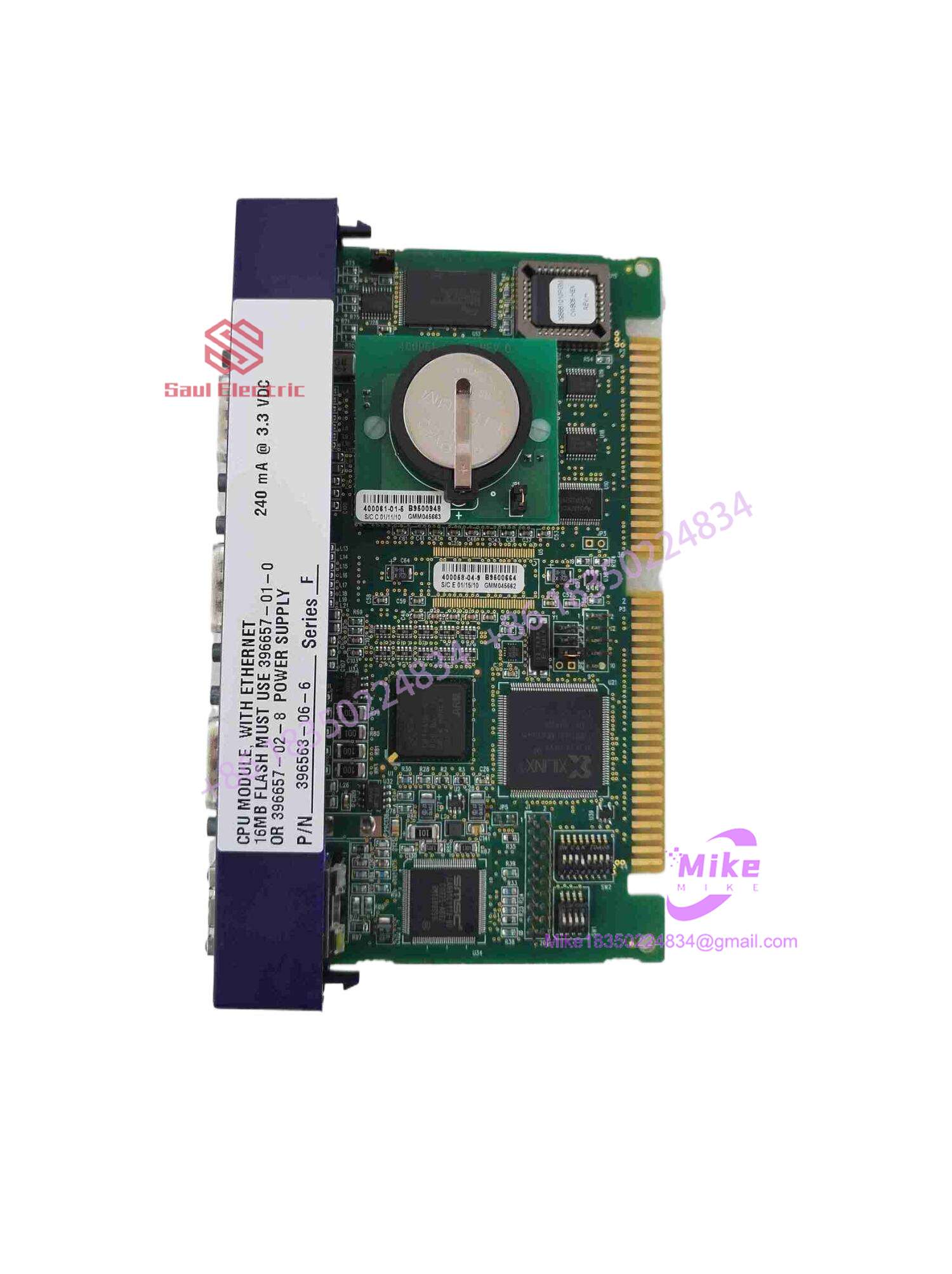
396563-06-6
Key Technical Specifications
| Parameter | Specification Data |
| Module Type | Discrete / Digital Input Module |
| Input Voltage Range | 24 VDC nominal field logic levels |
| Point Density | Multi-channel discrete sensing array |
| Hardware Series | Series C platform revision (-06-6 variant) |
| Isolation | Optical isolation between field inputs and system backplane |
| Operating Temperature | -40^\circC to +70^\circC |
| Storage Temperature | -40^\circC to +85^\circC |
| Relative Humidity | 5% to 95% non-condensing |
| Enclosure Type | Plug-in module for ControlWave chassis backplane |
Field Engineer’s Pitfall Guide
- Inductive Transient Feedthrough: Routing discrete input wires alongside high-power motor feeds without shielding can inject voltage spikes that fool the optical isolators into registering false status toggles. Always run instrument cables in dedicated metal conduit.
- Common Ground Lifts: Failing to tie the external 24VDC power supply common back to the system instrument ground reference will result in floating input states and unreadable bit channels.
- Series Suffix Incompatibilities: I have witnessed commissioning delays caused by swapping an older hardware revision card with a -06-6 variant when the underlying ControlWave firmware image lacked the corresponding module profile definition. Always verify device profiles prior to deployment.
QA & Testing SOP (Transparency)
- Visual & Origin Inspection: Verification of OEM manufacturing labels, Series C revision stamps, and pin integrity on the backplane edge connector.
- Bench Test Environment: Insertion into a live ControlWave test chassis powered by validated system supplies.
- Diagnostic Handshake: Firmware validation, backplane communication bus health checks, and module status LED verification.
- Signal Simulation Test: Injection of precise 24VDC switching steps across all input channels to verify discrete state transitions and logic scan accuracy.
- Packaging: ESD-shielded anti-static packaging encased in high-density anti-shock foam.
Technical FAQ
- Can I hot-swap this digital input module while the system is powered? Standard operational safety procedures for ControlWave hardware dictate powering down the local rack segment before inserting or removing input cards to prevent bus latch-up.
- What does the “-06-6” suffix designate? It specifies the precise hardware configuration tier, point density layout, and firmware packaging variant assigned by Bristol Babcock.
- Does the module retain configuration data after power loss? Yes, module configuration and operational parameters are managed by the main controller via non-volatile memory architectures.
- What causes input LEDs to remain lit when the field contact is open? A persistently lit indicator usually points to a leakage current from solid-state output field devices or a severe ground fault path pulling the input voltage high.





