

Description
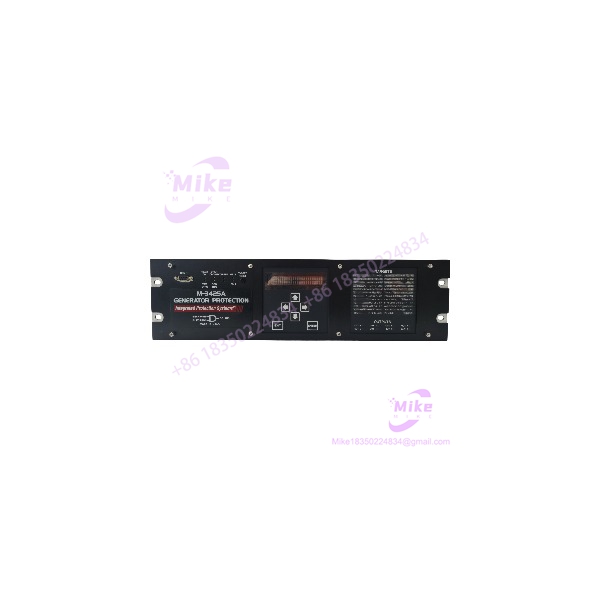
Beckwith Electric M-3425A | Generator Protection Relay
Dynamic Product Introduction
A generator protection relay is not a component you can replace based on its front-panel appearance alone. When a unit fails, the replacement must match the protection scheme, CT and VT inputs, trip logic, and installed options. A mismatch can leave a generator exposed to incorrect protection settings or prevent a planned return to service.
The Beckwith Electric M-3425A combines multiple generator protection functions in a single relay platform. Its capabilities include out-of-step protection (78), split-phase differential protection (50DT), underfrequency time accumulation (81A), inadvertent energizing protection (50/27), and turn-to-turn fault protection (59X). Depending on the package, the relay can also support generator backup protection using distance elements, load encroachment blinders, and power swing blocking.
For facilities maintaining older generator protection systems, the M-3425A can serve as a replacement candidate without requiring an automatic redesign of the entire protection architecture. However, compatibility must be established against the existing relay configuration—not simply the model number.
Honestly, the practical value here is functional consolidation. Replacing multiple discrete protection devices with an integrated relay platform can simplify panel architecture, but only when the existing protection philosophy and trip logic are properly preserved.
M-3425A
Key Technical Specifications
The following specifications are based on published M-3425A documentation. Confirm the exact unit’s nameplate, hardware configuration, and applicable instruction-book revision before purchase.
- Model: M-3425A
- Manufacturer: Beckwith Electric
- Application: Generator protection
- Protection Packages: Base and Comprehensive
- Standard Programmable Inputs: 6
- Standard Programmable Outputs: 8
- Optional Expanded I/O: 8 additional inputs and 15 additional outputs
- Communications: RS-232, RS-485, and optional Ethernet, depending on configuration
- Recording: Oscillographic recording in COMTRADE or BECO format
- Event Storage: Time-stamped targets for 32 events
- Physical Dimensions: 19.00 in. W × 5.21 in. H × 10.20 in. D, without expanded I/O
- Mounting: Rack/panel-mounted protective relay
Protection functions, communication options, and physical configurations should be verified against the specific unit. Do not assume every M-3425A has the same installed options.
Global Sourcing & Live-Test SOP (Transparency Core)
For surplus generator protection equipment, a clean enclosure and a successful power-on are not sufficient evidence of operational condition. The M-3425A must be evaluated against the intended generator protection application.
The following is a recommended procurement and acceptance procedure. It is not a claim that the specific unit in the supplied listing has undergone these tests.
Inbound Verification
Before accepting the M-3425A into inventory:
- Record the complete model number, serial number, nameplate data, and visible hardware revisions.
- Review available OEM invoices, certificates of origin, and chain-of-custody records.
- Inspect labels, seals, fasteners, connectors, and enclosure condition for signs of tampering or unauthorized repair.
- Compare the unit’s configuration against available OEM documentation.
- Record any missing accessories, configuration records, or test history.
A serial number alone does not establish authenticity. Where OEM verification is available, use it to corroborate the unit’s identity and history.
Live Simulation and Functional Testing
Testing should be performed by qualified personnel using an appropriate relay test setup and a documented acceptance procedure.
For the M-3425A, a proposed functional test sequence includes:
- Inspecting the relay before applying auxiliary power.
- Verifying the specified auxiliary supply requirements.
- Checking self-test status and available diagnostic indications.
- Establishing communications with compatible IPScom software.
- Injecting controlled current and voltage signals using a calibrated relay test set.
- Verifying selected protection pickup values, timing behavior, and output contact operation against approved settings.
- Exercising applicable control inputs and confirming programmed logic responses.
A test rack should be appropriate for the M-3425A itself. An AC800M backplane test is not an applicable acceptance test for this standalone generator protection relay.
Diagnostics and Extended Run
The acceptance record should distinguish between basic power-on testing and a complete functional test.
Where the buyer’s acceptance requirements call for extended operation, document the test duration, ambient conditions, alarms, and observed behavior.
Additional checks may include:
- Communications stability over the interfaces installed on the unit.
- Verification of selected protection elements against approved test points.
- Output contact operation and reset behavior.
- Review of available event and oscillography records.
- A documented extended heat run, if required by the purchase specification.
Modbus or PROFIBUS handshake testing should not be represented as a standard M-3425A requirement without confirming the actual interface and protocol configuration. Protocol validation must match the installed hardware and supported communications options.
Final Preparation and Shipment
Before dispatch, the supplier should provide a test report that identifies the actual work completed.
The report should include:
- Confirmed model and serial number.
- Hardware and firmware revision, where accessible.
- Installed protection package and options, where verified.
- Test equipment and calibration status.
- Functional tests completed and results.
- Known defects, limitations, or missing components.
Finally, protect the M-3425A with appropriate ESD-safe packaging, secure the unit against impact, and maintain traceability between the tested relay and the shipped item.
Procurement transparency: Unless supported by unit-specific documentation, do not describe a surplus M-3425A as factory sealed, OEM certified, fully tested, or covered by a manufacturer warranty.
The Field Engineer’s Pitfall Guide
Replacing a generator protection relay is a protection-system change, even when the replacement carries the same catalog number.
❗ Warning 1: Firmware and Configuration Mismatches
Do not assume that two M-3425A units with different firmware revisions will load or execute the same configuration identically. Verify IPScom compatibility, firmware requirements, settings-file compatibility, and any revision-specific limitations before commissioning.
A relay that powers up without an alarm is not necessarily ready to protect a generator. In a real replacement scenario, discovering that the settings file cannot be restored after the outage window has started can turn a planned swap into an extended commissioning job.
❗ Warning 2: Terminal Wiring and Input Configuration Errors
The M-3425A’s input wiring and terminal configuration must be checked against the OEM connection diagrams. Its contact inputs are internally wetted; applying external voltage to terminals 5 through 10 can damage the unit. Trip Circuit Monitoring input voltage configuration also requires attention, as an incorrect applied voltage can cause misoperation or permanent damage.
Before disconnecting the old relay, photograph and label every terminal. Verify wiring, input polarity, grounding, and applicable jumper or switch settings against the replacement unit’s documentation.
❗ Warning 3: Protection Package and Option Mismatches
Two M-3425A relays may have different protection packages or installed options. Expanded I/O, field ground protection, and low-frequency injection stator ground protection should never be assumed present based on the base model number alone.
I’ve seen replacement planning become unnecessarily complicated when procurement verifies the catalog number but ignores the actual installed options. For a generator protection relay, missing functionality can affect the approved protection scheme—not just convenience.
Before energization, compare the original relay’s approved settings and protection functions against the replacement. Any deviation requires engineering review and appropriate acceptance testing.
Intent-Driven FAQ
Q1: Is the Beckwith Electric M-3425A still available, or is it obsolete?
The M-3425A is listed in Beckwith Electric’s product catalog. However, catalog presence does not confirm current production status, factory lead time, or availability of a particular configuration. For surplus procurement, request the serial number, condition, and available test documentation. Confirm current OEM support directly with the manufacturer.
Q2: Can I replace my existing M-3425A with another M-3425A without changing the settings?
Not automatically. The replacement must have compatible hardware, firmware, protection options, and settings-file requirements. Before removing the existing relay, back up its configuration and document the installed protection functions. Validate the replacement settings and trip logic before returning the generator to service.
Q3: Will I lose my generator protection logic if I swap the M-3425A?
The replacement relay does not automatically inherit the original relay’s settings or logic. Preserve the original configuration using compatible IPScom software and verify that the backup can be restored to the replacement. After loading, check protection setpoints, IPSlogic schemes, output assignments, and communications settings.
Q4: Can the M-3425A be hot-swapped while the generator is running?
Do not assume that the M-3425A supports hot swapping in an energized protection circuit. Removing a generator protection relay can disable protection functions or affect trip circuits. A replacement requires an approved outage or protection-bypass procedure, with compensating protection measures established by qualified personnel.
Q5: Can I downgrade the M-3425A firmware to match my existing unit?
Firmware downgrade capability must be confirmed for the exact hardware and software revisions. Do not assume an older firmware image can be loaded onto every unit. Obtain the applicable OEM instructions and verify configuration compatibility before attempting a downgrade.
Q6: Does a surplus M-3425A come with an OEM warranty?
Not necessarily. Warranty coverage depends on the seller, the unit’s condition, and the written terms of sale. A surplus or refurbished relay should not be represented as carrying a Beckwith Electric factory warranty unless that coverage has been explicitly confirmed. Request written warranty duration, coverage limitations, return authorization requirements, and DOA terms before purchasing.
Q7: What should I request before buying a used M-3425A?
For a generator protection application, request:
- A clear nameplate photograph showing the complete model and serial number.
- Confirmation of the protection package and installed options.
- Available firmware and hardware revision information.
- A functional test report identifying the actual tests performed.
- Written warranty and return terms.
- Confirmation of included accessories and any known defects.
For an installed generator, also compare the proposed replacement against the existing relay’s approved settings, wiring diagrams, and protection requirements.
Final Procurement Assessment
The Beckwith Electric M-3425A is a multifunction generator protection relay intended for applications requiring coordinated electrical protection and configurable trip logic.
For replacement procurement, the deciding factor is not simply whether an M-3425A is listed as in stock. It is whether the specific unit’s configuration, condition, and documented test results support the intended protection application.
Verify the exact hardware, preserve the original settings, and complete the required protection testing before placing the replacement into service.





