

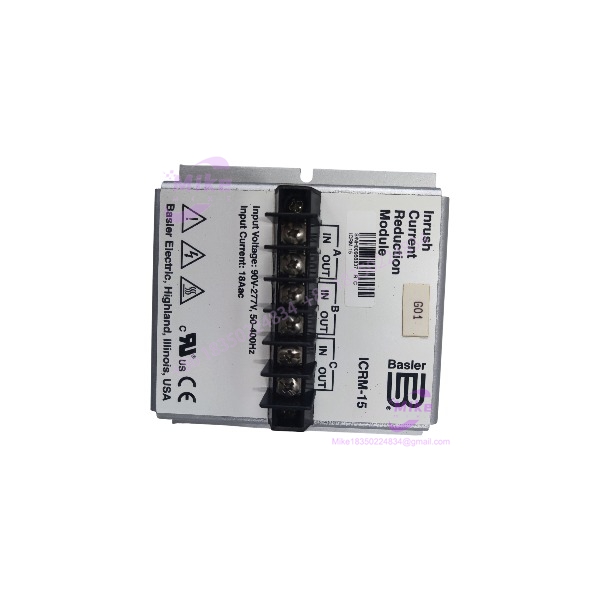
Description
Basler ICRM-15 | Inrush Current Reduction Module
Product Introduction
A voltage regulator connected to an independent power source can experience damaging inrush current during energization. In generator excitation systems, that initial surge is not a minor nuisance—it can put critical power electronics at risk. The Basler ICRM-15 is designed to reduce this exposure, helping protect compatible PWM-type voltage regulators during startup.
The ICRM-15 is used in Basler excitation applications where the regulator’s input power arrangement calls for inrush current reduction. With an 18 AAC input-current rating and support for 90–277 VAC or 90–300 VDC, it is a specialized component that must be selected against the actual regulator and wiring configuration. For maintenance teams managing legacy excitation equipment, verifying the OEM part number—9387900104—before ordering is essential to avoiding an electrically incompatible replacement.
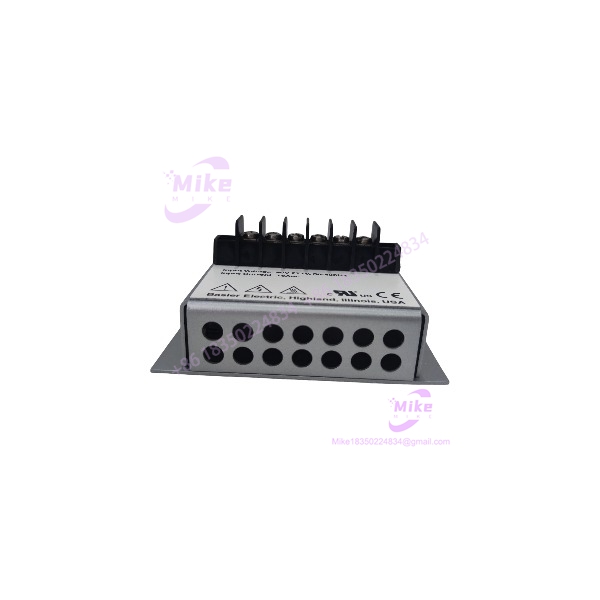
ICRM-15
Key Technical Specifications
- Manufacturer: Basler Electric
- Model: ICRM-15
- OEM Part Number: 9387900104
- Device Function: Inrush current reduction
- Input Voltage: 90–277 VAC
- DC Input Voltage: 90–300 VDC
- Input Frequency: DC or 50–420 Hz
- Input Current Rating: 18 AAC
- Power Dissipation: 25 W
- Operating Temperature: -25°C to 70°C (-13°F to 158°F)
- Storage Temperature: -40°C to 70°C (-40°F to 158°F)
- Weight: Approximately 227 g (8 oz)
- Dielectric Strength: 2,000 VAC for one minute, per IEC 60255-5
- Mounting: Surface mounting; follow OEM orientation and ventilation guidance
- Application: Compatible Basler PWM-type voltage regulators and excitation systems
- Product Configuration: Standalone inrush current reduction module; regulator, wiring, and associated excitation components are not included unless explicitly stated in the offer.
Final application approval should be based on the Basler ICRM instruction manual and the specific regulator documentation. Do not assume compatibility with every Basler voltage regulator.
Global Sourcing & Live-Test SOP
Industrial excitation components require more than a visual inspection. Our procurement and verification workflow is intended to reduce the risk of receiving an incorrectly identified, damaged, or unsuitable replacement.
Incoming Verification
- Confirm the ICRM-15 model designation and OEM part number 9387900104 against the purchase order.
- Inspect the enclosure, terminals, mounting points, and insulation surfaces for cracks, corrosion, overheating, or mechanical damage.
- Compare the received unit with available OEM documentation and reference photographs.
- Record visible nameplate information and serial or lot identifiers where present.
Authenticity & Traceability
- Review available OEM labels, markings, packaging, and supplier documentation.
- Flag missing or inconsistent identification for further review.
- Record the received condition and any discrepancies before inventory release.
Electrical Inspection
- Inspect terminal integrity and accessible wiring points.
- Perform appropriate resistance and continuity checks against the OEM service procedure.
- Do not apply operating voltage to a unit that fails preliminary inspection.
Functional Verification
- Where suitable equipment and an approved test procedure are available, verify operation in a controlled setup consistent with the OEM instructions.
- Confirm that the test configuration is appropriate for the ICRM-15 and the intended regulator application.
- Record test equipment, procedure, measured results, and inspection status.
- Do not represent a unit as live-tested unless the specific unit has completed and passed the documented test.
Extended Run & Configuration Record
- An extended heat run is performed only where an appropriate, approved test setup exists.
- Record the actual test duration and results; do not assume a 24-hour run has been completed.
- The is not a programmable controller. Firmware or user-configuration records are not applicable in the conventional PLC sense.
ESD & Export Packaging
- Protect terminals and exposed electrical surfaces against transit damage.
- Use suitable protective packaging and secure the module against movement.
- Include available inspection or test documentation with the shipment.
Procurement Note: Stock status, condition, testing history, warranty, and included accessories must be confirmed against the specific seller offer. Factory-sealed or unused status should not be assumed from the model number alone.
Field Engineer’s Pitfall Guide
❗ Do not confuse inrush current reduction with generator paralleling control. The is not a synchronizer, load-sharing controller, or PLC parallel I/O module. Its function is to reduce inrush current in supported regulator power arrangements.
❗ Verify the exact regulator and power-source arrangement before installation. Basler identifies specific compatible regulator applications. A regulator that operates from a generator or PMG may have different requirements from one powered by an independent source. Follow the applicable regulator manual and ICRM wiring diagram.
❗ Do not treat the 18 AAC rating as a universal system rating. Input voltage, frequency, wiring, and regulator-specific requirements must all be checked. Incorrect application or wiring can compromise excitation-system protection or damage equipment.
Intent-Driven FAQ
Q1: What does the Basler do?
The reduces inrush current in compatible Basler PWM-type voltage-regulator applications. It is intended to help protect the regulator when powered from an independent source rather than the generator or PMG.
Q2: Is the a generator parallel module?
Not in the conventional load-sharing or synchronizing sense. It is an Inrush Current Reduction Module. The “parallel module” wording found in some resale listings should not be used as the basis for compatibility decisions.
Q3: Which Basler part number should I use when sourcing a replacement?
The OEM part number for the is 9387900104. Confirm this number against the existing unit and the applicable regulator documentation before purchasing.
Q4: Can the be used with any Basler voltage regulator?
No. Compatibility depends on the regulator family and power arrangement. Check the Basler ICRM manual and the regulator’s own installation instructions before substituting this component.
Q5: Is the hot-swappable?
Do not treat it as a hot-swappable component. Isolate the relevant power sources and follow the OEM shutdown, discharge, and installation procedure before handling or replacing the module.
Q6: Does this module require firmware or configuration?
The is a hardware inrush current reduction device, not a programmable controller. Firmware loading and PLC-style configuration are not part of its normal commissioning process.
Q7: What should I confirm before ordering a used or surplus ?
Verify the exact model and OEM part number, physical condition, terminal integrity, seller-stated condition, test documentation, return terms, and warranty coverage. Also confirm that the matches the regulator and power-source configuration in your application.





